

USP Ingredient Verification: How It Works
The USP Ingredient Verification program ensures dietary supplements and ingredients meet strict quality, safety, and labeling standards. This independent process involves on-site audits, documentation reviews, and lab testing to verify identity, potency, purity, and performance consistency. Products that pass earn the trusted USP Verified Mark, signaling compliance with rigorous standards and providing confidence to consumers and manufacturers alike.
Key highlights:
- Focus Areas: Identity, potency, purity, and performance consistency.
- Process: Application, GMP audits, documentation reviews, and lab testing.
- Benefits: Supports FDA compliance, reduces contamination risks, and builds trust.
For supplements like molecular hydrogen tablets, where proper dissolution is critical, USP verification ensures reliable performance and accurate dosing. Look for the USP Verified Mark to confirm quality assurance.
What USP Ingredient Verification Is and Why It Matters
Overview of the U.S. Pharmacopeia (USP)
The U.S. Pharmacopeia (USP) has been around since 1820, operating as an independent, nonprofit scientific organization. Its primary role is to set quality standards for medicines, dietary supplements, and food ingredients. These standards are legally recognized under the Federal Food, Drug, and Cosmetic Act (FDCA). Any supplements that fail to meet USP-NF standards are considered either misbranded or adulterated under the law.
"USP's mission is to improve global health through public standards and related programs that help ensure the quality, safety, and benefit of medicines and foods." - U.S. Pharmacopeia
USP standards impact billions of people worldwide, providing a trusted benchmark for quality. These standards form the backbone of their rigorous supplement verification process.
Key Goals of USP Ingredient Verification
USP Ingredient Verification focuses on four main factors for every ingredient: identity, potency, purity, and performance consistency. Unlike a one-time check, this program involves continuous evaluation to ensure these criteria are consistently met.
A standout feature of the program is its focus on performance. This means it’s not just about the ingredient meeting purity requirements - it also has to dissolve and release properly during use.
Why Ingredient Verification Is Needed
The dietary supplement industry operates under a self-regulated framework, which can leave room for quality concerns. Global supply chains, often complex, can lead to variations in quality and contamination risks, such as heavy metals, pesticides, or microbial contamination.
USP verification tackles these vulnerabilities head-on. As USP explains:
"Disruptions and changes to your supply chain do not have to mean compromising quality." - U.S. Pharmacopeia
For manufacturers, this verification offers practical benefits. Using USP-verified ingredients can cut down on the need for expensive supplier audits and streamline preparation for FDA inspections under 21 CFR Part 111 (dietary supplements) and 21 CFR Part 117 (human food and ingredients). This independent verification builds trust, ensuring both manufacturers and consumers can have greater confidence in product quality.
sbb-itb-6860cc4
USP Verification Programs Overview
How the USP Ingredient Verification Process Works
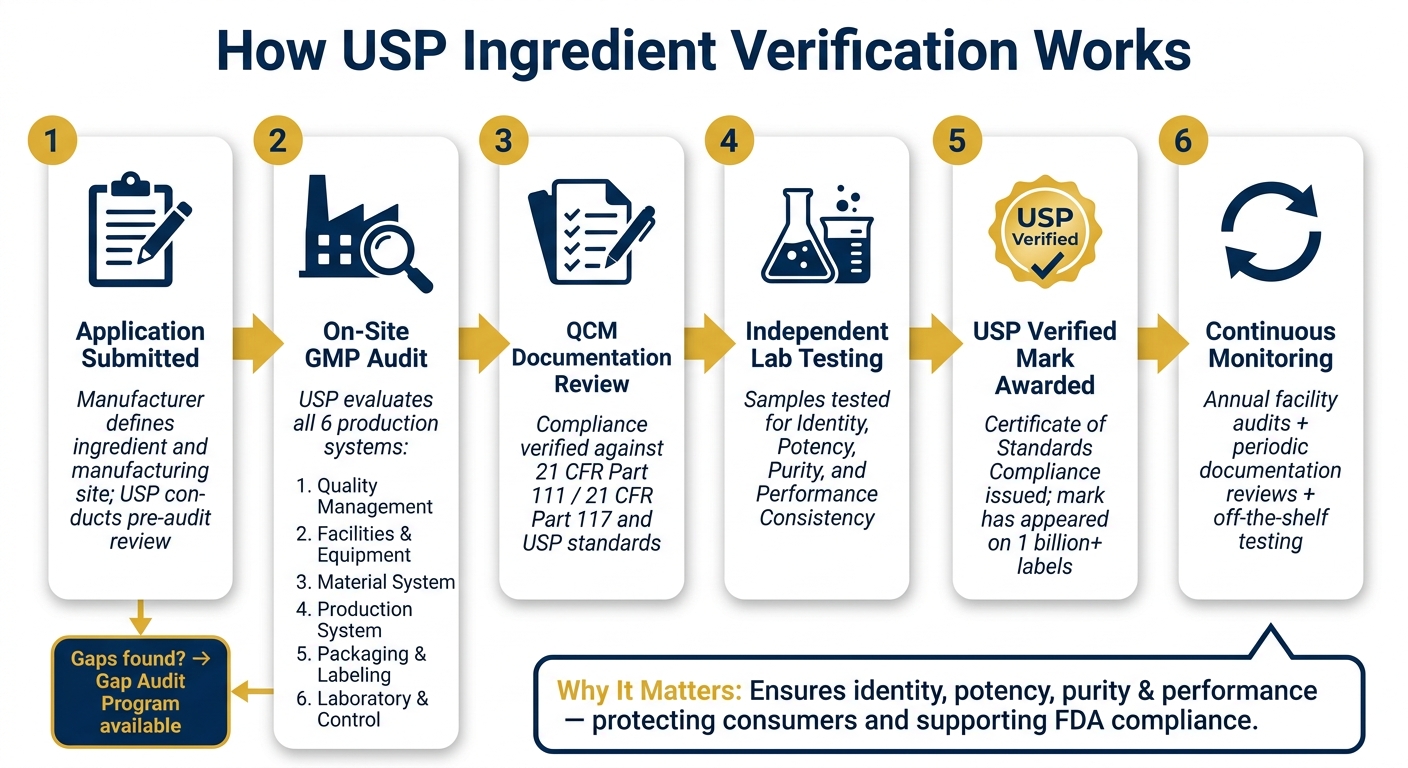
USP Ingredient Verification Process: Step-by-Step Guide
USP Ingredient Verification follows a detailed, step-by-step approach to assess a manufacturer's quality system, from handling raw materials to shipping finished ingredients.
Application and Scope Definition
The process kicks off when a manufacturer submits an application to USP, clearly defining the ingredient and manufacturing site to be verified. Before any on-site audits happen, USP conducts a pre-audit review to check whether the company’s quality system has the necessary foundational elements. If the review uncovers any major gaps, manufacturers can opt for USP's Gap Audit Program to address these issues before moving forward. Once the pre-audit review is complete, the process transitions to an in-depth GMP audit.
GMP Audits and Documentation Reviews
The next step involves on-site audits where USP evaluates the entire manufacturing operation. This includes every stage, from raw material handling to packaging and shipping. The audit focuses on six key production systems:
| Production System | What's Evaluated |
|---|---|
| Quality Management | GMP compliance, internal procedures, and specifications |
| Facilities and Equipment | Environmental conditions and equipment used in production |
| Material System | Controls for raw materials, intermediates, containers, and labeling materials |
| Production System | Processes in place to ensure proper manufacturing controls |
| Packaging and Labeling | Packaging and labeling procedures and safeguards |
| Laboratory and Control | Testing of raw materials and final products against established specifications |
During this phase, USP also reviews Quality Control and Manufacturing (QCM) documentation for specific ingredient lots. This ensures compliance with FDA regulations under 21 CFR Part 111 or 21 CFR Part 117, as well as adherence to USP standards.
"The USP GMP audit is not a substitute for a regulatory audit, but it will help a participant to prepare for a regulatory audit." - USP
Lab Testing and Certification
After the on-site audit and documentation review, USP conducts lab testing to verify the ingredient’s specifications. Samples are tested in USP's laboratory to confirm they meet standards for identity, potency, purity, and performance.
"The Verification Program helps protect and inform consumers by providing them assurances that the products with the USP Verified Mark will not contain harmful levels of specified contaminants, toxic botanical species, or greater amounts of active/marker compounds than that indicated on the product specification and label." - USP
If the ingredient passes all stages, the manufacturer is awarded a Certificate of Standards Compliance and gains the right to display the USP Verified Mark. This mark has appeared on over 1 billion labels and packages since the program's inception. Certification is upheld through annual facility audits, regular documentation reviews, and periodic off-the-shelf testing to ensure ongoing compliance.
Benefits of USP Ingredient Verification for Consumers and Brands
Quality and Safety Assurance
The USP Verified Mark is a reliable indicator that a supplement has undergone independent testing for critical factors like identity, potency, purity, and performance. This means the product's contents align with the label, and it’s free from harmful contaminants such as lead, mercury, pesticides, and microbes.
"Seeing the USP Verified Mark on a dietary supplement label indicates that the product... will break down and release into the body within a specified amount of time." - USP
This verification removes uncertainty for consumers, ensuring they get exactly what they expect in terms of safety and accuracy. Beyond consumer trust, these thorough evaluations also help brands meet regulatory expectations.
Support for Regulatory Compliance
For manufacturers, USP Ingredient Verification simplifies compliance with FDA regulations, specifically 21 CFR Part 111 cGMPs. By auditing manufacturing processes, it not only supports FDA inspections but also minimizes the need for additional supplier audits. This process strengthens supplier qualifications, reducing the risk of using subpar raw materials.
"The USP Dietary Supplement Verification Program can help enhance a manufacturer's competitive position and brand recognition by promoting the manufacturer's commitment to produce quality products for consumers." - USP
This focus on quality assurance can also boost a brand’s reputation, especially for specialized supplements like molecular hydrogen products.
Relevance to Molecular Hydrogen Supplements
In molecular hydrogen tablets, precise dissolution is key. Without proper disintegration and accurate dosing, the tablets fail to generate hydrogen effectively. That’s why USP verification is especially important for these supplements.
Edenvia Molecular Hydrogen tablets, for instance, undergo rigorous third-party testing to ensure they meet these standards. For consumers, this level of testing provides a clear signal of quality and performance when choosing molecular hydrogen supplements.
Conclusion: Why USP Ingredient Verification Matters
In a market where mislabeling is far too common, USP Ingredient Verification ensures that supplements deliver what they promise. This program checks for label accuracy, proper potency, contaminant safety, and correct dissolution.
"Consumers deserve to trust the quality of the dietary supplements and drug products they take." - John B. Atwater, Senior Director of USP Verification Services
Through ongoing audits, documentation reviews, and regular testing, the program maintains high standards of quality. This process benefits both consumers, who can trust the products they use, and manufacturers, who can demonstrate their commitment to quality.
To ensure you're choosing a product that meets these standards, look for the USP Verified Mark on labels or check compliance directly on the USP website. For supplements like Edenvia Molecular Hydrogen tablets - where precise dissolution is critical - this verification provides a reliable stamp of quality assurance.
FAQs
How do I verify a USP Verified Mark is real?
To confirm that a USP Verified Mark is genuine, consult the official list of participants provided by the United States Pharmacopeia. This mark indicates that the product or ingredient has undergone a detailed assessment process. This includes facility inspections, review of documentation, and laboratory testing to ensure it meets established quality standards. It verifies the product's identity, strength, purity, and overall quality.
Does USP verification cover every lot or just a one-time approval?
USP verification isn't a one-and-done deal. It's a continuous, multi-step process that keeps quality in check over time. This includes annual GMP facility audits, quality documentation and product (QCM) evaluations, and product testing. These steps ensure ongoing quality monitoring, with re-verification and surveillance happening as needed to maintain standards under the program.
What’s the difference between USP standards and FDA requirements?
USP standards serve as public benchmarks for the quality of medicines and related products, outlined in USP monographs and chapters. These standards become legally enforceable when a product claims to adhere to them. However, USP itself does not enforce compliance. Instead, enforcement falls under the jurisdiction of the FDA, as mandated by federal law. USP and FDA requirements are closely aligned, with the FDA frequently integrating USP standards into its regulations. As a result, manufacturers often meet USP criteria to ensure compliance with FDA rules.