

Oxidative Stress and Pain: Hydrogen's Role
Oxidative stress, caused by an imbalance between harmful free radicals (ROS/RNS) and antioxidants, is a key driver of chronic pain. It damages cells, triggers inflammation, and sensitizes pain receptors. Traditional antioxidants often fall short in addressing this issue effectively. However, molecular hydrogen (H₂) offers a targeted approach by neutralizing the most damaging free radicals while preserving beneficial ones. Its small size allows it to penetrate cells, reduce inflammation, and improve mitochondrial function, making it a promising option for pain relief.
Key Points:
- Oxidative Stress and Pain: Excess ROS leads to inflammation and heightened pain sensitivity.
- Why H₂ Works: Selectively targets harmful radicals (e.g., hydroxyl radicals) without disrupting essential cellular processes.
- Pain Relief Evidence: Studies show hydrogen reduces neuropathic pain, inflammation, and oxidative damage.
- Usage: Hydrogen-rich water and inhalation are effective methods, with no significant side effects.
Molecular hydrogen is safe, easy to use, and a potential complement to existing pain management strategies.
Oxidative Stress and How It Causes Pain
What Is Oxidative Stress?
Oxidative stress happens when the production of reactive oxygen species (ROS) surpasses the body’s ability to neutralize them with antioxidants. This imbalance allows these harmful molecules to wreak havoc on cells and tissues.
ROS include two main types: highly reactive radicals like superoxide (·O₂⁻) and hydroxyl radicals (·OH), which act quickly and locally, and more stable non-radicals like hydrogen peroxide (H₂O₂), which can travel between cells and act as signaling molecules.
Your body naturally generates ROS as part of everyday metabolic processes. For instance, mitochondria - your cells’ energy factories - produce superoxide during electron transport when electrons escape from the chain. Other sources include NADPH oxidases at the cell membrane, the endoplasmic reticulum during protein folding, and peroxisomes during fatty acid breakdown. External factors like cigarette smoke, radiation, and environmental toxins can also spike ROS levels.
One particularly damaging reaction is the Fenton reaction. Here, hydrogen peroxide reacts with metals like iron (Fe²⁺), creating hydroxyl radicals (·OH) that can irreversibly damage DNA and lipids. Normally, antioxidant enzymes such as the peroxiredoxin (PRX) family - responsible for neutralizing 80–90% of newly formed hydrogen peroxide - help prevent this damage. But when ROS production overwhelms these defenses, oxidative stress takes over.
The Link Between Oxidative Stress and Pain
Chronic oxidative stress doesn’t just harm cells - it also triggers inflammation and worsens pain sensitivity. Excess free radicals attack lipids, proteins, and DNA, causing cellular damage and even cell death. This damage sets off inflammatory responses that can amplify pain.
On a cellular level, oxidative stress activates pro-inflammatory pathways like NF-κB and MAPK in spinal cord microglia and astroglia. These cells then release molecules like IL-1β, TNF, and BDNF, which intensify pain signals and weaken the body’s natural pain-reducing mechanisms. This process, called central sensitization, makes pain feel more intense and harder to control. Molecular hydrogen, as we’ll see, specifically targets these processes to help manage pain.
Oxidative stress also creates a vicious cycle of inflammation. Damaged cells can enter a state known as the "senescence-associated secretory phenotype" (SASP), where they continuously release cytokines and prostanoids that amplify neuroimmune signaling. In peripheral nerves, this stress lowers the activation threshold of nociceptors, causing them to fire even without a trigger, which further increases pain sensitivity.
Additionally, nerve injuries and metabolic stress can damage mitochondria, leading to a feedback loop where impaired mitochondria generate even more ROS. This worsening cycle of mitochondrial damage and pain signaling explains why chronic pain is so difficult to treat.
Why Traditional Antioxidants Fall Short
While dietary antioxidants like vitamins C and E, selenium, and polyphenols are popular, they often fail to provide lasting relief for chronic pain linked to oxidative stress. The evidence supporting their effectiveness is inconsistent, particularly in people with normal baseline oxidative stress levels.
One major issue is timing and function. Traditional antioxidants are typically used after damage has already occurred. In contrast, the body’s own antioxidant systems - like glutathione peroxidase and heme oxygenase-1 - work continuously to prevent damage in the first place. Because of this, supplements often provide only temporary relief without addressing the root causes of oxidative stress.
For instance, in a study on knee osteoarthritis, participants who consumed 40 grams of freeze-dried blueberry powder daily for four months reported reduced pain and improved mobility. However, their inflammatory markers remained unchanged. This disconnect highlights the need for more targeted solutions, such as molecular hydrogen, which addresses oxidative stress at its core.
sbb-itb-6860cc4
Using Molecular Hydrogen an Analgesic?
How Molecular Hydrogen Reduces Pain
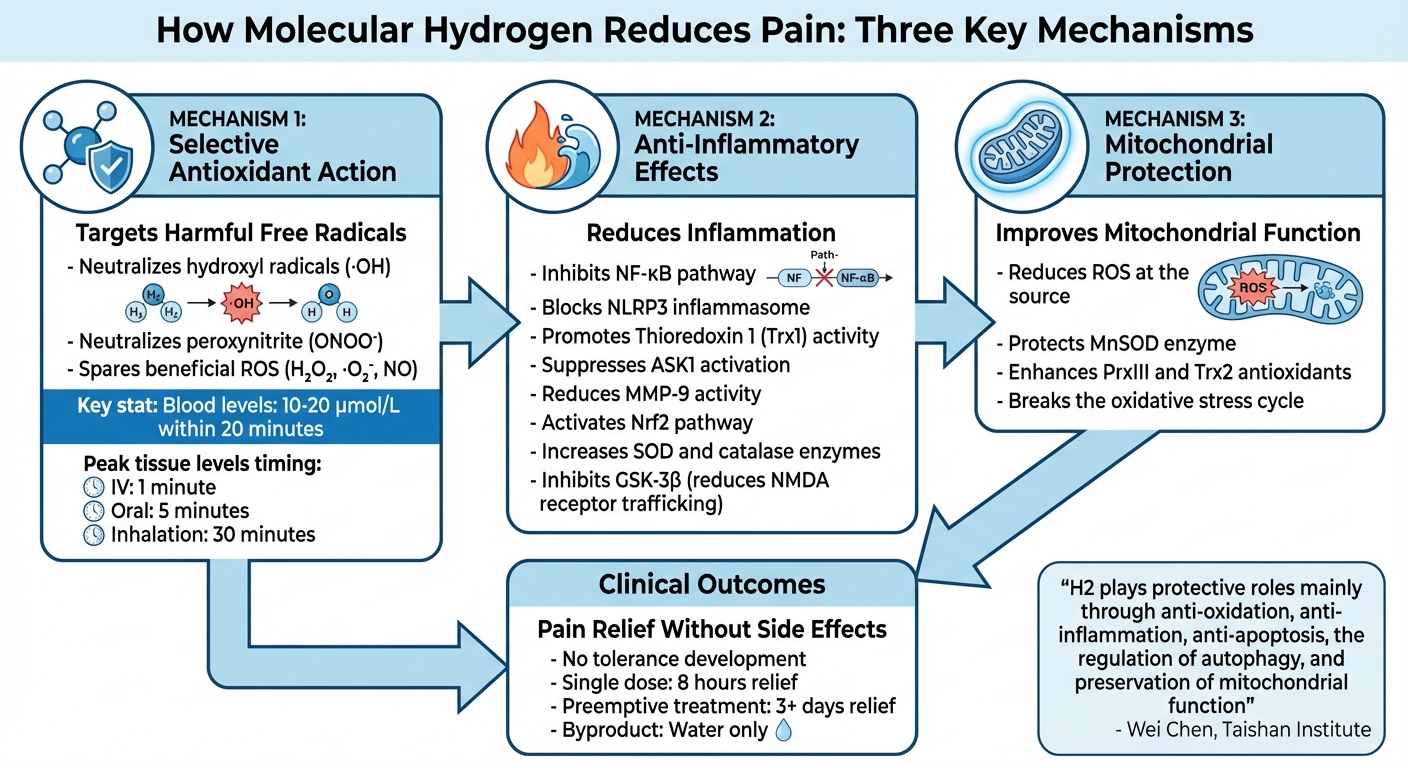
How Molecular Hydrogen Reduces Pain Through Three Key Mechanisms
Molecular Hydrogen's Mechanism of Action
Molecular hydrogen works in a highly targeted way, focusing on neutralizing the most harmful reactive oxygen species (ROS) without affecting the ones that are beneficial. Instead of indiscriminately neutralizing all ROS, it specifically targets hydroxyl radicals (·OH) and peroxynitrite (ONOO⁻) - two of the most damaging types of ROS. Meanwhile, it spares ROS like hydrogen peroxide, superoxide, and nitric oxide, which are essential for normal cell signaling and immune responses.
Dinesh Ramanathan from the Department of Neurosurgery at Loma Linda University explains this process:
"Molecular hydrogen selectively scavenges hydroxyl radicals and peroxy-nitric radicals that are responsible for oxidative stress and disease process, while sparing other reactive oxygen species such as hydrogen peroxide, superoxide and nitric oxide that are critical to normal cell physiology."
In clinical applications, inhaling a 3%–4% concentration of hydrogen gas can raise blood hydrogen levels to 10–20 μmol/L within 20 minutes. Tissue levels peak at different times depending on the method of administration: about 1 minute after intravenous delivery, 5 minutes after oral ingestion, and 30 minutes after inhalation. This precise targeting of harmful ROS helps reduce oxidative damage and sets the stage for lowering inflammation.
Reducing Inflammation with Molecular Hydrogen
Beyond neutralizing harmful ROS, molecular hydrogen plays a role in controlling inflammation - a key factor in chronic pain.
It works by inhibiting the NF-κB signaling pathway and blocking the NLRP3 inflammasome, both of which are major contributors to neuroinflammation and chronic pain conditions.
Hydrogen also promotes the activity of Thioredoxin 1 (Trx1), which suppresses Apoptosis signal-regulating kinase 1 (ASK1). This action prevents the activation of p38 and JNK MAPKs and reduces Matrix Metalloproteinase-9 (MMP-9) activity along with microglial activation.
Additionally, hydrogen stimulates the body's natural antioxidant defenses. It activates the Nrf2 pathway through mechanisms involving AMPK and the Sirt1-FoxO3a axis. This leads to an increase in antioxidant enzymes like superoxide dismutase (SOD) and catalase, which help the body manage oxidative stress more effectively.
In studies on neuropathic pain, hydrogen has been shown to inhibit GSK-3β activity. This reduces the trafficking of NMDA receptors to the membrane in the dorsal root ganglion, alleviating heightened pain sensitivity.
On top of reducing inflammation, hydrogen also supports cellular energy regulation by improving mitochondrial function.
Improving Mitochondrial Function
Mitochondria play a central role in chronic pain by producing excessive ROS. Molecular hydrogen helps interrupt this cycle by reducing ROS production directly at its source within the mitochondria.
It protects critical enzymes like Manganese Superoxide Dismutase (MnSOD) from being inactivated by oxidative stress. Research also indicates that hydrogen enhances mitochondrial antioxidants such as PrxIII and Trx2.
Wei Chen from the Taishan Institute for Hydrogen Biomedicine highlights the overall benefits of hydrogen:
"H2 plays protective roles mainly through anti-oxidation, anti-inflammation, anti-apoptosis, the regulation of autophagy, and preservation of mitochondrial function and the blood-brain barrier."
Research on Molecular Hydrogen for Pain Management
Studies on Neuropathic Pain Relief
Recent findings highlight molecular hydrogen's ability to ease neuropathic pain caused by nerve damage by breaking the oxidative stress cycle that fuels chronic pain.
In a 2014 study conducted by researchers at the Second Military Medical University in Shanghai, China, hydrogen-rich saline was tested on rats with L5 spinal nerve ligation, a commonly used model for neuropathic pain. Led by Y. Ge, the team administered 20 μl of hydrogen-rich saline (0.6 mmol/L) directly into the spinal area. The results were promising: the treatment significantly increased mechanical pain thresholds and improved heat response times. For instance, while nerve injury reduced paw withdrawal latencies to heat, hydrogen treatment extended these latencies to roughly 7.5 seconds. This effectively reduced thermal hyperalgesia and lowered levels of 8-hydroxyguanosine, a marker of oxidative DNA damage in the spinal cord.
"Intrathecal injection of hydrogen-rich normal saline produced analgesic effect in neuropathic rat... mediated by reducing the activation of spinal astrocytes and microglia."
– Ge Y. et al., PLOS One
In February 2023, a study in the Journal of Neuroinflammation explored hydrogen's effects on postoperative pain in mice. Researchers administered hydrogen-rich saline (5 mL/kg, twice daily) starting six hours before plantar incision surgery. The treatment effectively reduced mechanical allodynia by increasing Trx1 expression and lowering the phosphorylation of pain-related signaling molecules. This study also revealed hydrogen's ability to reduce MMP-9 activity and IL-1β maturation, showcasing its potential for managing postoperative pain.
"This study demonstrates that H2 can be used as a therapeutic agent to alleviate postoperative pain through the Trx1/ASK1/MMP9 signaling pathway."
– Journal of Neuroinflammation
Unlike traditional pain medications, repeated hydrogen treatments do not lead to tolerance. A single intrathecal dose provided pain relief for about eight hours, while preemptive treatment maintained higher pain thresholds for up to three days after the treatment stopped. These findings suggest that molecular hydrogen could offer both immediate and longer-term relief, addressing not only physical pain but also the psychological challenges tied to chronic pain.
Mental Health Benefits
Molecular hydrogen's ability to influence pain pathways may also help break the cycle of chronic pain and mental distress. The link between chronic pain and mental health is well-documented. Studies show that around 80% of surgical patients experience acute postoperative pain, with over 20% developing severe chronic pain. This persistent pain often leads to depression and anxiety, creating a feedback loop that worsens both physical suffering and emotional health. By alleviating pain at its source, hydrogen therapy could play a role in mitigating these psychological effects as well.
Using Molecular Hydrogen for Pain Relief
Methods for Taking Molecular Hydrogen
Molecular hydrogen offers a practical and effective way to manage pain, thanks to its targeted antioxidant properties. One of the easiest and most popular methods is drinking hydrogen-rich water. This is made by dissolving specialized tablets in water, providing a convenient option for daily use at home. For more acute conditions or clinical settings, inhalation therapy is another option. This involves breathing in a hydrogen-oxygen gas mixture - typically 67% hydrogen and 33% oxygen - delivered through specialized equipment. Studies reveal that hydrogen levels in the blood and hippocampus stay elevated for at least 30 minutes after treatment.
What makes molecular hydrogen so effective is its incredibly small molecular size, which allows it to penetrate tissues quickly, including the brain and mitochondria. This capability enables it to combat oxidative stress directly at the cellular level, making it a strong candidate for pain relief. Clinical studies have shown benefits with as little as 0.5 liters of hydrogen-rich water per day.
How to Use Hydrogen Tablets
Edenvia Molecular Hydrogen tablets are designed to release hydrogen gas when dissolved in water, using a magnesium-based formula. To use them, simply drop one tablet into 500 mL (about 17 fl oz) of water and let it dissolve completely. It's important to use room temperature or cool water, as hot water can cause the hydrogen gas to escape more quickly. These high-concentration tablets can deliver up to 21.5 ppm (parts per million) of hydrogen, which is significantly higher than the typical range of 0.1 to 4.0 ppm found in most products.
Once the tablet has dissolved, drink the water immediately to ensure you're getting the full dose of hydrogen, as the gas dissipates quickly. If you need to store it briefly, use a container with minimal air space to limit hydrogen loss. For those managing chronic inflammation or pain, consistent daily use over a period of 4 to 12 weeks - or longer - can yield noticeable benefits. Incorporating hydrogen water into your regular hydration routine, aiming for 1–2 liters (approximately 34–68 fl oz) daily, can help you maintain balance and support overall health.
With these straightforward instructions, the focus shifts to the safety and complementary benefits of molecular hydrogen.
Safety and Complementary Use
Molecular hydrogen has a strong safety record. It is classified as Generally Recognized As Safe (GRAS) by the U.S. FDA and has been approved as a food additive in Japan since 1965. In Japan, an estimated 15–20% of the population regularly consumes hydrogen water, providing decades of safety data. Unlike molecular hydrogen vs traditional antioxidants, hydrogen poses no risk of toxicity. Any excess hydrogen that the body doesn’t use is simply exhaled within minutes. Additionally, the only byproduct of its reaction with free radicals is water, so it doesn’t strain the liver or kidneys.
However, individuals undergoing chemotherapy or taking diabetes medications should consult their physician before starting hydrogen supplementation. Hydrogen is often used as a complementary therapy alongside standard treatments. As Dr. Matthew Antonucci from the Carrick Institute explains:
"Use H2 to restore redox balance, then use HBOT to push oxygen into tissues".
Pregnant women, children under 12, and those on complex medication regimens should also seek medical advice before adding hydrogen to their routine. With its excellent safety profile and compatibility with other treatments, molecular hydrogen offers a promising non-drug option for managing chronic pain.
Conclusion
The relationship between chronic pain and oxidative stress is undeniable, and molecular hydrogen provides a focused, research-supported approach to address this issue. By targeting and neutralizing harmful free radicals while leaving beneficial ones intact, molecular hydrogen stands out as a precise and effective option.
Studies highlight its ability to reduce inflammation, alleviate neuropathic pain, and enhance mitochondrial function - all without negative side effects. Unlike traditional antioxidants that may interfere with vital cellular processes, hydrogen's selective action ensures it supports the body's natural balance.
Its practicality is another advantage. With FDA GRAS status, molecular hydrogen is recognized as safe and non-pharmacological, making it a great addition to existing treatments. Its ease of use and rapid absorption into tissues make it an accessible solution for managing chronic pain and inflammation.
For those looking to integrate molecular hydrogen into their routine, drinking hydrogen-rich water is a simple yet effective step. Research suggests that consuming about 1 liter daily can lead to noticeable improvements over time. Products like Edenvia Molecular Hydrogen tablets make it easy to achieve therapeutic levels at home, giving your body the extra support it needs to combat oxidative stress and reduce pain.
FAQs
How is oxidative stress actually making my pain worse?
Oxidative stress intensifies pain by harming cells and making nerve pathways in both the peripheral and central nervous systems more sensitive. This increased sensitivity exaggerates pain signals, often playing a role in chronic pain conditions like fibromyalgia. Tackling oxidative stress can break this cycle, aiding in better pain control.
How is molecular hydrogen different from typical antioxidants?
Molecular hydrogen is different from standard antioxidants because of its targeted action. It neutralizes harmful reactive oxygen species (ROS), such as hydroxyl radicals, while leaving beneficial ROS intact, which are essential for cellular signaling. Unlike many antioxidants, it can pass through cell membranes and reach subcellular areas, helping to reduce oxidative stress without interfering with normal biological functions. This unique ability makes it especially helpful in managing oxidative damage tied to chronic pain and inflammation.
Which hydrogen method works best for pain - water or inhalation?
Hydrogen-rich water has been found to help reduce pain-related behaviors in animal studies, hinting at its potential for pain management. On the other hand, inhalation methods seem to have less targeted evidence when it comes to relieving pain. Studies emphasize the possible advantages of using hydrogen-infused water to combat both pain and oxidative stress.