

Oxidative Stress: How Hydrogen Protects Cells
Too much oxidative stress can drain cell energy, damage mitochondria, and keep inflammation going. In simple terms, your cells make reactive oxygen species during normal energy production, and when those molecules build up faster than your body can clear them, proteins, fats, and DNA can get hit.
Here’s the short version:
- Mitochondria are a main source of ROS. Even under normal conditions, about 0.2% to 2% of electrons can leak during energy production and form superoxide.
- Damage can snowball. Once mitochondria are hurt, they can make more ROS and less ATP, which may link to fatigue, slower recovery, and low-grade inflammation.
- Your body has built-in systems to fight back. SOD, catalase, GPx, glutathione, Nrf2, and mitophagy all help limit damage.
- Researchers track this with markers. MDA and 8-OHdG tend to go up with oxidative damage, while SOD activity and the GSH/GSSG ratio can drop when cells are under strain.
- Molecular hydrogen (H₂) vs traditional antioxidants differ for one main reason: it is small enough to move into cells and mitochondria and may react with the most damaging oxidants, such as hydroxyl radicals and peroxynitrite, while mostly leaving normal ROS signaling alone.
- Human studies are still mixed but promising. Some trials report better antioxidant enzyme activity and lower oxidative stress markers after daily hydrogen-rich water intake over several weeks.
If I boil the article down to one point, it’s this: oxidative stress often starts where your cells make energy, and hydrogen is being studied because it may help protect that process without shutting down the ROS your body still uses for normal signaling.
So if you want to understand what oxidative stress is, why mitochondria matter, how your body handles ROS, and where hydrogen-rich water may fit in, this article gives you the big picture in plain English.
Tyler LeBaron: Hydrogen Water, Mitochondrial Health, Selective Antioxidants, & Longevity | TUH #265
sbb-itb-6860cc4
How Oxidative Stress Damages Cells and Mitochondria
Mitochondria make ATP, but there’s a catch: some electrons slip out during the process and form reactive oxygen species, or ROS. Most of that ROS starts in the mitochondrial electron transport chain.
Where Reactive Oxygen Species Come From
Mitochondria make ATP through oxidative phosphorylation in the electron transport chain. Under normal conditions, about 0.2% to 2% of electrons leak and react with oxygen to form superoxide (O₂•⁻), which is a primary ROS.
That baseline leak is usually something cells can handle. The trouble starts when fuel is coming in fast, but ATP demand stays fairly low. High-calorie, high-fat, and high-sugar diets can increase mitochondrial substrate flux and push ROS production higher. Poor sleep, stress, and inactivity can make things worse by weakening antioxidant defenses.
How Mitochondrial Damage Affects Energy and Inflammation
When ROS stay high, they start hitting core parts of the mitochondria. They damage membranes, enzymes, and mtDNA. Lipid peroxidation disrupts mitochondrial membranes and the protein complexes embedded in them. Protein oxidation harms enzymes in the respiratory chain and the TCA cycle. Mitochondrial DNA, or mtDNA, takes an outsized hit because it sits close to the electron transport chain and doesn’t have the protective histones that shield nuclear DNA.
That sets off a nasty cycle. Damaged mitochondria make more ROS, which leads to more mtDNA and protein damage and lowers ATP output. As ATP production drops, cells have a harder time keeping normal signaling and ion balance in place. ROS also switch on stress pathways such as JNK and p38 MAPK, and oxidative stress can promote mtDNA damage and release, which helps keep inflammatory signaling turned on.
Over time, this feeds chronic low-grade inflammation linked with aging, metabolic syndrome, and neurodegenerative disease.
Table: Major Reactive Oxygen Species, Their Sources, and Targets
| ROS Type | Main Source | Primary Damage Targets |
|---|---|---|
| Superoxide (O₂•⁻) | Electron leakage at complexes I and III of the mitochondrial ETC; NADPH oxidases | Fe–S centers in respiratory complexes; precursor to H₂O₂; initiates lipid peroxidation |
| Hydrogen peroxide (H₂O₂) | Dismutation of superoxide via MnSOD; mitochondrial and cytosolic oxidases | Oxidizes proteins and enzymes; diffuses across membranes; forms hydroxyl radicals in the presence of iron |
| Hydroxyl radical (•OH) | Fenton reaction between H₂O₂ and iron or copper ions | DNA strand breaks and base modifications; severe protein and membrane lipid damage |
| Peroxyl and lipid radicals | Propagation of lipid peroxidation in mitochondrial and cellular membranes | Spread oxidative damage through membrane phospholipids; disrupt embedded respiratory proteins |
When mtDNA is damaged, faulty respiratory proteins can drive more electron leakage and more ROS. That feedback loop is tough for cells to stop. Cells do fight back with antioxidant defenses, which the next section covers.
How the Body Defends Against Oxidative Stress
Natural Antioxidant Systems Inside Cells
Cells have built-in ways to deal with mitochondrial ROS. The main players are SOD, catalase, GPx, glutathione, Nrf2, and mitophagy.
Here’s the basic chain reaction:
- SOD turns superoxide into hydrogen peroxide.
- Catalase and GPx then break hydrogen peroxide down into water and oxygen.
- GPx also uses glutathione to neutralize lipid peroxides.
After GPx uses GSH, it becomes its oxidized form, GSSG. The body then converts GSSG back into GSH, which helps cells keep their antioxidant defense going over time.
When ROS starts piling up, the Nrf2–Keap1 pathway steps in. Nrf2 breaks free from Keap1-driven degradation, moves into the nucleus, and switches on genes tied to antioxidant defense, glutathione production, and detoxification. Cells also use mitophagy to remove damaged mitochondria before those mitochondria can keep pumping out more ROS and spread damage. Put simply, when mitophagy is working as it should, fewer damaged mitochondria stick around.
That said, these defenses can get worn down. Aging, chronic disease, poor diet, toxins, inactivity, and inflammation can all push the system too far. In chronic conditions, researchers often see lower SOD, catalase, and GSH levels, along with higher oxidative damage. These are also the same pathways molecular hydrogen may help support.
Markers Researchers Use to Measure Oxidative Stress
Researchers look at both damage markers and defense markers to track this balance.
Malondialdehyde (MDA) is a common marker of lipid peroxidation. It goes up when ROS attacks polyunsaturated fatty acids in cell membranes. 8-hydroxy-2'-deoxyguanosine (8-OHdG) shows oxidative DNA damage caused when ROS oxidizes guanine bases. Higher 8-OHdG levels point to more mutagenic stress on both nuclear and mitochondrial DNA.
On the defense side, SOD activity and glutathione status help show whether antioxidant systems are keeping pace. Glutathione status is often measured as total GSH or the GSH/GSSG ratio. A high ratio means cells still have solid buffering capacity. A low ratio means glutathione is being used up faster than it can be restored. GPx activity is also useful because GPx depends on glutathione to reduce peroxides well.
In one human study, 8 weeks of hydrogen-rich water consumption increased SOD activity and showed a decreasing trend in 8-OHdG levels, which suggests better antioxidant status.
When MDA and 8-OHdG rise while SOD activity and the GSH/GSSG ratio fall, it can mean oxidative damage is outpacing the body’s defenses.
Table: Common Oxidative Stress and Antioxidant Markers
| Marker | What It Measures | Change Under Oxidative Stress | Why It Matters for Mitochondrial Health |
|---|---|---|---|
| MDA (Malondialdehyde) | Lipid peroxidation in cell membranes | Increases | Higher levels suggest membrane damage. |
| 8-OHdG | Oxidative DNA damage | Increases | Elevated levels reflect damage to nuclear and mitochondrial DNA. |
| SOD Activity | Ability to neutralize superoxide | Decreases when overwhelmed | Low activity signals weaker superoxide defense. |
| GSH / GSSG Ratio | Balance of reduced vs. oxidized glutathione | GSH falls; GSSG rises | A low ratio signals weaker antioxidant buffering and less protection for mitochondrial proteins and membranes. |
| GPx Activity | Glutathione peroxidase function | Decreases in chronic disease states | Reduced GPx activity weakens peroxide detoxification. |
Next, the article shows how molecular hydrogen supports these defenses, especially in mitochondria.
How Molecular Hydrogen Protects Cells
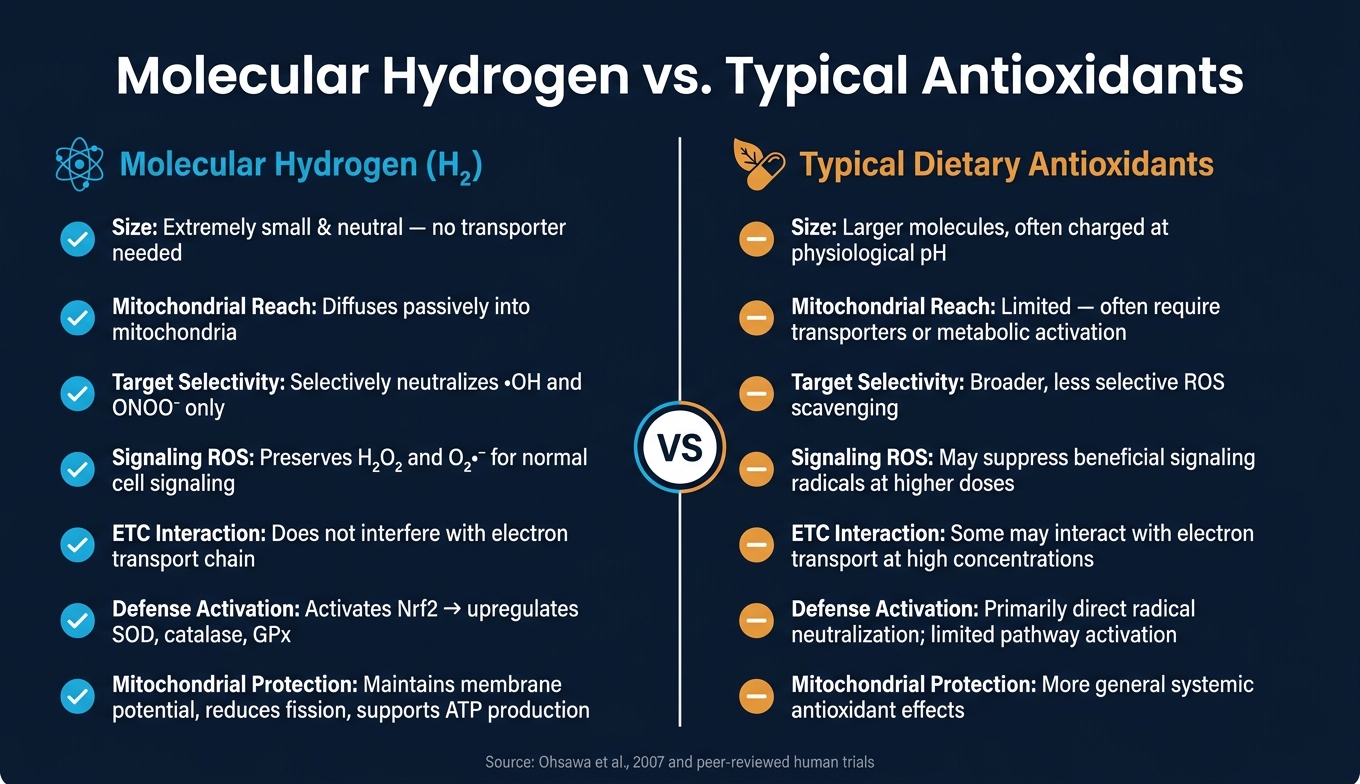
Molecular Hydrogen vs. Typical Antioxidants: Key Differences
A lot of oxidative stress starts in the mitochondria. That’s why H₂ gets so much attention here. It’s a tiny, neutral gas that can pass through membranes and reach mitochondria without needing transport proteins.
That matters because many larger antioxidants, including vitamin C and polyphenols, have a tougher trip. At physiological pH, they’re often charged, which makes it harder for them to get deep into cells.
Why Hydrogen Can Reach Mitochondria Efficiently
H₂ spreads passively through cellular and mitochondrial spaces, so it can get to oxidative stress right where it begins. It doesn’t need transport proteins. It also doesn’t need metabolic activation. It simply moves into mitochondria, where ROS from the electron transport chain are produced.
Selective Antioxidant Action and Mitochondrial Support
H₂ doesn’t wipe out all ROS across the board. Instead, it goes after the most reactive oxidants - hydroxyl radicals (•OH) and peroxynitrite (ONOO⁻) - while mostly leaving superoxide (O₂•⁻) and hydrogen peroxide (H₂O₂) alone.
That selectivity is a big deal. Some ROS are harmful, but others help with normal cell signaling. H₂ seems to hit the damaging species without shutting down the signals cells still use.
A foundational 2007 study by Ohsawa et al. showed that H₂ selectively reduced hydroxyl radicals in cultured cells and protected mitochondria from •OH-induced damage, with little effect on superoxide or H₂O₂ levels. The direct reaction converts hydroxyl radicals to water: H₂ + 2•OH → 2H₂O.
H₂ may also support the cell’s own defense systems. Beyond direct scavenging, it appears to act through the Keap1–Nrf2 pathway, increasing antioxidant enzyme expression, including SOD, catalase, GPx, and glutathione-related enzymes. Research also suggests that H₂ can help maintain mitochondrial membrane potential by reducing excessive fission and supporting fusion. In plain English, that can mean less electron leakage and better ATP production.
The table below shows why H₂ behaves differently from typical antioxidants.
Table: Molecular Hydrogen vs. Typical Dietary Antioxidants
| Feature | Molecular Hydrogen (H₂) | Typical Dietary Antioxidants |
|---|---|---|
| Molecular size | Extremely small and neutral | Typically larger and often charged at physiological pH |
| Mitochondrial reach | Diffuses passively into mitochondria | Limited; often require transporters or metabolic activation |
| Target selectivity | Selectively neutralizes •OH and ONOO⁻ | Broader, less selective ROS scavenging |
| Impact on signaling ROS | Largely preserves H₂O₂ and O₂•⁻ for normal signaling | May suppress beneficial signaling radicals at higher doses |
| Interaction with electron transport chain | Does not interfere with mitochondrial electron carriers | Some antioxidants may interact with electron transport at high concentrations |
| Endogenous defense support | Activates Nrf2 signaling and upregulates SOD, catalase, GPx | Primarily direct radical neutralization; limited pathway activation |
| Evidence for mitochondrial protection | Helps maintain membrane potential, reduce fission, and support ATP production | More general systemic antioxidant effects |
Research Findings and Using Edenvia Molecular Hydrogen Daily
What Studies Show About Hydrogen and Oxidative Stress
Building on the mitochondrial mechanisms above, human studies look at a practical question: can hydrogen-rich water help lower oxidative stress in day-to-day use?
So far, the data points in that direction. Human studies suggest hydrogen-rich water can lower markers tied to oxidative stress and inflammation, though results vary based on the group studied, the amount used, and how long the study ran. Across trials, the most consistent pattern is lower lipid peroxidation and inflammatory markers, along with better antioxidant enzyme activity.
For people who want a simple way to make this part of a daily routine, hydrogen tablets are an easy format.
Edenvia Molecular Hydrogen and Hydrogen-Rich Water
Edenvia Molecular Hydrogen tablets dissolve in water to release H₂. Use one tablet in room-temperature or chilled water, let it dissolve, and drink it soon after preparation. That timing matters because daily hydrogen intake is meant to support the same mitochondrial oxidative stress pathways discussed above. Edenvia Molecular Hydrogen is made for simple daily hydrogen-rich water use.
Key Takeaways on Oxidative Stress, Mitochondria, and Hydrogen
A few points stand out in practice:
- Oxidative stress hits mitochondria early. When ROS production outpaces the body's defenses, mitochondria take the hit first. That can lower energy output and add to inflammation over time.
- Molecular hydrogen is being studied for selective antioxidant support. It targets the most damaging ROS while leaving helpful cell signaling in place, and it may also switch on the body's own defense pathways, such as Nrf2.
- Most human studies use daily intake over several weeks. In plain English, consistency seems to matter more than perfect timing when the goal is to support redox balance.
FAQs
What causes oxidative stress to get out of control?
Oxidative stress gets out of control when harmful free radicals - like hydroxyl radicals and peroxynitrite - build up faster than the body’s natural antioxidant defenses can keep up.
A few common things can push the body in that direction:
- Aging
- Chronic low-grade inflammation
- Intense physical activity
Edenvia molecular hydrogen tablets help by acting as a selective antioxidant. In plain English, they support cellular health and help the body maintain a balanced inflammatory response.
Why are mitochondria so vulnerable to ROS damage?
Mitochondria are especially vulnerable to reactive oxygen species (ROS) because they make the cell’s energy and stay in close contact with harmful byproducts from the electron transport chain.
That creates a problem: many larger antioxidant molecules don’t easily get into these inner parts of the cell. As a result, extra ROS can build up inside mitochondria and lead to more oxidative damage.
How might hydrogen-rich water support antioxidant defenses?
Hydrogen-rich water may help the body’s antioxidant system in two main ways.
First, it may directly neutralize harmful free radicals like hydroxyl radicals and peroxynitrite, while leaving helpful reactive oxygen species alone. That matters because not all reactive oxygen species are bad. Some play a normal role in cell signaling, so wiping all of them out isn’t always a good thing.
Second, it may switch on the Nrf2 pathway. This pathway helps the body make its own antioxidant enzymes, which can support its built-in defense system.
And there’s another piece that makes molecular hydrogen stand out: it’s extremely small. Because of that, it can move into cells with ease, including mitochondria and the nucleus.