

Molecular Hydrogen vs. Vitamin C: Antioxidant Comparison
If you want the short answer: vitamin C fills a nutrient need, while molecular hydrogen is more about targeted oxidative stress support.
Here’s the simple breakdown:
- Vitamin C is a nutrient your body must get from food or supplements.
- Molecular hydrogen (H₂) is not a nutrient. It’s used for redox support and recovery.
- Vitamin C works broadly, which means it can affect both harmful and useful reactive molecules.
- H₂ works more selectively, mainly against the most damaging radicals.
- Vitamin C has a U.S. upper limit of 2,000 mg/day.
- H₂ has no established upper limit and extra hydrogen is breathed out.
- In studies, 1.5 to 2.0 liters per day of hydrogen-rich water showed changes in oxidative stress markers in about 4 to 10 weeks.
- High-dose vitamin C can cause stomach upset and may increase kidney stone risk in some people.
If I were choosing between them, I’d keep it simple:
use vitamin C to cover nutrition, and look at H₂ for recovery, inflammation, and oxidative stress support.
Quick Comparison
| Point | Molecular Hydrogen (H₂) | Vitamin C |
|---|---|---|
| Main role | Targeted redox support | Nutrient support |
| How it works | Selective action + supports antioxidant enzyme pathways | Direct antioxidant action |
| What it targets | Mainly the most damaging radicals | Many reactive molecules |
| Where it goes | Can move into cells, including mitochondria and nucleus | Works mainly in water-based body spaces |
| Best fit | Recovery, oxidative stress, joint comfort | Collagen, immune support, iron absorption |
| Intake notes | Often used in water soon after mixing | RDA: 90 mg/day men, 75 mg/day women |
| Safety | No known toxicity at normal use levels | UL: 2,000 mg/day |
| Main caution | Research is still growing | GI upset and stone risk at high doses |
Bottom line: these are not interchangeable. One helps meet a nutrition requirement. The other may help when your goal is exercise recovery, lower oxidative stress, or less inflammation.
sbb-itb-6860cc4
How Molecular Hydrogen Works as an Antioxidant
Molecular hydrogen (H₂) works as a selective antioxidant. In plain English, that means it goes after the most damaging reactive species instead of sweeping up every free radical in sight. That matters because not all reactive molecules are “bad.” Some help with normal cell signaling.
Selective Scavenging and Cell and Tissue Access
H₂ specifically neutralizes hydroxyl radicals (•OH) and peroxynitrite (ONOO⁻), which are among the most destructive reactive oxygen species in the body. At the same time, it mostly leaves signaling molecules like superoxide, hydrogen peroxide, and nitric oxide alone.
At just 2 daltons, H₂ is the smallest known molecule. Because it has a neutral charge and a nonpolar nature, it can move through cell membranes fast and reach subcellular areas like the mitochondria and nucleus. Those are major sites of ROS generation and DNA damage. Put simply, its tiny size helps it get into places that larger antioxidants may not reach as well.
H₂ doesn’t only act through direct scavenging. It also activates the Nrf2/ARE signaling pathway, which tells the body to make more of its own antioxidant enzymes, including superoxide dismutase (SOD), catalase, and heme oxygenase-1 (HO-1).
Potential Benefits for Oxidative Stress, Recovery, and Joint Comfort
Clinical trials have found that drinking 1.5 to 2.0 liters of hydrogen-rich water per day, which provides about 1.65 to 2.6 mg of H₂, can significantly increase SOD levels and lower oxidative stress markers in people with metabolic syndrome. In most studies that found measurable shifts in metabolic and inflammatory markers, daily use for 4 to 10 weeks was enough to show results.
Exercise recovery is one area where H₂ has drawn attention. It can reduce oxidative stress markers such as malondialdehyde (MDA) without interfering with mitochondrial biogenesis. That’s a big point for athletes and active people, since you want less oxidative damage without getting in the way of training-related adaptation.
For people dealing with joint discomfort or body-wide inflammation, H₂ has also been shown to down-regulate pro-inflammatory cytokines such as TNF-α and IL-6.
Safety and Daily Use
H₂ is classified as a non-toxic medical gas. At normal pressures, it has no known acute or chronic toxicity and no known toxic effects on cellular metabolic redox reactions or intracellular signaling.
For day-to-day use, molecular hydrogen is often taken through tablets dissolved in 8 to 16 fl oz of water. Since H₂ is a very light gas and escapes fast, it’s best to drink the water soon after the tablet has fully dissolved so the concentration stays as high as possible. Researchers are still studying exact dose-response patterns for specific conditions, along with H₂’s full role as a signaling molecule.
Vitamin C works in a different way. It acts more broadly, is less selective, and also has other jobs in the body.
How Vitamin C Works as an Antioxidant
Vitamin C (L-ascorbic acid) is a broad-spectrum, electron-donating antioxidant. It helps neutralize many reactive oxygen species (ROS) and reactive nitrogen species (RNS), including some that take part in normal cell signaling.
Broad-Spectrum Antioxidant Action and Redox Cycling
Vitamin C also helps regenerate vitamin E after vitamin E neutralizes lipid radicals in cell membranes. That matters because vitamin E works in fatty parts of the body, like cell membranes, while vitamin C works in watery spaces. In a sense, vitamin C helps “recharge” vitamin E so it can keep doing its job.
Vitamin C is water-soluble and enters cells through transport proteins, SVCT1 and SVCT2. Molecular hydrogen works differently than traditional antioxidants. It diffuses across membranes without a transport system.
So while vitamin C works well as a general antioxidant, it isn’t as targeted as molecular hydrogen.
Health Roles Beyond Antioxidant Support
Vitamin C does more than deal with free radicals. It also helps with collagen formation, immune function, and iron absorption.
As a cofactor for collagen-stabilizing enzymes, it supports skin, blood vessels, bones, connective tissue, and wound healing. It also supports white blood cell production and helps protect immune cells from oxidative damage. On top of that, it improves absorption of non-heme iron from plant foods.
The U.S. Recommended Dietary Allowance (RDA) is 90 mg/day for adult men and 75 mg/day for adult women. Smokers need an extra 35 mg/day because cigarette toxins increase oxidative stress.
Safety, Upper Limits, and High-Dose Concerns
Vitamin C is water-soluble, and the adult U.S. upper limit is 2,000 mg (2 g) per day. At higher intakes, side effects become more likely. Doses of 3 to 4 g/day can cause abdominal pain, nausea, and diarrhea.
High supplemental doses can also increase kidney stone risk in people who are prone to stones. About 44% of vitamin C is metabolized into oxalate, and doses of 1,000 mg/day or more can increase urinary oxalate levels. For that group, high-dose supplementation calls for caution.
These differences matter most when you compare tissue access, safety, and best-fit use.
Molecular Hydrogen vs. Vitamin C: Side-by-Side Comparison
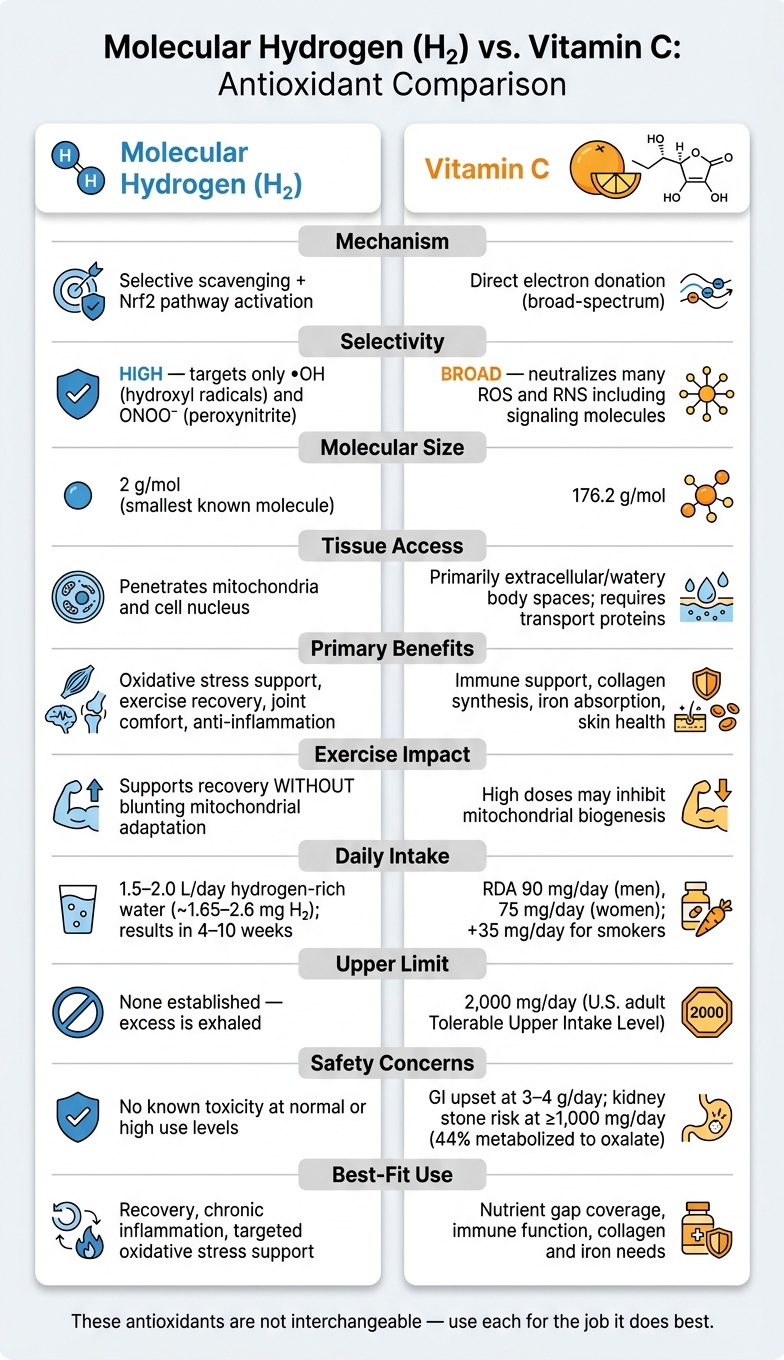
Molecular Hydrogen vs. Vitamin C: Antioxidant Comparison Chart
The practical difference comes down to how they work, where they can go in the body, and how much safety margin they leave you with.
Mechanism, Selectivity, and Tissue Access
The biggest split is mechanism and tissue access. H₂ is tiny and neutral, so it can move into cells and reach the mitochondria. Vitamin C depends on transporters and acts mostly in extracellular fluid.
Selectivity matters too. H₂ is selective, while vitamin C works more broadly. Molecular hydrogen targets the most damaging radicals, mainly hydroxyl radicals (•OH), but leaves useful signaling molecules like hydrogen peroxide alone. Vitamin C can neutralize both harmful and useful reactive oxygen species.
| Feature | Molecular Hydrogen (H₂) | Vitamin C |
|---|---|---|
| Mechanism | Selective scavenging + Nrf2 activation | Direct electron donation |
| Selectivity | High; targets •OH radicals | Broad-spectrum; non-selective |
| Molecular Size | 2 g/mol | 176.2 g/mol |
| Tissue Access | Mitochondria, nucleus | Primarily extracellular fluids |
That gap helps explain why these two antioxidants don’t always do the same job, even when they’re both used for oxidative stress support.
Evidence, Main Benefits, and Best-Fit Use Cases
Vitamin C has decades of nutrition research behind it. Its role in immune function, collagen synthesis, and iron absorption is well established. Molecular hydrogen is newer by comparison, though the research base is growing.
The split shows up in exercise recovery too. A 2021 study in 81 rats found that vitamin C supplementation lowered markers of mitochondrial biogenesis, while hydrogen inhalation did not. For people who care about training gains over time, that’s a big deal. Short-term recovery is one thing. Long-term adaptation is another.
| Feature | Molecular Hydrogen (H₂) | Vitamin C |
|---|---|---|
| Evidence Maturity | Emerging; growing clinical focus | Long-established; decades of research |
| Primary Benefits | Oxidative stress support, recovery, joint comfort | Immunity, collagen synthesis, iron absorption |
| Exercise Impact | Supports recovery; does not blunt adaptation | High doses may inhibit mitochondrial biogenesis |
| Best-Fit Use | Athletic recovery, chronic inflammation, oxidative stress support | Immune support, skin health, nutrient replacement |
This is where the comparison gets more practical. Vitamin C fits best when the goal is nutrient support. H₂ fits better when the focus is recovery, inflammation, or oxidative stress in places that are harder to reach.
Safety and Long-Term Considerations
Safety is one of the clearest differences.
Vitamin C has a defined upper limit. In the U.S., the Tolerable Upper Intake Level for adults is 2,000 mg/day, and higher intakes have been linked to GI distress and higher urinary oxalate. Molecular hydrogen has no established upper limit. Any extra is exhaled.
| Feature | Molecular Hydrogen (H₂) | Vitamin C |
|---|---|---|
| Safety | No known toxic effects even at high intake | Low toxicity; defined upper limits apply |
| Upper Limit | None established; excess is exhaled | 2,000 mg/day (U.S. adult UL) |
| Pro-oxidant Risk | None known | Possible at very high pharmacological doses |
That makes vitamin C more dose-sensitive, especially at the high end. H₂, by contrast, appears simpler from a long-term use standpoint because the body doesn’t store the excess.
Practical Takeaways and Conclusion
When to Use Vitamin C and When Molecular Hydrogen May Help
The simplest rule is this: fix nutrient gaps first, then add targeted oxidative-stress support if needed.
If your diet is low in fruits and vegetables, vitamin C should come first. It’s a dietary need, not just an optional add-on.
Molecular hydrogen is extra support, not a replacement for nutrients. It makes the most sense for people dealing with oxidative stress, recovery demands, or joint discomfort. For active people, H₂ may support recovery without blunting training adaptation. For joint comfort, clinical trials have shown that H₂ can improve joint comfort in inflammatory conditions.
You can also use both together. Vitamin C supports collagen, immune function, and iron absorption, while H₂ offers targeted support inside cells. Before making changes, talk to your healthcare provider, especially if you use high-dose vitamin C or have a history of kidney stones.
Key Points to Remember
Bottom line: use each antioxidant for the job it does best.
- Vitamin C is a dietary need that supports collagen, immunity, and iron absorption.
- Molecular hydrogen is selective, targeting only the most damaging radicals while leaving helpful signaling molecules intact.
- They reach different places: H₂ penetrates the mitochondria and nucleus, while vitamin C works mostly in extracellular fluid.
- Safety profiles differ: vitamin C has a defined upper limit and can cause GI distress or increase kidney stone risk at high doses; H₂ has no known toxicity.
- Let your goal guide the choice: nutrient support points to vitamin C; recovery, inflammation, and oxidative stress support point to H₂.
FAQs
Can I take vitamin C and molecular hydrogen together?
Yes. Vitamin C and molecular hydrogen can be taken together, and the research points to complementary effects, not a conflict between the two.
Vitamin C helps support the immune system, collagen production, and day-to-day health. Molecular hydrogen works a bit differently. It offers targeted antioxidant support by selectively neutralizing harmful free radicals.
Taken together, they can support oxidative stress and overall wellness. So if you're using Edenvia Molecular Hydrogen along with vitamin C, the two are generally seen as working side by side rather than against each other.
Who might benefit most from molecular hydrogen?
Molecular hydrogen may help people who want cell-level support for oxidative stress and inflammation. It may be especially useful for athletic recovery, including endurance, power output, and exercise-related muscle fatigue.
It may also help people dealing with chronic inflammation, joint discomfort, or metabolic concerns as part of their overall wellness goals.
How long does molecular hydrogen take to work?
Molecular hydrogen can act fast because its tiny molecular size lets it move into the body and pass across cell membranes with little delay.
After you drink hydrogen-rich water, peak blood levels are usually reached within 5 to 15 minutes. That means its effects may start almost right away.