

Molecular Hydrogen vs. Traditional Antioxidants
If I had to sum it up in one line: molecular hydrogen is more targeted, while vitamins, glutathione, NAC, and polyphenols work more broadly.
Here’s the short version in plain English:
- Molecular hydrogen (H2) appears to go after the most damaging reactive compounds, mainly hydroxyl radical and peroxynitrite
- It can move through cell membranes, reach mitochondria, and cross the blood-brain barrier
- Hydrogen-rich water (HRW) is often used for intake, and studies in the article point to about 1.5 to 2.0 liters per day, giving roughly 1.65 to 2.6 mg of H2
- Antioxidants like vitamin C, vitamin E, glutathione, NAC, and polyphenols work in a broader way and may also affect signaling molecules your body still needs
- High doses of some antioxidant supplements can cause GI issues or, in some cases, work against the body’s normal stress response
- The article’s main point is simple: H2 may fit daily oxidative stress support, while food-based antioxidants still matter for diet and nutrient intake
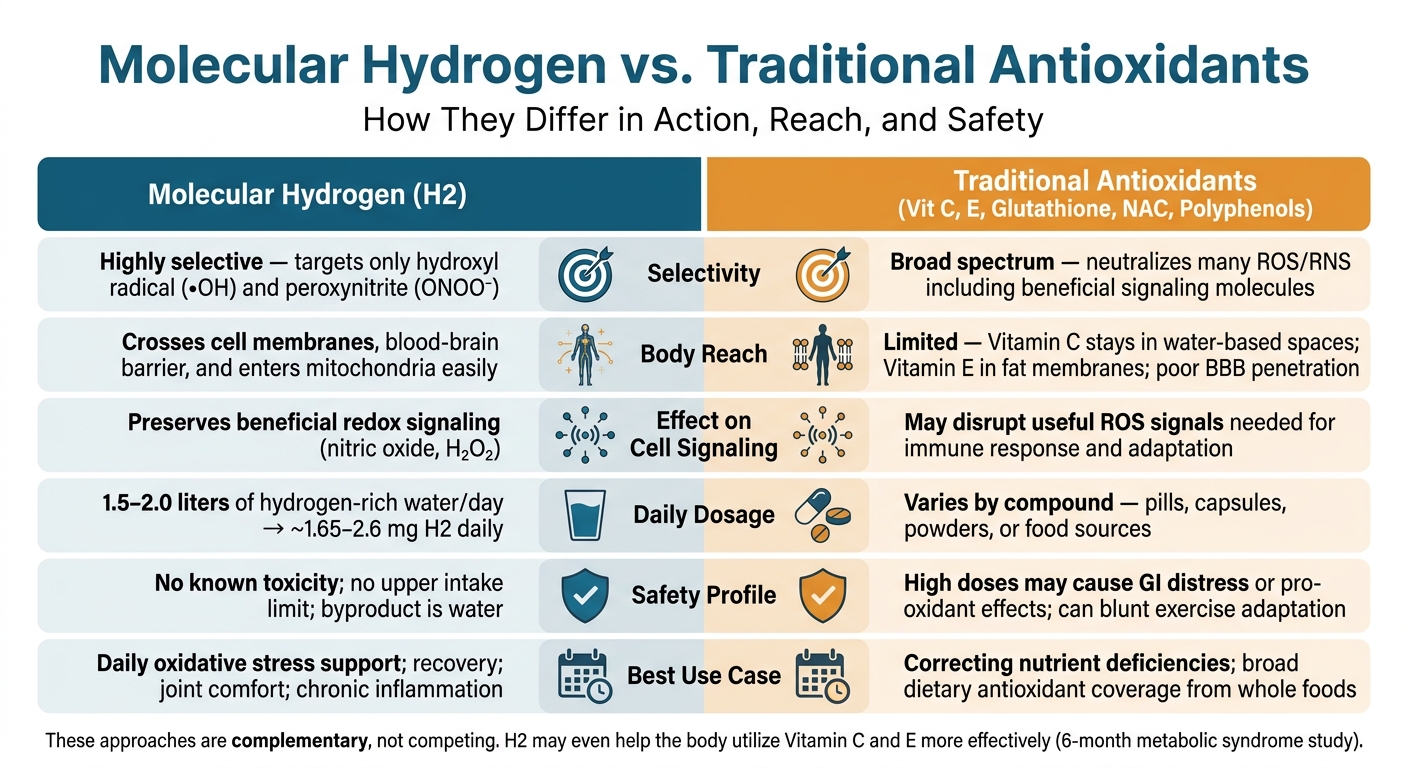
Molecular Hydrogen vs. Traditional Antioxidants: Key Differences at a Glance
Tyler LeBaron: Hydrogen Water, Mitochondrial Health, Selective Antioxidants, & Longevity | TUH #265
sbb-itb-6860cc4
Quick Comparison
| Criteria | Molecular Hydrogen (H2) | Vitamins / Glutathione / NAC / Polyphenols |
|---|---|---|
| Main action | More selective | Broad antioxidant action |
| Main targets | Hydroxyl radical, peroxynitrite | Many ROS/RNS |
| Reach in the body | Enters cells and mitochondria with ease | Depends on the compound |
| Effect on signaling | Less likely to affect normal redox signaling | May affect useful signaling too |
| Common forms | HRW, tablets, inhalation | Foods, pills, capsules, powders |
| Safety at studied doses | No known toxicity reported in the article | High doses may cause side effects |
My takeaway: if you want the simplest read, this is not an either-or choice. H2 looks like a focused option for oxidative stress support, while antioxidant-rich foods and basic nutrients still have a clear place.
How Molecular Hydrogen Works
Compared with regular antioxidants, H2 plays a different game. Its tiny size helps it move through the body fast, cross membranes with ease, and get into tissues without much trouble. Instead of reacting with a wide range of compounds, molecular hydrogen (H2) appears to focus on the most damaging radicals.
How H2 Selectively Targets Harmful Reactive Species
H2 selectively neutralizes the most damaging radicals, especially hydroxyl radical and peroxynitrite, while leaving helpful signaling molecules largely intact. That matters because not all reactive species are bad; some help the body send signals and keep normal processes running.
H2 may also activate Nrf2, a pathway tied to the body’s own antioxidant enzymes, including glutathione peroxidase, catalase, and superoxide dismutase (SOD). Its small size may help it reach the mitochondria and the nucleus more easily than larger antioxidant molecules. Put simply, H2 seems to pair selective action with deep reach, and that’s what sets it apart.
Hydrogen-Rich Water, Absorption, and Daily Use
One common way to take H2 is through hydrogen-rich water (HRW), which is water infused with dissolved H2 gas. Under standard conditions, H2 dissolves in water at about 1.6 mg/L (1.6 ppm). Edenvia Molecular Hydrogen offers tablets that dissolve in water to create hydrogen-rich water.
There’s one simple catch: drink HRW soon after you make it. The gas can escape over time.
In clinical research, people usually consumed 1.5 to 2.0 liters of HRW per day, which delivered about 1.65 to 2.6 mg of H2 daily. Research also suggests that smaller servings spaced across the day may work better than taking one large dose at once.
What Human Research and Safety Data Show
Human studies have reported improvements in lipid markers, antioxidant activity, inflammation, and recovery outcomes. H2 has also shown good tolerability and no known toxicity at the doses studied.
There’s also a long safety track record here. H2 has been used safely in deep-sea diving medicine for decades at much higher concentrations than the ones used in nutrition-focused products. That helps put the comparison in perspective before looking at antioxidants that act in a much broader way.
How Traditional Antioxidants Work
Compared with H2’s selective action, traditional antioxidants take a much broader route. They generally fit into three buckets: nutrient-based vitamins, compounds your body makes, and plant-derived antioxidants. And unlike H2, they usually act across the board instead of picking specific targets.
Common Antioxidants and What They Do
Vitamin C is water-soluble, so it works in fluid-filled areas like the cytoplasm and bloodstream. It neutralizes reactive oxygen species (ROS) by donating electrons directly. Vitamin E is fat-soluble, which means it works inside cell membranes. There, it helps stop the chain reaction of lipid peroxidation before it spreads.
These two also work as a team. Vitamin C is needed to recycle oxidized vitamin E back into its active form.
Glutathione plays two roles: it acts as a direct scavenger and also serves as a cofactor for antioxidant enzymes such as glutathione peroxidase. N-acetylcysteine (NAC) helps the body produce more glutathione, though its oral bioavailability is low. Polyphenols such as resveratrol and quercetin can neutralize radicals, bind metals, and may help cut down the formation of new radicals. Some polyphenols also activate the Nrf2 pathway, which helps regulate the body’s antioxidant enzymes.
That broad reach can help. But it comes with trade-offs.
Where Traditional Antioxidants Work Well and Where They Fall Short
Traditional antioxidants tend to work best when fixing deficiencies and in some acute settings. For chronic prevention, though, results have been less consistent, and clinical trials have often shown mixed outcomes.
A big reason is selectivity. Most traditional antioxidants neutralize free radicals broadly. They don’t do much sorting between harmful radicals and useful signaling molecules like nitric oxide and hydrogen peroxide, which the body uses for immune response and metabolic adaptation.
Reach inside the body is another limit. Vitamin C works mostly in water-based spaces. Vitamin E works in fat-rich membranes. CoQ10 has low bioavailability unless it uses special delivery methods. Larger molecules can also have trouble getting into the brain or reaching mitochondria, even though oxidative stress often begins there.
Molecular Hydrogen vs. Traditional Antioxidants: A Direct Comparison
Mechanism, Selectivity, and Tissue Reach: Side-by-Side
The biggest gap between these two options comes down to selectivity.
Traditional antioxidants like vitamins C and E are non-selective. That means they can neutralize harmful radicals, but they can also interfere with the ROS your body uses for cell signaling and immune response. H2 works differently. It selectively targets the most damaging radicals - hydroxyl radical and peroxynitrite - while leaving key signaling species alone.
H2 also has a reach advantage. It diffuses through cell membranes, crosses the blood-brain barrier, and gets into mitochondria fast without specialized transporters.
Here’s the direct comparison:
| Property | Traditional Antioxidants (Vit C, E) | Molecular Hydrogen (H2) |
|---|---|---|
| Mechanism | Direct electron donation; chain-breaking | Selective scavenging plus Nrf2 activation |
| Target Species | All ROS/RNS | Hydroxyl radical (•OH) and peroxynitrite (ONOO⁻) |
| Tissue Distribution | Limited; poor blood-brain barrier penetration | Rapid diffusion; crosses the BBB and cell membranes |
| Mitochondrial Access | Very limited | Excellent; enters mitochondria easily |
| Cell Signaling | Can disrupt beneficial redox signaling | Preserves and modulates signaling |
| Byproduct | May form secondary radicals | Water |
Safety, Practical Use, and Who May Benefit
H2 also stands apart on safety.
It has no known toxicity and no established upper intake limit, and its only byproduct is water. Traditional antioxidants, on the other hand, can cause gastrointestinal distress or even act as pro-oxidants at high doses. High-dose vitamin C may also blunt exercise adaptation by suppressing oxidative signals the body actually needs.
That matters for people who want support without overdoing it. H2 may be especially relevant for older adults, active adults, and people focused on joint comfort and mobility.
| Feature | Traditional Antioxidants | Molecular Hydrogen |
|---|---|---|
| Safety Margin | Risk of toxicity or pro-oxidant effects at high doses | Extremely high; no known toxicity or upper limit |
| Risk of Over-suppression | High; can blunt exercise-induced adaptations | Minimal; does not disturb normal ROS signaling |
| Dosing Practicality | Pills or capsules | Hydrogen-rich water, inhalation, or molecular hydrogen tablets |
| Side Effects | GI distress; pro-oxidant effects at high doses | None known |
How the Two Approaches Can Work Together
H2 and traditional antioxidants don’t do the same job. They act at different points in the oxidative stress pathway.
A simple way to think about it: H2 looks more like a daily base layer. It’s a selective, low-risk option for managing chronic oxidative stress across the body. Traditional antioxidants still matter too, especially when they come from whole foods in a nutrient-rich diet.
There’s also early evidence that the two may work well together. In a 6-month study of patients with metabolic syndrome, drinking hydrogen-rich water significantly increased serum levels of both vitamin E and vitamin C compared to baseline. That suggests H2 doesn’t compete with old-school antioxidants. It may help the body use them better.
The catch? Research on combinations is still limited. So the safest read for now is that H2 complements a nutrient-rich diet.
These differences set up the main takeaways below.
Conclusion: Key Differences and Practical Takeaways
What to Take Away From This Comparison
When oxidative stress affects recovery, comfort, and mobility, the main difference comes down to scope: H2 is targeted, while traditional antioxidants work more broadly.
Molecular hydrogen stands out for a few simple reasons. It is selective, it can reach deep tissues with ease, and it helps support the body’s own antioxidant defenses.
Traditional antioxidants play a different part. They still matter, especially when they come from a nutrient-rich diet.
For recovery, inflammation, and joint comfort, molecular hydrogen offers targeted redox support. Traditional antioxidants still have an important place for broad nutritional coverage. The practical move is not choosing one over the other. It’s matching the tool to the goal.
Edenvia Molecular Hydrogen tablets dissolve in water to make hydrogen-rich water for convenient daily use.
FAQs
Is molecular hydrogen better than antioxidants?
Molecular hydrogen (H₂) is often viewed as a more selective way to deal with oxidative stress than standard antioxidants. Instead of broadly reacting with many compounds, it appears to target the most damaging radicals, such as hydroxyl radicals, while leaving helpful signaling molecules alone.
It may also help the body support its own antioxidant systems by activating the Nrf2 pathway. And because H₂ is so small, it can move deep into cells, including the mitochondria and nucleus.
Can I use H2 with antioxidant-rich foods?
Yes. Molecular hydrogen (H2) can work alongside an antioxidant-rich diet by helping lower oxidative stress. It does this by selectively targeting harmful reactive oxygen species, such as hydroxyl radicals and peroxynitrite, without broadly interfering with the helpful ROS your cells need for normal function.
For best results, use your H2 routine with meals. For example, drink hydrogen-rich water soon after Edenvia tablets fully dissolve.
How soon should I drink hydrogen-rich water?
Drink hydrogen-rich water soon after it’s made. After the tablet fully dissolves - usually in 90 seconds to 3 minutes - try to drink it within 15 to 30 minutes to get the most out of it.
Hydrogen levels in the blood go up fast, often within about 5 to 15 minutes after drinking. If you wait too long, the effect may be lower.