

Molecular Hydrogen vs. NSAIDs for Joint Pain
When it comes to managing joint pain, you have two options: NSAIDs (like ibuprofen) for quick relief or molecular hydrogen for long-term support. NSAIDs reduce inflammation within 30–60 minutes but come with risks like gastrointestinal and cardiovascular issues. Molecular hydrogen, taken as hydrogen-rich water, works slower (2–4 weeks for noticeable effects) but targets oxidative stress at the cellular level without reported side effects.
Key Takeaways:
- NSAIDs: Fast pain relief but short-term and can cause side effects with prolonged use.
- Molecular Hydrogen: Slower but safer for ongoing joint health, reducing inflammation and oxidative stress.
Quick Comparison:
| Feature | Molecular Hydrogen (H₂) | NSAIDs (e.g., Ibuprofen) |
|---|---|---|
| Pain Relief Speed | 2–4 weeks | 30–60 minutes |
| Inflammation Support | Targets oxidative stress | Blocks COX enzymes |
| Safety | No reported side effects | GI, heart, kidney risks |
| Best Use Case | Chronic joint pain | Acute flare-ups |
For chronic pain, molecular hydrogen offers a safer, long-term approach, while NSAIDs are better for sudden flare-ups. A combined strategy might work best.
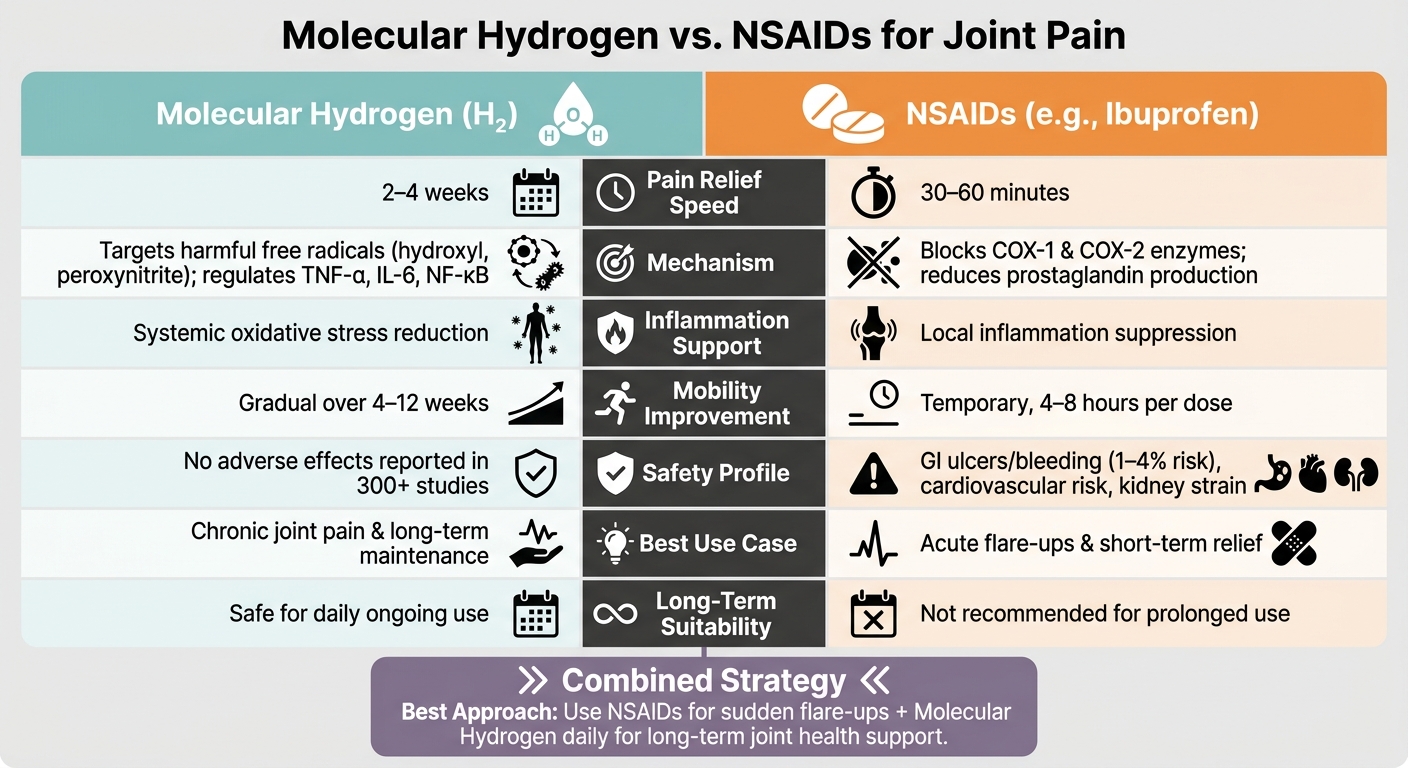
Molecular Hydrogen vs. NSAIDs for Joint Pain: Side-by-Side Comparison
Molecular Hydrogen for Joint Pain
What Is Molecular Hydrogen?
Molecular hydrogen (H₂) is a tiny molecule made up of just two hydrogen atoms bonded together. What makes it stand out is its selective antioxidant function. While most antioxidants neutralize all reactive oxygen species (ROS) indiscriminately, H₂ specifically targets the most harmful ones, like hydroxyl radicals (•OH) and peroxynitrite (ONOO⁻), leaving beneficial ROS untouched. Its small size also allows it to penetrate deep into cellular areas, including the nucleus and mitochondria, which many larger antioxidants can't reach.
"Molecular hydrogen's selective antioxidant action targets the hydroxyl radical, and its small size enables it to reach deep cellular compartments." - Medical Gas Research
These properties make molecular hydrogen a promising option for addressing joint inflammation.
How Molecular Hydrogen Supports Joint Health
Molecular hydrogen helps combat joint inflammation by addressing oxidative stress and inflammatory processes. Joint damage often results from a chain reaction of oxidative stress and inflammation. H₂ interrupts this chain by reducing inflammation through the regulation of cytokines like TNF-α and IL-6, and by suppressing NF-κB signaling.
In osteoarthritis, H₂ has been shown to restore mitochondrial function and slow down the aging of chondrocytes (cartilage cells). A clinical study on rheumatoid arthritis patients found that drinking hydrogen-rich water daily reduced urinary 8-OHdG, a key marker of oxidative stress, by 14.3% on average. Remarkably, all five early-stage rheumatoid arthritis patients in the study achieved remission.
Edenvia Molecular Hydrogen Tablets

Edenvia Molecular Hydrogen tablets make it simple to enjoy the benefits of hydrogen-rich water at home. To use, drop one tablet into a glass of cold or room-temperature water, wait 2–3 minutes for it to dissolve, and drink the water within 30 minutes to maximize its hydrogen content.
For joint health, Edenvia recommends using the tablets once or twice daily as part of a regular routine. Many users report improvements in joint comfort and mobility within 1–2 weeks, with the best results typically seen after 30 days of consistent use.
"After adding hydrogen water to my routine, I started noticing less discomfort within a couple weeks. I'm moving easier and waking up without that constant stiffness."
These tablets are third-party tested, free of stimulants and artificial additives, and any unabsorbed hydrogen naturally dissipates, ensuring a safe and effective experience.
sbb-itb-6860cc4
NSAIDs for Joint Pain
What Are NSAIDs?
Nonsteroidal anti-inflammatory drugs (NSAIDs) are among the most commonly used treatments for joint pain and inflammation. Popular options include ibuprofen (Advil, Motrin), naproxen (Aleve), aspirin, and diclofenac. These medications are available over the counter or in prescription strengths, depending on the dosage and form.
NSAIDs are widely relied upon for managing conditions like osteoarthritis, rheumatoid arthritis, and acute musculoskeletal pain. They’re known for their effectiveness, quick action, and accessibility.
How NSAIDs Work
To understand why NSAIDs are so effective, it helps to know how they work. These drugs block the enzymes COX-1 and COX-2, which play a key role in converting arachidonic acid into prostaglandins. Prostaglandins are signaling molecules that cause pain, swelling, and fever in affected joints.
"Inhibition of the COX-1 and COX-2 pathways reduces the expression of prostaglandin precursors; this, in turn, lessens the degree of cellular response to pathologic or physiologic stimuli." - StatPearls
By limiting prostaglandin production, NSAIDs reduce inflammation directly at its source. While pain relief often begins shortly after the first dose, achieving the full anti-inflammatory effect can take up to three weeks. Interestingly, ibuprofen inhibits COX-1 about 2.5 times more strongly than COX-2, which influences both its effectiveness and potential for side effects.
Common Uses of NSAIDs
This mechanism makes NSAIDs particularly effective for managing acute joint pain and swelling. For example, prescription-strength ibuprofen typically ranges from 1,800–2,400 mg per day, compared to the over-the-counter limit of 1,200 mg. However, NSAIDs are most effective when combined with non-drug approaches like physical therapy or weight management, as they address symptoms rather than the root causes of joint issues.
Patients should never adjust or stop their prescribed NSAID regimen without consulting their doctor. While NSAIDs provide quick relief for flare-ups, they are symptom-focused and don’t tackle the underlying causes that other treatments, such as molecular hydrogen, may target.
Effectiveness: Molecular Hydrogen vs. NSAIDs
Pain Relief and Symptom Management
When it comes to pain relief, NSAIDs are the go-to option for quick results. Over-the-counter medications like ibuprofen and naproxen can ease joint pain in as little as 30 to 60 minutes. This is because they work by blocking prostaglandin production, which rapidly reduces inflammation and pain. This makes them ideal for sudden pain flare-ups or injuries.
Molecular hydrogen, on the other hand, takes a more gradual approach. Users typically need to stick with daily use for 2 to 4 weeks before noticing significant relief. It works at a deeper level, targeting harmful free radicals and regulating inflammatory pathways. While slower to act, this method addresses chronic inflammation in a more systemic way.
Inflammation and Mobility Support
The way these two options handle inflammation and mobility also differs. Molecular hydrogen has shown promise in reducing systemic inflammation markers like C-Reactive Protein (CRP). For instance, a small study involving 20 rheumatoid arthritis patients found that 20% achieved remission after drinking hydrogen-rich water for four weeks. Improvements in mobility, such as grip strength and walking ability, tend to emerge gradually over a period of 4 to 12 weeks.
NSAIDs, while effective at quickly reducing inflammation, offer only short-term benefits, typically lasting between 4 and 8 hours per dose. They don’t address oxidative stress, which can lead to cartilage damage over time, limiting their long-term effectiveness for joint health.
"Hydrogen is likely to have multiple master regulators, which drive a diverse array of downstream regulators and achieve beneficial biological effects against oxidative stress, inflammation, apoptosis, and dysmetabolism." - Medical Gas Research
Comparison Table
Here’s a side-by-side look at how molecular hydrogen and NSAIDs stack up in terms of pain relief, inflammation control, and mobility support:
| Feature | Molecular Hydrogen (H₂) | NSAIDs (e.g., Ibuprofen, Naproxen) |
|---|---|---|
| Pain Relief Speed | Slow (2–4 weeks for initial effect) | Fast (30–60 minutes) |
| Inflammation Support | Targets harmful free radicals and regulates inflammatory pathways | Blocks COX-1/COX-2 enzyme activity locally |
| Mobility Improvement | Gradual improvement over 4–12 weeks | Temporary (4–8 hours per dose) |
| Safety Profile | No adverse effects reported in trials | Risks include gastrointestinal upset, cardiovascular issues, and kidney strain |
| Best-Fit Use Case | Chronic joint pain and long-term inflammation | Acute injuries and sudden pain flare-ups |
Side Effects and Safety
NSAID Side Effects
NSAIDs are effective at reducing inflammation, but their long-term use comes with notable risks. By blocking COX-1 and COX-2 enzymes, these drugs not only reduce inflammation but also suppress prostaglandins that protect the gastrointestinal tract, kidneys, and cardiovascular system.
For the gastrointestinal system, the risks include ulcers, bleeding, and even perforation. These issues affect about 1% of NSAID users within the first 3 to 6 months of use, increasing to 2% to 4% after a year. The FDA has explicitly warned:
"NSAIDs cause an increased risk of serious gastrointestinal (GI) adverse events including bleeding, ulceration, and perforation of the stomach or intestines, which can be fatal." - FDA Prescribing Information
Cardiovascular risks are another concern. NSAIDs reduce prostacyclin, a compound that helps prevent blood clots, potentially leading to a prothrombotic state. A Danish study found that people with a history of heart attack who used NSAIDs had a death rate of 20 per 100 person-years in the first year, compared to 12 per 100 person-years among non-users.
Here’s how some common NSAIDs compare in terms of risks:
| NSAID (Daily Dose) | GI Risk (RR) | Major Vascular Events (RR) | Heart Failure (RR) |
|---|---|---|---|
| Celecoxib / Etoricoxib | 1.81 | 1.37 | 2.28 |
| Diclofenac (150 mg) | 1.89 | 1.14 | 1.85 |
| Ibuprofen (2,400 mg) | 3.97 | 1.44 | 2.49 |
| Naproxen (1,000 mg) | 4.22 | 0.93 | 1.87 |
RR = Risk Ratio compared to placebo.
Kidney health is also at risk with NSAID use. These drugs reduce renal blood flow by inhibiting prostaglandins that regulate kidney circulation, posing a particular danger for individuals with preexisting kidney problems. Medical guidelines consistently recommend using the lowest effective dose for the shortest duration possible.
Safety of Molecular Hydrogen
Molecular hydrogen stands out with an exceptional safety profile. More than 300 research articles and numerous clinical trials report no toxic effects. This safety is largely due to its selective mechanism: hydrogen targets harmful free radicals like hydroxyl and peroxynitrite while leaving the reactive oxygen species needed for normal cellular functions untouched .
Even in extreme conditions, such as deep-sea divers using gas mixtures with over 75% hydrogen for extended periods, no adverse effects have been reported. As noted by Medical Gas Research:
"Hydrogen may also have undisclosed toxic effects, although none have been reported to date." - Medical Gas Research
Thanks to its small, uncharged molecular structure, hydrogen easily crosses cell membranes and the blood-brain barrier, reaching mitochondria directly. This allows it to support the body’s natural processes rather than interfere with them. For those managing chronic joint pain and concerned about the risks of long-term NSAID use, molecular hydrogen offers a safer alternative. Its ability to work harmoniously with the body makes it an appealing option for ongoing joint health management.
Using Molecular Hydrogen an Analgesic?
Long-Term Use and Daily Practicality
When selecting a remedy for joint pain, it’s important to consider not just immediate effects and safety but also how well it works over time and fits into daily routines.
Ongoing Use vs. Occasional Relief
NSAIDs are known for delivering quick, short-term relief, typically kicking in within 30 to 60 minutes. This makes them a go-to choice for sudden pain flares. However, they’re not designed for long-term use due to potential side effects, so they’re best taken in small doses for short periods.
On the other hand, molecular hydrogen works differently. It focuses on reducing oxidative stress over time. Many users report feeling less discomfort and stiffness within 7 to 10 days of daily use, with even better results noticeable after 2 to 4 weeks. One user shared:
"Improved my daily joint comfort and reduced my reliance on traditional pain medications." - Elijah S., Verified Buyer
These differences in how they work and how often they’re used can make one option more practical than the other, depending on your needs.
Fitting Each Option Into Daily Life
Both options are straightforward to use. NSAIDs are usually taken as a quick tablet, while molecular hydrogen comes in the form of dissolvable tablets. For optimal results with molecular hydrogen, dissolve the tablet in water and drink it within 30 minutes. Regular use is key to experiencing its full benefits.
For example, Edenvia Molecular Hydrogen tablets have been rated 4.9 out of 5 stars by over 12,674 reviewers. Many users highlight improvements in mobility and reduced stiffness as standout benefits. Unlike NSAIDs, molecular hydrogen doesn’t require periodic safety checks, making it a more hands-off option for regular use.
While NSAIDs are great for quick relief from acute pain, molecular hydrogen offers a more sustainable solution for long-term joint health. The table below breaks down which option works best for different scenarios.
Decision Table
| Situation | Better Option | Why |
|---|---|---|
| Sudden, acute joint pain flare | NSAIDs | Provides fast relief within 30–60 minutes |
| Daily joint maintenance and mobility | Molecular hydrogen | Safe for long-term use; addresses oxidative stress at the cellular level |
| Concern about GI or cardiovascular issues | Molecular hydrogen | No reported adverse effects |
| Acute post-injury inflammation | NSAIDs (short course) | Effective for temporary inflammation when used briefly and at low doses |
| Active lifestyle and recovery support | Molecular hydrogen | Shown to reduce muscle damage markers and soreness in clinical trials |
Conclusion: Which Option Is Right for Your Joint Pain?
Molecular hydrogen and NSAIDs play distinct roles when it comes to managing joint pain. NSAIDs are effective for quick relief during acute flare-ups, targeting pain and visible swelling. On the other hand, molecular hydrogen works at the cellular level, addressing oxidative stress to support long-term joint health.
A pilot study revealed that drinking hydrogen water reduced DAS28 scores from 3.83 to 3.02 within four weeks, with 100% remission in ACPA-negative early-stage RA patients.
"H2 may be useful to complement conventional RA therapy by reducing oxidative stress, especially in early stage and ACPA‑negative RA, to assist diagnosis and treatment decisions." - Medical Gas Research
This highlights how both approaches serve different but complementary purposes. Managing joint pain effectively often requires balancing immediate relief with strategies for long-term health.
For those dealing with chronic or inflammation-related joint pain, molecular hydrogen - such as Edenvia Molecular Hydrogen tablets - provides a safe, ongoing option without known toxicity. NSAIDs, meanwhile, remain a reliable choice for temporary relief during flare-ups. A combined approach of NSAIDs for short-term relief and molecular hydrogen for daily support could be an ideal strategy for joint pain management.
FAQs
Can I take hydrogen-rich water and NSAIDs together?
Yes, you can take hydrogen-rich water alongside NSAIDs, as no negative interactions have been documented. Hydrogen water, which contains molecular hydrogen, works as a selective antioxidant that may help lower oxidative stress and inflammation. This could potentially enhance the effects of NSAIDs in relieving joint pain. However, since NSAIDs can cause side effects like stomach irritation or kidney problems, it's always a good idea to check with your healthcare provider before using both together to ensure they're safe and effective for your situation.
How do I know if my joint pain is chronic or a flare-up?
Chronic joint pain can stick around for months or even years, often tied to conditions like arthritis. It typically comes with symptoms like persistent stiffness and swelling. On the other hand, a flare-up is a sudden increase in symptoms that can last anywhere from a few days to weeks. These episodes are often set off by factors like injury or overuse.
Keeping track of your symptoms and identifying potential triggers can be helpful. However, if the pain doesn’t improve or gets worse, it’s important to seek advice from a healthcare professional for a proper diagnosis.
Who should avoid NSAIDs for joint pain?
People who have experienced allergic reactions such as asthma attacks, hives, or other symptoms after taking aspirin or NSAIDs should avoid using them. Additionally, NSAIDs should not be taken before or after heart bypass surgery because they can lead to complications. Following these precautions is important to minimize the risk of serious side effects associated with NSAID use.