

Molecular Hydrogen vs Antioxidants: Mechanisms Explained
Here’s the short answer: molecular hydrogen (H₂) and antioxidants like vitamin C, vitamin E, and glutathione do not work the same way. H₂ appears to act more narrowly, with research tying it mainly to hydroxyl radicals and peroxynitrite, while standard antioxidants cover a broader set of reactive molecules.
If you want the plain-English version, it comes down to this:
- Standard antioxidants donate electrons and help buffer many oxidants
- H₂ appears to leave signaling molecules like hydrogen peroxide, superoxide, and nitric oxide mostly alone
- That matters because some reactive species help with cell signaling, exercise response, and immune function
- H₂ can also cross cell membranes and reach mitochondria and the brain with little resistance
- Standard antioxidants depend more on location, transport, and recycling systems like glutathione regeneration and NADPH
A key point many people miss: oxidative stress is not just “bad molecules vs good molecules.” Your cells still use some reactive oxygen and nitrogen species at low levels. So the goal is not to wipe them all out. It’s to cut damage without shutting down signals your body still needs.
What this means for you: if broad antioxidant support is one side of the equation, H₂ is framed as a more selective option. That’s the main contrast in this article.
Molecular Hydrogen - Is It the Best Antioxidant You Can Take? – Interview With Tyler LeBaron
sbb-itb-6860cc4
Quick Comparison
| Criteria | Molecular Hydrogen (H₂) | Vitamin C / Vitamin E / Glutathione |
|---|---|---|
| Main action | Narrow reaction pattern + cell signaling effects | Broad electron donation and enzyme support |
| Main targets | Hydroxyl radicals, peroxynitrite | Many ROS/RNS, including lipid radicals and peroxides |
| Effect on signaling ROS | Often described as sparing them | Can lower them, especially at high intakes |
| Cell access | Diffuses through membranes | More compartment-limited |
| Mitochondria | Reaches them with ease | Access depends on molecule and transport |
| Recycling need | Not based on the usual redox recycling loop | Often depends on glutathione, NADPH, and related enzymes |
So when I compare molecular hydrogen with antioxidants, I’m not asking which one is “stronger.” I’m asking a better question: what does each one target, where does it work, and what cell signals does it leave intact?
How Traditional Antioxidants Work
Traditional antioxidants work in a more direct way. They neutralize reactive molecules themselves or help enzymes break them down. And they don't work alone. They function more like a linked system than a set of separate shields.
Direct Scavenging by Vitamin C, Vitamin E, and Glutathione
These antioxidants work in different parts of the cell. That's why they pair well together.
Vitamin C (ascorbic acid) is water-soluble, so it works in plasma and the cytosol. It gives up electrons to neutralize reactive species like hydroxyl and peroxyl radicals.
Vitamin E (α-tocopherol) is fat-soluble. It sits in cell membranes and lipoproteins, where it donates a hydrogen atom to lipid peroxyl radicals. That step stops the chain reaction of lipid peroxidation before it spreads through the membrane.
Glutathione (GSH) also works in the aqueous phase. It scavenges radicals in the cytosol and mitochondria and also helps detoxifying enzymes do their job. Since cells can regenerate it, glutathione stays at the center of this antioxidant network.
Enzyme Systems That Neutralize Superoxide and Peroxides
Enzymes add another layer of defense through a relay-style process.
Superoxide dismutase (SOD) converts superoxide, a reactive byproduct of normal metabolism, into hydrogen peroxide. Catalase then breaks hydrogen peroxide into water and oxygen in peroxisomes. Glutathione peroxidase (GPx), a selenium-dependent enzyme family, reduces hydrogen peroxide and lipid hydroperoxides in the cytosol and membranes, using glutathione as its electron source.
Glutathione reductase uses NADPH to turn oxidized glutathione (GSSG) back into active GSH. That keeps the enzyme system supplied and working.
The Limits of Broad Antioxidant Activity
The main limit of these antioxidants is simple: they don't sort harmful reactive species from useful ones. At normal physiological levels, molecules such as hydrogen peroxide also act as signaling agents. They help regulate cell growth, immune activity, gene expression, and adaptive stress resistance. So when broad scavenging happens at high doses, those signals can get disrupted.
There are also absorption and distribution limits. Vitamin C reaches saturation at higher doses, vitamin E depends on fat transport, and glutathione has to be produced inside each cell.
That leads to the key contrast: molecular hydrogen seems to act with more selectivity than broad antioxidant systems.
How Molecular Hydrogen Works
Molecular hydrogen works in a different way than nutrient antioxidants. It’s a tiny, fast-moving gas. Because H₂ is small, neutral, and nonpolar, it can pass through membranes without needing transporters. That means it can get to cells, mitochondria, and the brain fast.
Selective Reactions With the Most Damaging Reactive Species
Instead of reacting with a broad range of oxidants, H₂ is linked again and again with a narrow group of highly reactive species, especially hydroxyl radicals (•OH) and peroxynitrite (ONOO⁻).
That matters because hydroxyl radicals are among the most destructive reactive oxygen species the body makes, and they have no known useful signaling role. Peroxynitrite forms when superoxide reacts with nitric oxide, and it can drive protein nitration, lipid peroxidation, and DNA damage.
Just as important, H₂ shows little to no reactivity toward hydrogen peroxide (H₂O₂), superoxide (O₂•⁻), or nitric oxide (NO•). Those molecules help run normal cell signaling. So when H₂ leaves them mostly alone, that’s one of its main mechanistic upsides.
Effects on Nrf2, Mitochondria, and Inflammatory Signaling
H₂ may do more than direct scavenging. It may also shift redox signaling inside the cell. Research suggests H₂ may activate Nrf2–Keap1, which can increase protective enzymes such as HO-1. In plain English, it may help the cell switch on more of its own defense tools.
In mitochondria, H₂ has been reported to help maintain membrane potential, support ATP production under stress, and limit oxidative damage to mitochondrial DNA and respiratory chain parts. Since mitochondria are one of the main places where reactive oxygen species are made, that kind of support is a big deal.
H₂ also affects inflammatory signaling. Research shows it can inhibit NF-κB activation and modulate upstream kinases such as ERK, p38, and JNK. Those shifts may help dial down inflammatory signaling rather than letting it spiral.
Hydrogen-Rich Water and Edenvia Molecular Hydrogen
One common way to deliver H₂ is through hydrogen-rich water. After ingestion, H₂ is absorbed through the gastrointestinal tract, carried through the bloodstream, and later exhaled through the lungs after exerting its effects.
Tissue levels rise for a short time after ingestion. But because H₂ diffuses so fast, even those brief increases may still trigger its antioxidant and signal-modulating actions.
Edenvia Molecular Hydrogen tablets dissolve in water to create hydrogen-rich water for this delivery method.
Molecular Hydrogen vs Traditional Antioxidants: Key Mechanism Differences
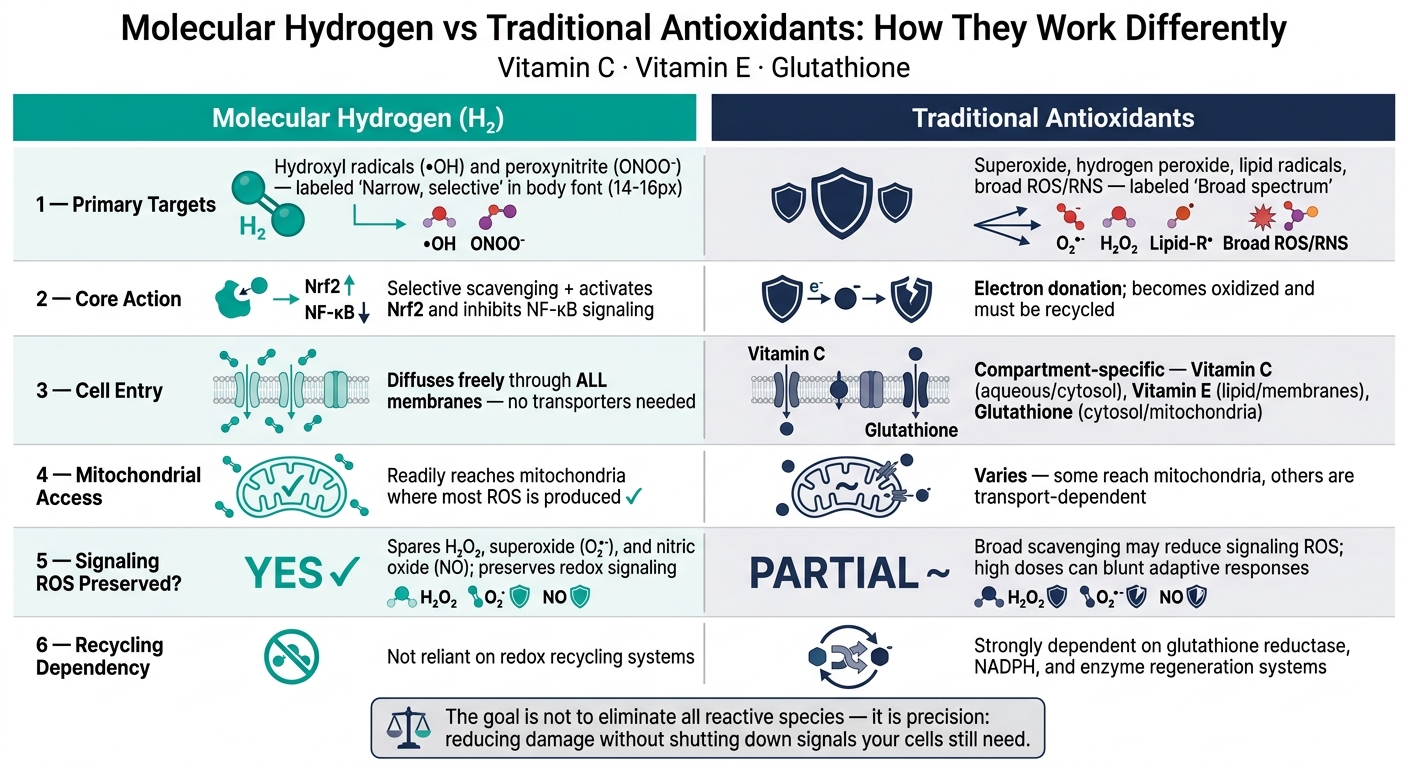
Molecular Hydrogen vs Traditional Antioxidants: Mechanism Comparison
The main difference isn't whether these compounds lower oxidative stress. It's how they do it, and how selective that action is.
Target Specificity and Preservation of Redox Signaling
The biggest gap between H₂ and standard antioxidants comes down to what they actually go after. That matters because broad antioxidant activity, especially at high doses, can also dampen redox signals that cells use for normal function.
Low levels of ROS aren't always the bad guys. Molecules like hydrogen peroxide (H₂O₂), superoxide (O₂•⁻), and nitric oxide (NO) act as controlled messengers. They help cells communicate, adjust to stress, and regulate immune responses. So when conventional antioxidants sweep too broadly, they can blunt those adaptive signals.
H₂ works differently. It appears to focus mainly on hydroxyl radicals and peroxynitrite, which are among the most cytotoxic species, while leaving H₂O₂, superoxide, and NO largely alone. That's why researchers describe it as selective. It lowers damage without broadly shutting down normal redox signaling.
And selectivity is only part of the story. The other part is simple: can the compound get where it needs to go?
Cellular Reach, Recycling Needs, and Speed of Action
Traditional antioxidants are limited by location and by their need for regeneration. They tend to work in certain compartments, and their activity outside those areas depends on transport or recycling systems.
H₂ doesn't run into those same limits. It's a small, neutral gas, so it diffuses across cell membranes, mitochondrial membranes, and other lipid structures without needing transporters. That means it can move into mitochondria - where much of ROS production happens during normal respiration - fast and evenly. Bigger molecules, or ones whose movement depends on polarity, don't have that same kind of access.
There's another split here. Traditional antioxidants rely on recycling systems, and those systems can get strained during sustained oxidative stress. H₂ doesn't follow that same pattern. Its effects are tied to selective direct reactions and downstream signaling modulation, not repeated oxidation-reduction cycling.
That creates a clear trade-off: broad buffering on one side, and selective, membrane-spanning action on the other.
What the Mechanistic Trade-Offs Mean in Practice
Each approach brings something different to the table. H₂ is more selective, while standard antioxidants offer broader buffering across a range of reactive species.
Conventional antioxidants have well-known nutritional roles, clear deficiency syndromes, and deep ties to the body's enzymatic systems. In plain English, they provide broad substrate-level support. The downside is that broad scavenging at high doses may suppress signaling ROS and put extra pressure on recycling systems when oxidative stress is heavy.
H₂ takes a different route. It offers selective, signaling-aware modulation by targeting the most damaging radicals while also nudging the cell's own defenses upward through Nrf2 and related pathways. But it leans heavily on that selectivity and on downstream signaling effects rather than mass scavenging.
| Aspect | Molecular Hydrogen (H₂) | Traditional Antioxidants (e.g., Vitamin C, Vitamin E, Glutathione) |
|---|---|---|
| Primary targets | Hydroxyl radicals (•OH) and peroxynitrite (ONOO⁻) | Superoxide, hydrogen peroxide, lipid radicals, broad ROS/RNS |
| Core action | Selective scavenging + indirect signaling modulation (Nrf2, NF‑κB) | Stoichiometric electron donation; becomes oxidized and requires recycling |
| Cell entry | Rapid diffusion across all membranes; no transporters needed | Compartment-specific: vitamin C (aqueous), vitamin E (lipid), glutathione (cytosolic/mitochondrial) |
| Mitochondrial access | Readily reaches mitochondria where much of ROS production occurs | Varies; some reach mitochondria, others are limited or transport-dependent |
| Signaling impact | Spares H₂O₂, superoxide, and NO; preserves physiological redox signaling | Broad scavenging may reduce signaling ROS; high doses can blunt adaptive responses |
| Recycling needs | Not reliant on classic redox recycling; effects tied to selectivity and signaling | Strongly dependent on regeneration systems (glutathione, NADPH, reductases) |
Conclusion: What This Means for Cellular Health and Healthy Aging
The main difference comes down to selectivity. Standard antioxidants tend to offer broad protection. Molecular hydrogen, by contrast, appears to target the most damaging reactive species more narrowly. That matters because selectivity affects how cells hold on to normal redox signaling.
By acting on hydroxyl radicals and peroxynitrite while leaving signaling-related species mostly alone, H₂ works with the cell’s communication systems instead of getting in their way. Its support for Nrf2 - a key regulator of antioxidant and cytoprotective genes - also suggests that it may help strengthen the cell’s own defense systems. That point becomes more relevant with age, as mitochondrial function drops and inflammation tends to climb.
Those cell-level effects help explain why H₂ may matter beyond basic antioxidant support. In day-to-day terms, that could relate to recovery, mobility, and energy. Human studies point to possible effects on oxidative stress and inflammatory markers, though the findings are still mixed.
In plain English, this comparison is about balance, not wiping everything out.
Key Takeaways From the Comparison
The big takeaways here are pretty simple. Oxidative stress is a balancing act. Some reactive species help cells send signals, so the goal isn’t total removal. It’s precision. The body’s own defense systems - SOD, catalase, glutathione peroxidase, and the Nrf2 pathway - are still the base of long-term cellular health, and no supplement can take their place.
Molecular hydrogen stands out because it selectively reduces the most cytotoxic species while supporting the body's own defenses from within. Edenvia Molecular Hydrogen tablets dissolve in water to create hydrogen-rich water, which gives people a simple way to take molecular hydrogen in water. Like any supplement, it makes the most sense when paired with the basics: a nutrient-rich diet, regular movement, good sleep, and steady stress management.
FAQs
Can molecular hydrogen replace antioxidants?
Molecular hydrogen isn’t a direct swap for standard antioxidants. It works differently.
Instead, it acts as a selective antioxidant that helps support the body’s own defense systems. That matters because, unlike many antioxidants, it doesn’t just wipe out everything in its path.
It targets harmful radicals like hydroxyl radicals and peroxynitrite while leaving important cellular signaling molecules alone. On top of that, it activates the Nrf2 pathway, which helps the body make its own antioxidants, including glutathione and superoxide dismutase.
Why is selectivity important in oxidative stress?
Selectivity matters because not all reactive oxygen species (ROS) are bad. Some, like hydroxyl radicals and peroxynitrite, can damage cells. Others, such as hydrogen peroxide and nitric oxide, help with immune function, cell signaling, and blood vessel dilation.
That’s why molecular hydrogen stands out. It can target the more damaging radicals while leaving the helpful ROS alone, which may help lower oxidative damage without interfering with normal cell function.
How long does hydrogen-rich water stay active in the body?
After dissolving an Edenvia molecular hydrogen tablet in water, drink it within 15 to 30 minutes to get the full benefit. Molecular hydrogen dissipates fast because it’s extremely small and can escape soon after it forms.
So the best move is simple: drink it soon after mixing. That helps you get a full, potent dose before the hydrogen drifts into the air.