

How Molecular Hydrogen Reduces Oxidative Stress
Molecular hydrogen (H₂) is a small, naturally occurring molecule that can help reduce oxidative stress by targeting harmful reactive oxygen species (ROS) like hydroxyl radicals (•OH) and peroxynitrite (ONOO−). Unlike traditional antioxidants, H₂ works selectively, neutralizing damaging radicals while preserving beneficial ROS needed for essential cellular functions. Its small size allows it to penetrate deep into cells, including mitochondria and the nucleus, where oxidative damage is most severe.
Key takeaways:
- Selective action: Neutralizes harmful radicals without disrupting beneficial ROS.
- Cellular protection: Reaches mitochondria and DNA to prevent damage.
- Enhances natural defenses: Activates the Nrf2 pathway, boosting production of antioxidants like glutathione.
- Supports recovery: Reduces inflammation, joint pain, and promotes cellular health.
H₂ is available in forms like hydrogen-rich water or inhalation therapy and has shown promise in improving conditions like Parkinson’s disease, reducing inflammation, and slowing cellular aging. Edenvia Molecular Hydrogen Tablets are one way to incorporate H₂ into your routine, offering high concentrations of hydrogen for daily use.
Molecular Hydrogen Benefits, Oxidative Stress and Autophagy - Tyler LeBaron
sbb-itb-6860cc4
How Molecular Hydrogen Reduces Oxidative Stress
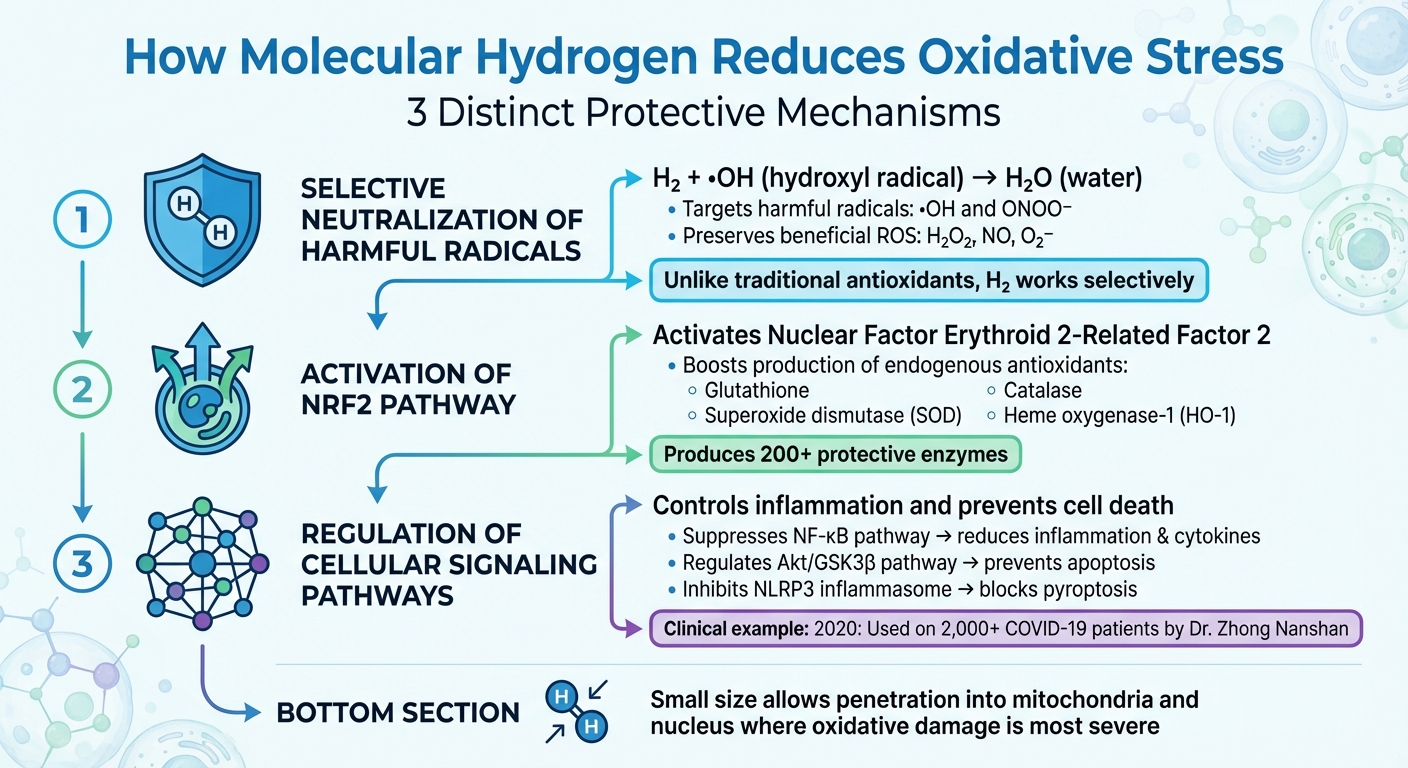
How Molecular Hydrogen Reduces Oxidative Stress: 3 Key Mechanisms
Molecular hydrogen (H2) combats oxidative stress by targeting free radicals in three distinct ways, offering protection to cells from oxidative damage.
Selective Neutralization of Harmful Radicals
H2 has a unique ability to react with harmful radicals, such as hydroxyl radicals (•OH), to form water. This selective neutralization spares beneficial reactive oxygen species (ROS) like hydrogen peroxide and nitric oxide, which are essential for processes like immune function, blood vessel dilation, and cell signaling.
"H2 selectively reduced the hydroxyl radical, the most cytotoxic of reactive oxygen species (ROS), and effectively protected cells; however, H2 did not react with other ROS, which possess physiological roles." - Shigeo Ohta, PhD, Department of Biochemistry and Cell Biology, Nippon Medical School
Unlike traditional antioxidants, which often neutralize both harmful and beneficial molecules, H2’s targeted action helps maintain normal cellular processes while reducing oxidative damage. This precise mechanism also enhances the body’s own defense systems.
Activation of the Nrf2 Pathway
H2 doesn’t just neutralize harmful radicals - it also activates the Nrf2 (nuclear factor erythroid 2-related factor 2) pathway, a key player in the body’s antioxidant defense. When Nrf2 is activated, it boosts the production of important endogenous antioxidants such as glutathione, superoxide dismutase (SOD), and catalase.
The importance of this pathway is evident in studies on Nrf2-knockout mice. In these cases, inhaling H2 gas failed to trigger the production of heme oxygenase-1 (HO-1) and offered no protection against hyperoxic lung injury. This highlights that the Nrf2 pathway is essential for H2’s protective effects, rather than being a secondary benefit.
Regulation of Cellular Signaling Pathways
H2 also influences key cellular pathways to manage inflammation and prevent cell death. It suppresses the NF-κB pathway, which is responsible for inflammation and cytokine production, while regulating the Akt/GSK3β pathway to prevent apoptosis (premature cell death). Additionally, H2 inhibits the NLRP3 inflammasome, which helps block pyroptosis, a form of inflammatory cell death.
This regulatory ability has had real-world success. In 2020, Dr. Zhong Nanshan used H2/O2 inhalation therapy on over 2,000 COVID-19 patients. The therapy reduced oxidative stress and cytokine storms, leading to improved clinical outcomes. This example illustrates how H2’s impact on multiple signaling pathways can address complex inflammatory conditions.
"Molecular hydrogen selectively scavenges hydroxyl radicals and peroxy-nitric radicals that are responsible for oxidative stress and disease process, while sparing other reactive oxygen species such as hydrogen peroxide, superoxide and nitric oxide that are critical to normal cell physiology." - Dinesh Ramanathan, Department of Neurosurgery, Loma Linda University
Health Benefits of Molecular Hydrogen
Molecular hydrogen (H₂) offers a range of health perks by targeting oxidative stress directly at its root. This approach not only reduces oxidative damage but also helps with chronic inflammation, joint pain, and cellular aging. By addressing these issues, H₂ supports better mobility and overall wellness.
Reducing Inflammation and Joint Pain
H₂ works by neutralizing harmful free radicals, which helps ease joint pain and reduce chronic inflammation. Specifically, it lowers the release of key pro-inflammatory cytokines like TNF-α, IL-6, and IL-1β - major culprits behind inflammation and discomfort. It also promotes a shift in macrophages from the M1 (inflammatory) state to the M2 (repair) state, aiding the body’s natural recovery processes.
Additionally, H₂ boosts mitochondrial efficiency and ATP production, which is essential for energy and cellular function.
One clinical pilot study conducted in Japan tested the effects of drinking 1 liter of hydrogen-rich water daily for 48 weeks in Parkinson's disease patients already taking levodopa. The results were promising: the treatment group showed significant improvement on the unified Parkinson's disease rating scale compared to the placebo group, indicating better mobility and symptom relief. Dr. Matthew Antonucci from the Carrick Institute highlighted the synergy between therapies, stating, "Use H₂ to restore redox balance, then use HBOT to push oxygen into tissues".
Supporting Cellular Recovery and Longevity
H₂ also plays a role in long-term cellular health, helping to slow aging and support recovery. It inhibits the Akt/GSK3β pathway, which helps prevent apoptosis (cell death), and preserves crucial antioxidants like SOD and catalase that protect cells from damage.
In a randomized controlled pilot trial, elderly participants who drank hydrogen-rich water for six months experienced a 4% increase in their mean telomere length - a marker of cellular aging - and improved DNA methylation. These findings suggest that H₂ can positively impact aging at the cellular level.
Hydrogen has been approved as safe by the FDA, making it suitable for daily use. Therapeutic hydrogen-rich water usually contains concentrations between 0.5 and 1.6 ppm, making it an accessible option for managing chronic pain, supporting recovery, and enhancing overall cellular health. These benefits highlight molecular hydrogen’s role in managing oxidative stress and promoting everyday wellness.
How to Use Molecular Hydrogen
Incorporating molecular hydrogen into your daily routine is simple and can help enhance its antioxidant properties while addressing oxidative stress.
Using Edenvia Molecular Hydrogen Tablets

Start by filling an 8–16 oz glass or bottle with clean, room-temperature water. Drop one Edenvia tablet into the water and wait for it to fully dissolve - this usually takes 90 seconds to 3 minutes. Once dissolved, drink the water within 15–30 minutes to get the most out of its benefits [10, 11, 12]. It's important to let the tablet dissolve completely before drinking; never swallow it directly [10, 11].
Edenvia tablets stand out because they can generate up to 12 ppm of hydrogen concentration, far exceeding the 0.5–1.6 ppm found in most pre-bottled hydrogen water. This method ensures you're maximizing the molecular hydrogen vs traditional antioxidants potential, which plays a role in reducing oxidative stress.
For general wellness and antioxidant support, use 1–2 tablets daily. If you're dealing with chronic inflammation, joint discomfort, or have an active lifestyle, you can take up to 3 tablets a day, spacing them throughout the day. Drinking hydrogen water on an empty stomach, especially within 30 minutes of waking, can improve absorption. Stick to room-temperature water, as hot or boiling water allows the hydrogen gas to escape too quickly.
Once you’ve mastered the routine, the next step is to explore Edenvia's pricing plans to find the best fit for your goals.
Edenvia Molecular Hydrogen Pricing and Plans
Edenvia offers flexible pricing options to help you seamlessly integrate molecular hydrogen into your lifestyle. Their Buy 1 Get 1 Free plan is a customer favorite, priced at $16.98 per bottle and includes a complimentary Cellular Recovery Protocol. For the best overall value, the Buy 2 Get 2 Free plan brings the cost down to $12.76 per bottle, along with the Cellular Recovery Protocol and free express shipping.
Pricing Comparison Table
| Plan | Price per Bottle | Key Benefits |
|---|---|---|
| Buy One | $33.95 | Single purchase, no commitment |
| Buy 1 Get 1 Free | $16.98 | Popular choice, includes Cellular Recovery Protocol |
| Buy 2 Get 2 Free | $12.76 | Best value, includes Cellular Recovery Protocol + free express shipping |
All plans come with a 30-day money-back guarantee, giving you the chance to experience the benefits of molecular hydrogen without any risk.
Conclusion
Molecular hydrogen offers a powerful way to combat oxidative stress by targeting harmful radicals, activating the Nrf2 antioxidant pathway, and penetrating deep into cells to protect critical structures. It works by selectively neutralizing harmful radicals while preserving beneficial reactive oxygen species (ROS) that are essential for normal cellular signaling. Additionally, it activates the Nrf2 pathway, which promotes the production of over 200 protective enzymes like superoxide dismutase and catalase. Its ability to penetrate cell membranes allows it to reach areas like the mitochondria and nucleus, where oxidative damage is often most severe. This multi-faceted approach highlights molecular hydrogen's role in protecting cells at a foundational level.
"Molecular hydrogen (H2), due to its unique physical and chemical properties, provides a number of benefits for alleviating oxidative stress. H2 is superior to conventional antioxidants as it can selectively reduce •OH radicals while preserving important ROS that are otherwise used for normal cell signaling."
– Ján Slezák, Institute for Heart Research, Slovak Academy of Sciences
The research surrounding molecular hydrogen is extensive, with more than 1,800 scientific publications and over 80 human clinical studies exploring its medical applications. In 2017, hydrogen gas inhalation was even approved by the Japanese government as an advanced medical treatment for post-cardiac arrest syndrome. This level of scientific validation underscores its potential for reducing inflammation, aiding cellular recovery, and supporting long-term health. Incorporating molecular hydrogen into a daily routine is a practical way to invest in overall well-being.
For those looking to make molecular hydrogen part of their daily lives, Edenvia Molecular Hydrogen offers a convenient and reliable option. Their tablets are designed to deliver therapeutic levels of hydrogen, producing up to 12 ppm of hydrogen concentration per dose. With flexible pricing, a 30-day money-back guarantee, and third-party lab testing, Edenvia ensures both quality and peace of mind.
Whether you're addressing chronic inflammation, staying active, or seeking everyday protection from oxidative stress, molecular hydrogen provides a safe, non-toxic, and effective solution for supporting cellular health.
FAQs
How is molecular hydrogen different from typical antioxidants?
Molecular hydrogen differs from standard antioxidants because of its precise and selective behavior. It focuses on neutralizing harmful reactive oxygen species (ROS), such as hydroxyl radicals, while sparing beneficial ROS that are crucial for essential cellular activities. This targeted action effectively lowers oxidative stress without interfering with necessary physiological processes, offering a safer and more focused antioxidant solution.
How does H₂ activate Nrf2 and boost my body's own antioxidants?
H₂ works by releasing Nrf2 from its bond with Keap1. Once freed, Nrf2 moves into the nucleus, where it triggers the production of antioxidant genes. This process boosts the body's natural ability to defend against oxidative stress.
How quickly can hydrogen-rich water affect inflammation or joint discomfort?
Hydrogen-rich water has the potential to ease inflammation or joint discomfort in a fairly short time. This is because molecular hydrogen interacts quickly with free radicals, which helps lower oxidative stress - a major contributor to inflammation. That said, the exact timing of relief can differ and isn't clearly specified.