

Molecular Hydrogen for Mitochondrial Health
If you want the short answer: each option helps mitochondria in a different way, and molecular hydrogen is mainly about lowering oxidative stress without shutting down normal cell signaling.
I’d sum the article up like this:
- Molecular hydrogen (H2) may help with oxidative stress, lactate control, and short-term recovery support.
- Exercise is still the main driver of making more mitochondria and improving how they work.
- CoQ10 supports the electron transport chain and may fit best for low-energy states tied to aging or low CoQ10 status.
- NAD+ support is more about repair signaling and sirtuin activity.
- PQQ is more about mitochondrial turnover, including biogenesis and mitophagy.
The article compares these five options by mechanism, human data, dosing, and ease of use. It also points out a key trade-off: some tools help build mitochondrial capacity, while others help limit damage when stress is high.
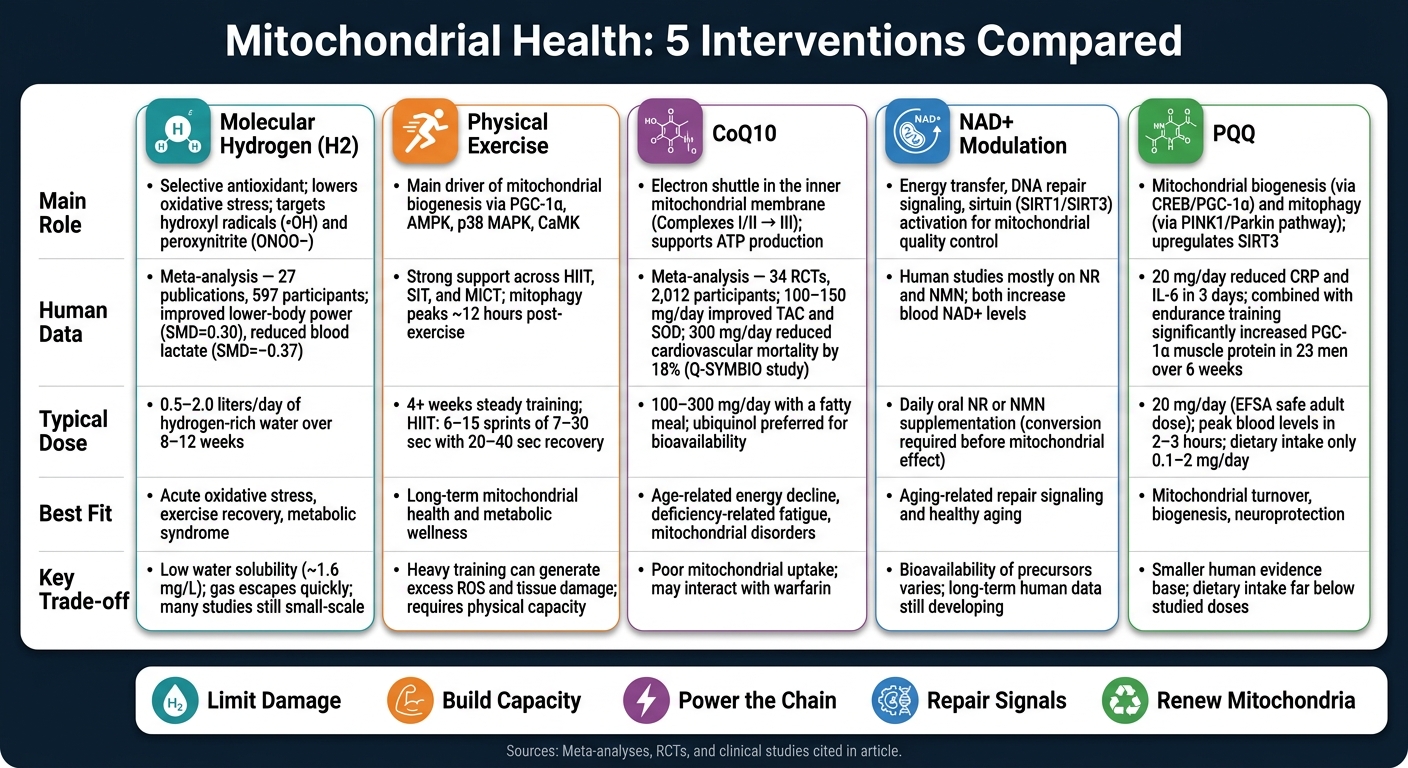
Molecular Hydrogen vs. Exercise vs. CoQ10 vs. NAD+ vs. PQQ: Mitochondrial Health Comparison
Tyler LeBaron: Hydrogen Water, Mitochondrial Health, Selective Antioxidants, & Longevity | TUH #265
sbb-itb-6860cc4
Quick Comparison
| Option | Main role | Human data snapshot | Typical use pattern | Best fit |
|---|---|---|---|---|
| Molecular Hydrogen | Lowers oxidative stress; supports redox balance | Meta-analysis: 27 publications, 597 people; lower-body power and lactate improved | 0.5 to 2.0 liters/day of hydrogen-rich water | Recovery, oxidative stress, metabolic strain |
| Exercise | Builds mitochondrial capacity | Strong human support across HIIT, SIT, and steady training | At least 4 weeks of steady training | Long-term mitochondrial health |
| CoQ10 | Supports electron transport chain | Meta-analysis: 34 RCTs, 2,012 people | 100 to 300 mg/day, often with food | Energy support, aging, deficiency-related fatigue |
| NAD+ Modulation | Supports repair signaling | Human work mostly on NR and NMN | Daily precursor use | Aging-related repair support |
| PQQ | Supports biogenesis and mitophagy | Early human data; 20 mg/day used in studies | Daily dosing | Mitochondrial turnover |
Bottom line: if the main problem is acute oxidative stress, H2 makes the most sense. If the goal is long-term mitochondrial growth and function, exercise stays at the center. The other tools fit around those goals based on what you’re trying to fix.
1. Edenvia Molecular Hydrogen

Edenvia Molecular Hydrogen tablets dissolve in water to make hydrogen-rich water (HRW). H2 is small enough to pass through cell membranes and reach mitochondria. It also works as a selective antioxidant. The main question is simple: do those chemical actions lead to measurable support for mitochondrial function?
Mitochondrial Mechanisms
H2 supports the Keap1-Nrf2 defense system and mitochondrial biogenesis. In plain English, that means it may help switch on genes tied to antioxidant defense and increase mitochondrial content over time through the PPARγ/PGC-1α/TFAM pathway. It also helps maintain mitochondrial membrane potential and reduce excessive mitochondrial fission, both of which matter for steady energy production.
One of the more interesting parts is that H2 doesn't wipe out all reactive oxygen species. That would be a bad trade. Some ROS signaling is useful. Instead, H2 appears to target the most damaging species - hydroxyl radicals (•OH) and peroxynitrite (ONOO−) - while leaving the more helpful signaling pathways in place. That balance matters because it may limit damage without shutting down normal cell signaling.
Cellular Repair Effects
By reducing oxidative damage, H2 helps protect mitochondrial DNA, membranes, proteins, and ATP production. One key target is the Rieske iron–sulfur protein (RISP) in complex III. H2 triggers its degradation, which starts a mild adaptive stress response. Think of it like a small training load for the cell: not enough to harm it, but enough to push it to get tougher over time.
There is also some direct patient data. In people with mitochondrial myopathies, drinking hydrogen-rich water significantly improved the lactate-to-pyruvate ratio, which is a marker of mitochondrial electron transfer system function.
Human Evidence
Human data are still limited, but the research base is growing. A 2024 meta-analysis covering 27 publications and 597 participants found that H2 supplementation significantly improved lower-body power (SMD = 0.30) and reduced blood lactate (SMD = −0.37).
A randomized, double-blind crossover trial published in October 2011 tested 0.5 liters of hydrogen-enriched water per day for 8 weeks in 12 patients with mitochondrial myopathies. Serum lactate levels improved significantly in that group. That's a small trial, so it's not the final word. Still, it's one more signal that the mechanism may show up in human outcomes, not just lab models. Exercise also supports mitochondria, but through a different route: repeated metabolic demand.
Practical Use Patterns
Typical study protocols use 0.5 to 2.0 liters per day, usually split into multiple doses over 8 to 12 weeks. Since H2 is a volatile gas, timing matters. The tablets should be consumed soon after dissolving, and the container should have no air gap. If that sounds a bit fussy, it is - but with dissolved hydrogen, storage and handling can change what you're actually drinking.
2. Physical Exercise
Unlike molecular hydrogen, exercise helps mitochondria by pushing the body to adapt again and again. At the center of this process is PGC-1α, a main regulator of mitochondrial biogenesis. Exercise turns it on through upstream signals like AMPK, p38 MAPK, and the calcium-sensing enzyme CaMK.
Mitochondrial Mechanisms
Exercise doesn't just help the body make more mitochondria. It also helps them work better. Physical activity regulates mitochondrial dynamics - the balance between fission (splitting), fusion (joining), and mitophagy (clearing out damaged mitochondria). Training can also increase mitochondrial volume and cristae density, which gives energy-producing enzymes more surface area to work with.
Cellular Repair Effects
Exercise also creates a controlled ROS signal that pushes the body’s own antioxidant defenses and adaptive response. In plain English, this is a hormetic effect: a small, controlled stress that helps the system get stronger. Exercise-induced mitophagy usually peaks about 12 hours after exertion, which is when cleanup of damaged mitochondria is most active.
Human Evidence
Not all exercise affects mitochondria in the same way. HIIT and sprint interval training (SIT) stand out for turning on PGC-1α signaling and increasing maximal mitochondrial respiration. Moderate-intensity continuous training (MICT) may do a better job of sustaining autophagic flux because it creates a milder, steadier metabolic stress. Subgroup data also show that intermittent exercise improved antioxidant capacity more than continuous exercise.
Practical Use Patterns
A HIIT protocol with 6 to 15 short sprints, each lasting 7 to 30 seconds, followed by 20 to 40 seconds of recovery, can provide a strong mitochondrial stimulus. For more sustained mitochondrial effects, training at about 120% of the anaerobic threshold for around 30 minutes can drive metabolic adaptation.
Research also suggests that you may need at least 4 weeks of steady training before meaningful gains in antioxidant capacity and endurance start to show up. That’s why exercise works well as a baseline move, while other methods can support mitochondrial energy production from a different side.
3. Coenzyme Q10 (CoQ10)
CoQ10 is a fat-soluble molecule found in the inner mitochondrial membrane. Its job is to shuttle electrons from complexes I and II to complex III so the cell can keep making ATP. That puts it in a different lane from exercise or molecular hydrogen: CoQ10 works inside the electron transport chain itself. When CoQ10 levels are too low, electron transfer through the respiratory chain gets less efficient.
Mitochondrial Mechanisms
CoQ10 switches between two forms: ubiquinone and ubiquinol. In its reduced form, ubiquinol, it donates electrons to neutralize free radicals. It can also increase superoxide dismutase (SOD), a key antioxidant enzyme.
CoQ10 levels drop with age.
Cellular Repair Effects
By helping limit ROS damage, CoQ10 helps protect the membrane gradient that powers ATP synthesis. It may also lower activation of uncoupling proteins such as ANT1/2 and UCP-3.
Human Evidence
The human data is solid enough to pay attention to. A meta-analysis of 34 randomized controlled trials with 2,012 participants found that 100-150 mg/day led to the strongest gains in antioxidant biomarkers like total antioxidant capacity (TAC) and SOD. In heart failure patients, the Q-SYMBIO study found that 300 mg/day reduced cardiovascular mortality by 18% over two years.
In healthy males, a 2026 study found that 300 mg/day of ubiquinol for six weeks improved oxidative phosphorylation coupling efficiency without a meaningful change in VO2max. In plain English, that suggests better mitochondrial efficiency, not a jump in exercise capacity.
Practical Use Patterns
CoQ10 works best as a daily supplement, so steady use matters more than workout timing. Since it is highly hydrophobic, absorption improves when you take it with a fatty meal.
A few details matter here:
- Ubiquinol has higher bioavailability, and about 95% of circulating CoQ10 in the body is already in this reduced form.
- Even so, the clinical evidence for lowering cardiovascular mortality is stronger for ubiquinone.
- For better uptake, solubilized or oil-based capsules tend to make more sense than standard tablets.
CoQ10 is chemically similar to vitamin K, so it may reduce the effect of warfarin. If you're taking blood thinners, check with your doctor before starting supplementation.
CoQ10 supports the electron transport chain directly, while the next approach works through cellular energy signaling.
4. NAD+ Modulation
NAD+ helps mitochondria do two big jobs: move energy and manage repair signals. It also helps keep the NAD+/NADH ratio in a healthier range, which matters for metabolic control. If CoQ10 is more about direct electron transfer, NAD+ is more about the signaling side of mitochondrial upkeep.
Mitochondrial Mechanisms
NAD+ modulation works through energy transfer, repair signaling, and sirtuin activation. Sirtuins like SIRT1 and SIRT3 help regulate mitochondrial biogenesis and stress responses, which supports mitochondrial quality control over time. Through sirtuin activation and DNA maintenance, NAD+ helps maintain mitochondrial quality and repair capacity.
Human Evidence
In human studies, oral NR and NMN increase blood NAD+ and are the most studied forms. So the main practical issue comes down to delivery and conversion.
Practical Use Patterns
NR and NMN need uptake and conversion before they can affect mitochondrial NAD+ pools. That’s different from molecular hydrogen, which diffuses across membranes directly. PQQ points in a different direction, with more focus on mitochondrial biogenesis.
5. PQQ
Pyrroloquinoline quinone (PQQ) is mainly about mitochondrial biogenesis and mitophagy. If NAD+ modulation leans toward repair signaling, PQQ leans toward mitochondrial turnover. In plain English: it helps the body build new mitochondria and clear out worn-down ones.
Mitochondrial Mechanisms
PQQ helps the body make new mitochondria by activating CREB and increasing expression of PGC-1α. It also works as a cofactor for mammalian lactate dehydrogenase and has strong redox cycling capacity compared with other quinone cofactors.
That’s the key difference here. NAD+ modulation supports signaling and repair capacity. PQQ, by contrast, pushes mitochondrial rebuilding and cleanup.
Cellular Repair Effects
PQQ promotes mitophagy through the PINK1/Parkin pathway and has been shown to restore mitochondrial cristae architecture after oxidative injury. It also upregulates SIRT3, a key factor in mitochondrial metabolism and redox homeostasis.
So this isn’t just about shielding cells from stress. PQQ appears to affect the quality-control side of the system too, helping mitochondria stay in better working shape.
Human Evidence
Human data is still limited, but a few early findings stand out. A clinical study led by Harris et al. found that about 20 mg/day reduced C-reactive protein (CRP) and IL-6 levels in healthy subjects after just three days.
Another study ran for six weeks and included 23 non-endurance-trained men. In that trial, 20 mg/day of PQQ combined with supervised endurance training led to a significant increase in PGC-1α muscle protein content, beyond what exercise alone produced.
That makes the dose easy to follow. Still, the evidence base is smaller than what we have for exercise or CoQ10.
Practical Use Patterns
EFSA lists 20 mg/day as a safe adult dose. PQQ reaches peak blood levels within 2 to 3 hours of ingestion. Diet usually provides only 0.1 to 2 mg/day, which is far below supplement intake in studies.
PQQ acts as a cofactor and a biogenesis signal, not only as an antioxidant. That distinction matters when comparing it with other mitochondrial support options side by side.
Pros and Cons of Each Intervention
Looking at each option side by side makes the trade-offs much easier to see. There isn't one fix for every case. The better move is to match the tool to the job.
| Intervention | Key Pros | Key Cons | Best Use Case |
|---|---|---|---|
| Molecular Hydrogen (H2) | Selective antioxidant; moves into mitochondria fast; activates Nrf2; simple daily use | Low water solubility (~1.6 mg/L); escapes water fast; many studies are still small-scale | Acute oxidative stress, exercise recovery, and metabolic syndrome |
| Physical Exercise | Main driver of mitochondrial biogenesis; improves endurance and glucose metabolism | Heavy training can generate too much ROS and cause tissue damage; requires physical capacity | Long-term metabolic health and general mitochondrial wellness |
| CoQ10 | Directly supports the electron transport chain; best suited to deficiency-related fatigue and mitochondrial disorders | Poor mitochondrial uptake | Age-related energy decline and specific mitochondrial disorders |
| NAD+ Modulation | Supports DNA repair signaling and sirtuin activation; best suited to aging-related repair support | Bioavailability of precursors varies; long-term human data are still developing | Healthy aging and repair signaling |
| PQQ | Promotes mitochondrial biogenesis and mitophagy; upregulates PGC-1α and SIRT3 | Smaller human evidence base; dietary intake is far below studied doses | Mitochondrial turnover and neuroprotection |
A simple way to think about it: exercise helps build the system, CoQ10 and NAD+ support parts of the system, PQQ helps cycle older mitochondria out and new ones in, and Molecular Hydrogen (H2) helps limit damage when oxidative stress spikes.
That matters because the problem isn't always the same. Someone dealing with post-exercise oxidative stress may need a different approach than someone focused on age-related repair signaling or fatigue linked to mitochondrial dysfunction.
Conclusion
Taken together, these options work on different parts of mitochondrial health.
Each one helps through a different path. Exercise drives biogenesis. CoQ10 and NAD+ support energy and repair. PQQ supports mitochondrial renewal. And H2 helps limit oxidative damage. So when oxidative stress is the immediate issue, H2 makes the most sense.
That’s also why H2 fits a repair-focused approach. It targets acute redox stress while leaving adaptation in place. Paired with exercise, H2 may help blunt acute oxidative stress without dulling training adaptation.
The choice depends on three things: mechanism, evidence, and goal. Use H2 for acute oxidative stress, exercise and PQQ for mitochondrial renewal, and CoQ10/NAD+ for energy and repair signaling.
For readers who want a simple way to use H2, Edenvia Molecular Hydrogen offers third-party tested tablets that dissolve in water to create hydrogen-rich water.
FAQs
Can molecular hydrogen replace exercise for mitochondrial health?
No. Molecular hydrogen may help support mitochondrial function, ATP production, and mitochondrial biogenesis, but it does not replace exercise when it comes to mitochondrial health.
Exercise drives physical changes the body needs. Molecular hydrogen works better as a support tool, especially for recovery, by helping reduce exercise-induced oxidative stress and inflammation.
Who is most likely to benefit from molecular hydrogen?
People dealing with oxidative stress, inflammation, or mitochondrial dysfunction may be the ones most likely to benefit from molecular hydrogen. That can include people looking for support with neurodegenerative, cardiovascular, respiratory, or metabolic conditions. It can also include those focused on recovery after injury, exercise, or the effects of cellular aging.
Edenvia Molecular Hydrogen tablets offer a simple way to make molecular hydrogen part of a daily routine. They’re designed to support cellular health, energy production, mobility, and overall wellness.
Can molecular hydrogen be combined with CoQ10, NAD+, or PQQ?
Yes. Molecular hydrogen can be used alongside CoQ10 because they support mitochondrial health in different, complementary ways. CoQ10 helps drive energy production in the electron transport chain. Molecular hydrogen helps manage oxidative byproducts that can build up during that process.
There’s less direct research on pairing hydrogen with NAD+ or PQQ. Still, hydrogen’s role in activating the Nrf2 pathway points to a good fit with other cell-support approaches.