

Molecular Hydrogen and Endothelial Health
Here’s the short answer: human research suggests hydrogen-rich water may help blood vessel function, but the studies are small, short, and focused on markers like FMD and RHI - not heart attack or stroke rates.
If I boil the article down, this is what matters most:
- The endothelium is the inner lining of blood vessels. It helps control blood flow and nitric oxide.
- Oxidative stress can hurt that lining and reduce nitric oxide, which can make vessels less able to relax.
- Molecular hydrogen (H₂) is being studied because it may lower some of that stress without shutting down normal cell signaling.
- In one human trial, FMD increased from 6.80% to 7.64%.
- In another trial, RHI improved by 22.2% in 24 hours and 25.4% after 2 weeks with 500 mL/day of hydrogen-rich water.
- Safety data so far looks reassuring, with few reported side effects in short-term studies.
- Bottom line: this looks like a possible add-on, not a substitute for blood pressure care, exercise, diet, or clinician-guided treatment.
What I take from the article is simple: there’s early signal, but not proof of long-term cardiovascular gain. That makes hydrogen-rich water interesting, but still in the “watch the research” category.
What Makes Hydrogen Rich Water So Special for Your Health? | TUH #144
sbb-itb-6860cc4
What Human Studies Show About Hydrogen-Rich Water and Endothelial Function
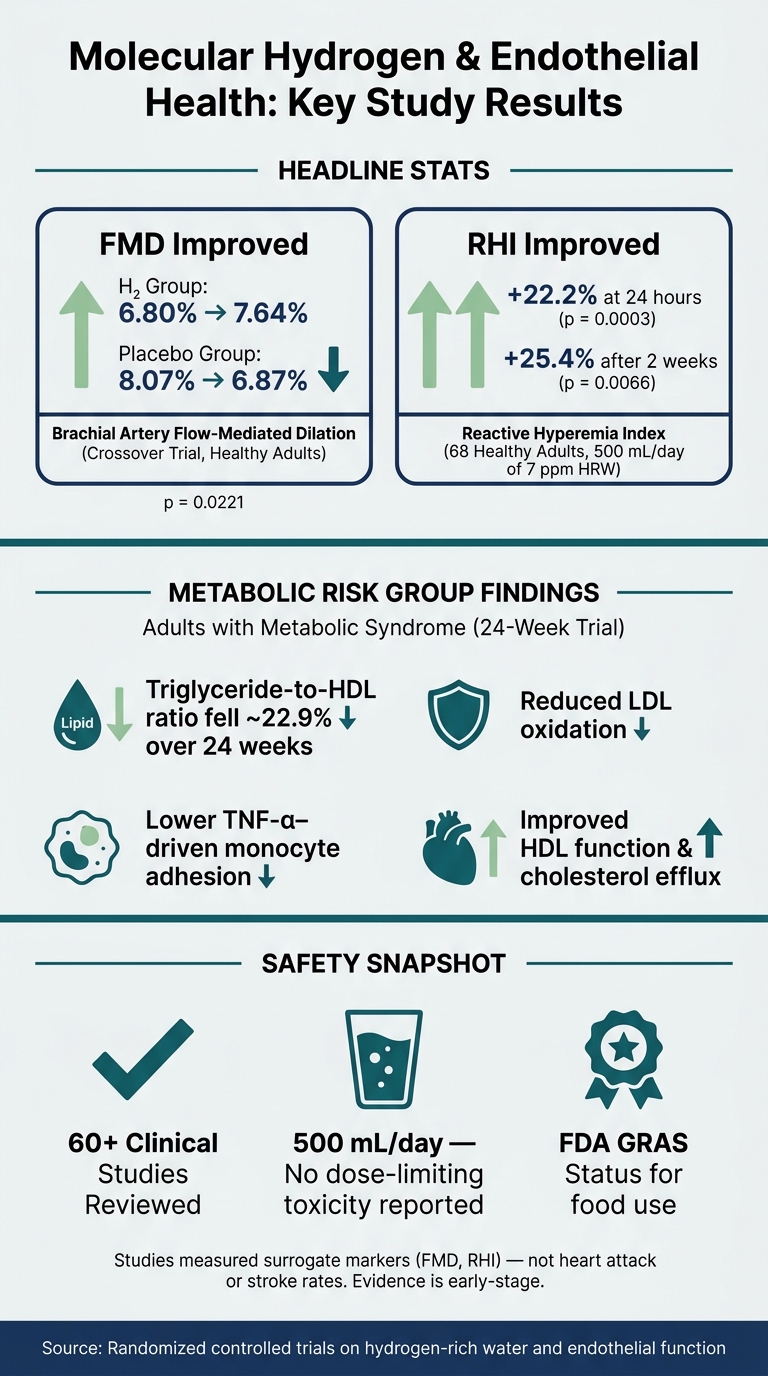
Molecular Hydrogen & Endothelial Health: Key Study Results at a Glance
Those proposed redox effects now show up in small human trials. The studies are limited in size, but randomized data suggest hydrogen-rich water may help vascular responsiveness in both healthy adults and adults with cardiometabolic risk.
Short-Term Trials Measuring FMD and RHI
Several trials looking at endothelial function used hydrogen-rich water with about 7 ppm hydrogen.
In a controlled crossover trial in healthy adults, brachial artery flow-mediated dilation (FMD) increased from 6.80% ± 1.96% to 7.64% ± 1.68% in the high-H₂ group. In the placebo group, it dropped from 8.07% ± 2.41% to 6.87% ± 2.94%. The difference was significant (p = 0.0221). Resting diameter did not change, which suggests the effect was on vascular responsiveness, not baseline dilation.
Another randomized trial included 68 healthy adults and looked at peripheral endothelial function using RHI through finger arterial tonometry. Participants who drank 500 mL/day of 7 ppm HRW had RHI improve by 22.2% at 24 hours (p = 0.0003) and 25.4% after 2 weeks (p = 0.0066), compared with a nitrogen-water placebo.
Findings in Adults With Metabolic Risk
The evidence in higher-risk groups is less direct, but it still matters for endothelial health. One study in adults with metabolic syndrome did not measure FMD or RHI. Even so, the shifts in risk markers are still relevant. Over 24 weeks, molecular hydrogen tablets improved lipids, glucose control, and inflammatory markers, including a triglyceride-to-HDL ratio that fell by about 22.9%.
In adults with metabolic risk, HRW also improved HDL function, reduced LDL oxidation and TNF-α–driven monocyte adhesion, improved cholesterol efflux, and protected endothelial cells from apoptosis.
These results line up with the oxidative stress and nitric oxide pathways discussed next.
How Molecular Hydrogen May Protect the Endothelium
Those human findings lead to the next issue: what might H₂ be doing inside the vessel wall? Cell and animal research gives us a working model. That said, preclinical data doesn't automatically map to what happens in people.
Oxidative Stress, Nitric Oxide, and eNOS Signaling
Healthy arteries rely on nitric oxide (NO) to stay flexible. An enzyme called endothelial nitric oxide synthase, or eNOS, makes NO. It responds to blood flow and shear stress, then tells the vessel wall to relax. When oxidative stress gets in the way, eNOS can "uncouple" and make superoxide instead of NO. Less NO means less vasodilation, stiffer arteries, and weaker vascular recovery.
In a 2025 obstructive sleep apnea-hypopnea syndrome model, H₂ restored NO bioavailability by improving eNOS phosphorylation at Ser1177 and preserving the BH4/BH2 ratio. It also reduced MDA and ROS levels in vascular tissue. That kind of selectivity could help keep normal redox signaling in place.
Inflammation, Endothelial Aging, and Vascular Repair
H₂ may also dial down inflammatory signaling in the endothelium. Animal and cell studies suggest that H₂ can reduce activation of NF-κB, a key signaling switch that controls inflammatory cytokines and adhesion molecules such as ICAM-1 and TNF-α. Lower ICAM-1 and TNF-α may mean fewer immune cells stick to the vessel wall, which is an early step in vascular damage and remodeling.
H₂ has also been tied to lower endothelial apoptosis in stressed vascular tissue. A 2013 cell study found that hydrogen-rich medium lowered apoptosis under glycoxidative stress, increased the Bcl-2/Bax ratio, and boosted antioxidant enzymes including SOD and GSH-PX. Put simply, fewer endothelial cells dying off helps the vessel lining stay intact. That matters for barrier function, antithrombotic activity, and long-term vessel upkeep.
Oxidative stress also plays a part in endothelial senescence. So these same effects may matter for vascular aging too, although that idea still comes from preclinical work.
These pathways could help explain the FMD and RHI signals, but human outcome data are still limited.
Safety, Study Limits, and Practical Context for U.S. Readers
What the Research Says About Safety and Tolerability
Once early results point to possible upside, the next step is simple: is hydrogen well tolerated in people?
So far, the safety picture looks reassuring. Reviews covering more than 60 clinical studies report that hydrogen has been well tolerated across different delivery methods, with no serious toxic effects at typical doses. Many studies focused on endothelial function use about 17 fl oz (500 mL) of hydrogen-rich water per day, and at that intake, researchers have not reported dose-limiting toxicity.
One 24-week trial in adults with metabolic syndrome is a good example. Every participant finished the study, and neither group reported adverse effects. A few trials did note mild, short-lived issues such as loose stools, heartburn, headaches, or occasional gastrointestinal discomfort, but those reports were uncommon. Molecular hydrogen in water also has FDA GRAS status for food use.
Why the Evidence Is Promising but Still Early
That said, there's an important catch: most of this work is based on small, short studies that look at function, not hard clinical outcomes.
The current research is encouraging, but it's still early. Most trials on hydrogen and endothelial markers like FMD and RHI have been small and brief, ranging from a single dose to a few weeks. That matters because FMD, RHI, and molecular hydrogen and traditional antioxidants are surrogate endpoints. They can show changes in vascular function, but they do not tell us whether hydrogen lowers the odds of a heart attack or stroke.
There's also a dosing problem. Study protocols vary a lot, and researchers have not established a clear dose-response relationship. In plain English: we don't yet know how much is best, for whom, or for how long. Experts describe the current evidence as hypothesis-generating, which means the data supports more research, not medical recommendations. Larger, longer, and better-standardized randomized trials are still needed.
How Hydrogen Tablet Products Relate to the Research
This is where tablet products fit into the picture. Most studies used hydrogen-rich water, which is the same basic delivery format tablets are meant to produce. Edenvia Molecular Hydrogen tablets dissolve in water to create hydrogen-rich water, but the clinical studies on this method do not prove efficacy for any one consumer product. They support the delivery format, not a promise that every product will produce the same results.
If you have a health condition or take prescription medication, talk with a healthcare professional before starting a hydrogen supplement.
Conclusion: What Current Research Suggests About Molecular Hydrogen and Endothelial Health
The endothelium helps regulate blood flow, supports nitric oxide signaling, and plays a part in controlling inflammation. When endothelial function starts to slip, cardiovascular risk tends to go up.
That’s why the human data matters here. Current research suggests molecular hydrogen may help support endothelial health by lowering oxidative stress and low-grade inflammation. In human trials, hydrogen-rich water improved FMD and RHI, including an increase from 6.80% to 7.64% in one study and a 25.4% RHI increase in another. Those shifts are encouraging, but they’re still surrogate markers rather than proof of long-term clinical benefit.
Short-term tolerability looks good. At the same time, most studies have been small, short, and centered on biomarkers, so long-term benefit and best dosing are still unproven.
So the main issue isn’t just whether molecular hydrogen can help. It’s where it fits. The practical takeaway is simple: molecular hydrogen looks like a promising adjunct, not a replacement, for standard cardiovascular care. It makes the most sense alongside blood pressure control, healthy nutrition, regular physical activity, and physician-guided treatment.
Edenvia Molecular Hydrogen tablets dissolve in water to create hydrogen-rich water, the same format used in these studies. Larger and longer trials will show how much benefit people may actually see.
FAQs
What do FMD and RHI measure?
The provided search results do not explain what FMD (flow-mediated dilation) or RHI (reactive hyperemia index) measure.
In short, that information is not available in the source material provided.
Can hydrogen-rich water improve heart health long term?
Yes. Hydrogen-rich water may help support long-term cardiovascular health by reducing oxidative stress at the cellular level.
Put simply, molecular hydrogen may help neutralize free radicals linked to arterial plaque and LDL oxidation. Over time, that may support healthy arterial function and cholesterol balance.
This isn’t an overnight fix. But with steady daily use, some people may notice measurable effects within 6 to 8 weeks. Edenvia Molecular Hydrogen tablets offer a simple way to make hydrogen-rich water and add steady antioxidant support to your day.
How much hydrogen-rich water was used in the studies?
Dosages varied from one study to the next, but human clinical trials usually used 0.5 to 2.0 liters per day.
Here’s what that looked like in practice:
- 1 liter daily
- 1.5 to 2.0 liters daily
- 0.5 liters daily for six months
Hydrogen concentrations were usually 0.5 to 1.6 ppm or 1,000 ppb and above.