

Molecular Hydrogen for Autoimmune Conditions
Here’s the short answer: molecular hydrogen may help with inflammation and oxidative stress in autoimmune disease, but the human research is still early, small, and not enough to treat it as standard care.
If I were summing up the article in plain English, I’d put it this way:
- What it is: most studies use hydrogen-rich water
- Why people care: it may lower oxidative stress and calm some inflammatory signals
- Where human data looks strongest: rheumatoid arthritis
- What’s still missing: large, long-term studies in people
- What it is not: not a cure, not FDA-approved for autoimmune disease, and not a replacement for your doctor or your meds
Autoimmune disease affects millions of people in the U.S., and symptoms like pain, stiffness, and fatigue can wear you down day after day. Some early studies reported drops in markers like IL-6, 8-OHdG, and ESR, along with better symptom scores. But most of those studies were short and had small sample sizes, so the results should be read with care.
A few points matter most:
- Hydrogen may work by reducing damaging free radicals and affecting pathways like NF-κB, NLRP3, and Nrf2
- RA has the clearest early human data
- Lupus data is thin, with mixed-cohort studies and case-level reports
- Hydrogen-rich water is the main at-home format
- Safety looks decent so far, but long-term use is still not well mapped out
If you’re thinking about trying it, the main takeaway is simple: see it as a support option, not a treatment plan. And if you take immunosuppressants or biologics, talk with your clinician first.
That’s the core of the article: a biologically interesting idea, a few early human signals, and a lot of unanswered questions.
The Science of Molecular Hydrogen Therapy - Tyler LeBaron
Autoimmune Disease, Oxidative Stress, and the Case for Hydrogen Support
Autoimmune disease is, at its core, an immune misfire. The immune system turns on healthy tissue and keeps joints, skin, organs, or glands inflamed. That helps explain why joint pain, morning stiffness, skin rashes, and heavy fatigue can stick around even when there's no active infection.
A big part of what keeps this going is a loop between inflammatory cytokines and reactive oxygen species (ROS). TNF-α, IL-1β, and IL-6 keep inflammation going and can drive pain, fatigue, and tissue damage. When those signals stay high for months or years, inflammation becomes chronic and starts wearing down day-to-day function. That's where oxidative stress starts to matter a lot.
How Oxidative Stress Can Worsen Immune-Driven Tissue Damage
Two pathways stand out here: NF-κB and NLRP3. NF-κB helps control inflammatory genes. When ROS or cytokines switch it on, it increases production of TNF-α, IL-1β, IL-6, and other inflammatory enzymes. NLRP3 is an inflammasome sensor that reacts to cell stress, including ROS and mitochondrial damage. Once activated, it drives release of IL-1β and IL-18.
In rheumatoid arthritis, that can show up as swollen, painful joints and less mobility. Excess ROS can damage chondrocytes and synoviocytes. It can also activate NF-κB in synoviocytes and macrophages, which helps drive pannus formation, cartilage breakdown, and bone resorption. Mitochondrial damage may also cut energy output, which can add to fatigue even during light activity. So the goal isn't to shut down oxidation across the board. It's to support redox balance in a more targeted way.
Why Selective Antioxidant Support Has Drawn Research Interest
Here's the catch: ROS aren't all bad. At normal levels, they help the body fight infections and support cell signaling. If you wipe out ROS too broadly, you can interfere with immune defense and disrupt cell function. That's a real concern in autoimmune disease, where immune control is already off balance. For that reason, researchers have looked at selective antioxidant approaches that target the most damaging reactive species without interfering with the ROS the body still needs.
Molecular hydrogen fits that idea. It selectively scavenges hydroxyl radicals and peroxynitrite, which are two highly reactive oxidants, while leaving other ROS mostly untouched. Because H₂ is a small, neutral gas, it can move across cell membranes and into mitochondria, reaching areas of oxidative stress directly. Research also suggests it may affect NF-κB and NLRP3, which means it could help turn down the inflammatory loop instead of only mopping up free radicals afterward.
That makes H₂ a plausible add-on option, although most of the evidence is still mechanistic or from early clinical work. Those pathways are a big reason early studies are looking at H₂ in autoimmune and other immune-mediated conditions.
How Molecular Hydrogen May Influence Inflammation and Immune Response
Building on the oxidative stress pathways above, H₂ may also affect immune signaling further downstream. Research suggests it works through a broader regulatory network, shaping the crosstalk between NF-κB, Nrf2, and NLRP3 rather than simply turning immunity off. That matters in autoimmune research, where inflammation and oxidative stress often feed into each other.
One key part of this network is Nrf2. This pathway helps switch on the body's own antioxidant defenses, including enzymes like superoxide dismutase (SOD), catalase (CAT), and glutathione peroxidase (GPx). In preclinical models, H₂ lowered ROS and lipid peroxidation while increasing SOD, GPx, and CAT. In those same models, when Nrf2 was absent, H₂ lost much of its ability to suppress NLRP3 and NF-κB. That suggests Nrf2 signaling sits near the center of these protective effects. This pathway may also shape inflammasome activity.
Effects on NF-kB, NLRP3, and Pro-Inflammatory Cytokines
NF-κB and NLRP3 are two inflammation-related pathways that sit upstream of cytokines often found at higher levels in autoimmune disease, including IL-1β, IL-6, and TNF-α. When these pathways stay overactive, they can keep chronic inflammatory signaling going.
Research suggests H₂ may reduce NLRP3 activation by lowering mitochondrial ROS (mtROS), which can help block NLRP3 activation. In preclinical inflammation models, H₂ inhibited NF-κB activation and reduced serum IL-1β, IL-6, and TNF-α, which led to less tissue inflammation. Multiple animal models of inflammatory conditions also show lower TNF-α, IL-1β, IL-6, and HMGB1 after H₂ administration. That said, most of this evidence comes from preclinical work, so human autoimmune data are still limited.
Possible Effects on T Cells and Immune Balance
In autoimmune disease, the aim isn't to shut down the immune system. It's to calm misdirected immune activity while keeping normal defense in place. That's one reason H₂ keeps drawing attention in this area.
Early studies suggest it may affect neutrophils, macrophages, and lymphocytes, including how these cells move, activate, and survive. Some findings also point to possible shifts in T-cell balance, including reduced Th17 activity and changes in regulatory T-cell populations. It's still not clear whether these effects happen directly or if they follow reduced oxidative stress and inflammatory signaling.
Human autoimmune findings remain limited, which is why the next section turns to early clinical results.
sbb-itb-6860cc4
What the Research Shows in Autoimmune and Immune-Mediated Conditions
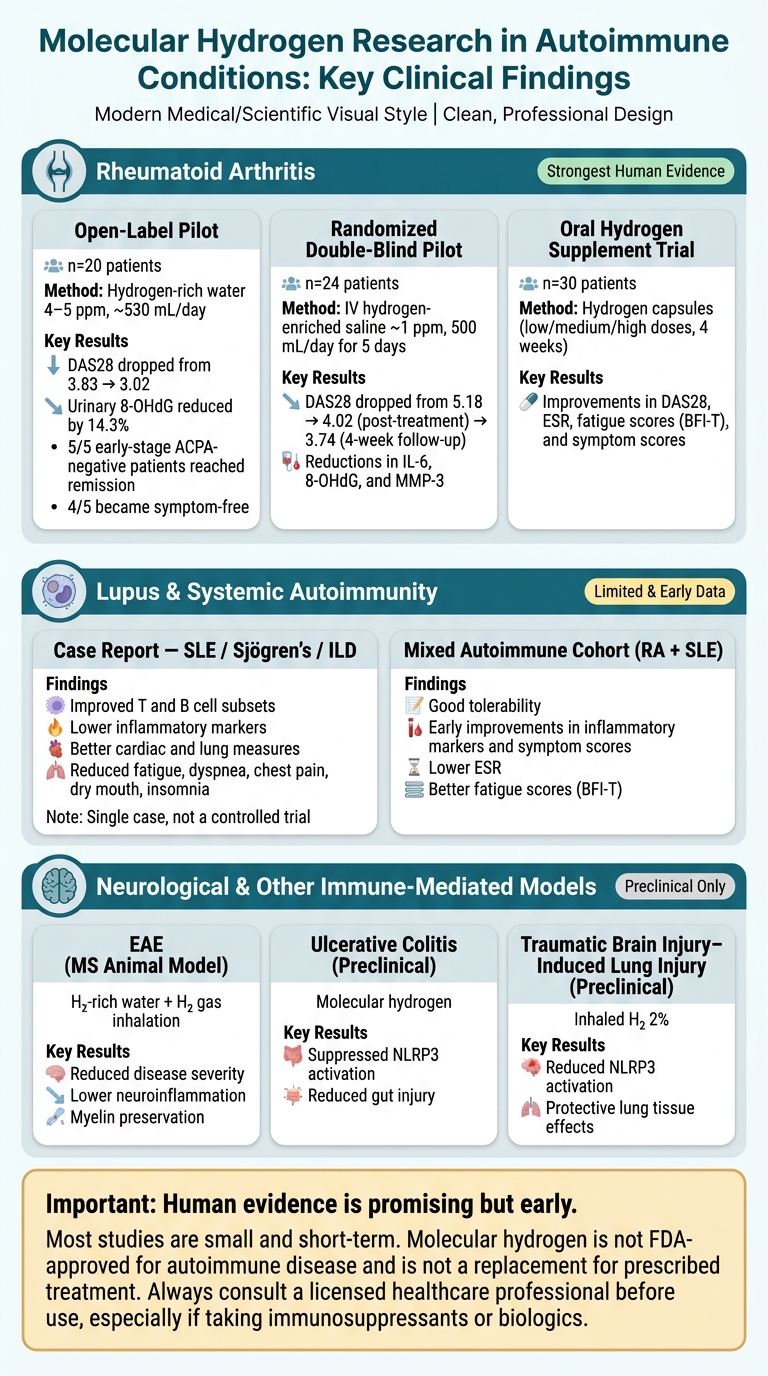
Molecular Hydrogen for Autoimmune Disease: What the Research Shows
The mechanism makes sense on paper, but the human data are still at an early stage. Most studies are small, short, and use different ways of delivering hydrogen. So the findings are promising, but not settled. Because hydrogen may affect NF-κB and NLRP3, early human work has mostly looked at inflammation markers and symptom changes. Rheumatoid arthritis has the clearest human data so far.
Rheumatoid Arthritis and Autoimmune Joint Symptoms
In a 20-patient open-label pilot, hydrogen-rich water at 4–5 ppm lowered DAS28 from 3.83 to 3.02 and reduced urinary 8-OHdG by 14.3% after the first phase. All 5 early-stage, ACPA-negative patients reached remission, and 4 were symptom-free.
In a 24-patient randomized pilot, intravenous hydrogen-enriched saline at about 1 ppm lowered DAS28 from 5.18 to 4.02 right after treatment and to 3.74 at 4 weeks. The study also found drops in IL-6, 8-OHdG, and MMP-3. Those gains were still present at the 4-week follow-up.
| Study | Delivery Method | Outcomes Measured |
|---|---|---|
| Open-label pilot (n=20) | Hydrogen-rich water, 4–5 ppm, ~530 mL/day | DAS28, urinary 8-OHdG, remission rates |
| Randomized, double-blind pilot (n=24) | IV hydrogen-enriched saline, ~1 ppm, 500 mL/day for 5 days | DAS28, IL-6, 8-OHdG, MMP-3 |
| Oral hydrogen supplement trial (n=30) | Hydrogen capsules, low/medium/high doses, 4 weeks | DAS28, ESR, fatigue (BFI-T), symptom scores |
Lupus and other systemic autoimmune conditions have far fewer human studies, and the outcome data are less consistent.
Lupus, Systemic Autoimmunity, and Fatigue-Related Findings
A mixed autoimmune cohort using oral hydrogen capsules reported good tolerance and early signs of improvement in inflammatory markers and symptoms. A separate 4-week trial in chronic inflammation found lower ESR and better fatigue scores. Neither study used lupus-specific activity indices.
A case report in overlapping SLE, Sjögren's syndrome, and interstitial lung disease found improved T and B cell subsets, lower inflammatory markers, better cardiac and lung findings, and less fatigue, dyspnea, chest pain, dry mouth, and insomnia. But this was one case, not a controlled trial.
| Condition | Markers Studied | Clinical Outcomes Tracked |
|---|---|---|
| SLE / Sjögren's / ILD (case report) | T/B cell subsets, inflammatory markers, cardiac and pulmonary measures | Fatigue, dyspnea, chest pain, immune panel shifts |
| Mixed autoimmune cohort (RA + SLE) | General inflammatory markers, safety labs | Symptom scores, tolerability |
| Chronic inflammation / mixed cohort | ESR, CRP trend, fatigue (BFI-T) | Fatigue reduction, inflammation trend |
Outside systemic autoimmunity, most of the evidence comes from animal models of neuroinflammation and tissue injury.
Neurological and Other Immune-Mediated Models
Human data in neurologic autoimmune disease remain limited. In EAE models of multiple sclerosis, hydrogen-rich water and hydrogen gas inhalation reduced disease severity, lowered microglial activation, cut pro-inflammatory mediators, and helped preserve myelin and axons. Molecular hydrogen can also cross the blood-brain barrier, which adds to the biologic case for neuroinflammatory conditions.
Other preclinical models, including ulcerative colitis and autoimmune myocarditis, show hydrogen suppressing NLRP3 inflammasome activation, reducing tissue injury, and supporting mitochondrial function. The gap between these lab findings and human clinical outcomes is still large.
| Intervention Type | Model or Condition | Main Findings |
|---|---|---|
| Hydrogen-rich water / H₂ gas inhalation | EAE (MS model, animal) | Reduced severity scores, lower neuroinflammation, myelin preservation |
| Molecular hydrogen (various) | Ulcerative colitis (preclinical) | Suppressed NLRP3 activation, reduced gut injury and pyroptosis |
| Inhaled H₂ (2%) | Traumatic brain injury–induced acute lung injury model | Reduced NLRP3 activation, protective effects on lung tissue |
Across all three areas, the biologic case is strong, but human evidence is still limited. A phase 1 study (NCT05116215) is now testing safety and possible efficacy in 27 rheumatologic patients using gas, capsules, and hydrogen-rich water over 1 month.
Hydrogen-Rich Water, Edenvia Molecular Hydrogen, Safety, and Key Takeaways
What Research-Based Use Looks Like in Practice
Once you get past the “how it may work” part, the next question is simple: how do people actually use molecular hydrogen? The studies in this guide looked at a few delivery methods, and the format makes a big difference in day-to-day use.
| Delivery Method | Typical Setting | Endpoints Studied | Use Notes |
|---|---|---|---|
| Hydrogen-rich water (including dissolved tablets like Edenvia Molecular Hydrogen) | Home, outpatient, clinical trials | Inflammation and symptom markers | Most accessible for daily use; drink soon after mixing |
| Hydrogen inhalation (H₂ gas) | Hospital or supervised clinic | Clinical and oxidative stress markers | Requires gas delivery equipment and medical oversight |
| Hydrogen-rich saline (clinical infusion) | Research, hospital settings | Clinical and oxidative stress markers | Invasive; requires clinical supervision and sterile preparation |
Of these options, hydrogen-rich water lines up best with the outpatient studies covered earlier. In those studies, people have often used about 1 to 1.5 liters per day for 4 weeks or longer, with dissolved hydrogen levels near 1.6 mg/L.
Edenvia Molecular Hydrogen fits into that same bucket. It’s a tablet that turns plain water into hydrogen-rich water. The practical use is pretty straightforward: dissolve the tablet in water, then drink it soon after it’s prepared. Since direct studies on branded tablet products are still limited, it makes more sense to view Edenvia as a hydrogen-rich water format, not as its own proven therapy.
For home use, this is the easiest option by far. That said, the research points to hydrogen-rich water as a support tool for inflammation balance, not a treatment for disease.
Safety, Evidence Gaps, and What Readers Should Keep in Mind
This is where a little caution helps. The biggest limits in the current research are small study size, short study length, and unclear dosing. Human studies have generally reported good tolerability, with few adverse events across trials using hydrogen-rich water, inhaled gas, and hydrogen-rich saline.
There’s another point that matters: the best dose still isn’t settled. And higher doses haven’t shown clearer results, so it’s not smart to assume that more will work better. That’s a common trap with wellness products, and the data here don’t support it.
What the current evidence suggests is fairly clear:
- Molecular hydrogen is being studied for its role in oxidative stress and inflammatory balance.
- Human data in autoimmune disease look promising, but they are not final.
- Hydrogen-rich water remains the most practical option for everyday use.
If someone is dealing with an autoimmune condition, any care plan, including the choice to add hydrogen-rich water, should go through a licensed healthcare professional. That matters even more for people taking immunosuppressants or biologics.
FAQs
Can molecular hydrogen help autoimmune symptoms feel better?
Yes, molecular hydrogen may help with autoimmune-related symptoms by lowering oxidative stress and long-term inflammation tied to these conditions.
It may help support a steadier inflammatory response and ease joint discomfort and stiffness, which can help with mobility. Edenvia Molecular Hydrogen tablets offer a simple way to make hydrogen-rich water as part of overall cellular wellness.
How long does it take to notice effects from hydrogen-rich water?
Molecular hydrogen reacts with free radicals fast. But the time it takes to feel a difference can vary from person to person.
Many people say they notice changes in joint pain, stiffness, and mobility within 7 to 10 days of steady daily use.
More noticeable effects, like less inflammation and easier movement, often show up within 2 to 4 weeks. For the best shot at good results, stick with a daily routine for at least 30 days.
Is molecular hydrogen safe with biologics or immunosuppressants?
Molecular hydrogen is generally recognized as safe, and people often use it alongside other supplements and wellness habits.
That said, there’s no clear guidance on using it with biologics or immunosuppressants.
If you take prescription medications or live with a medical condition, talk with your healthcare professional before adding it. Your doctor is in the best position to judge how it may fit with your specific biologic therapy.