

What IHSA Certification Means for Hydrogen Supplements
Most hydrogen supplement labels do not tell the whole story. One 2024 study found that 75% of products tested delivered under 70% of their claimed hydrogen level, and 30% delivered less than half.
If I’m checking an IHSA-certified product, I’d read that badge as one thing: the product met set rules for hydrogen level, testing method, and contaminant limits. It does not mean FDA approval. And it does not mean the product can treat or prevent disease.
Here’s the short version:
- IHSA is a private standards group for molecular hydrogen products.
- Certification applies only to some hydrogen water products right now, not inhalers, creams, or bath items.
- Gas chromatography is the required test method, because IHSA does not accept indirect tools like ORP meters for hydrogen measurement.
- Minimum hydrogen levels matter: many certified products must meet at least 0.5 mg/L.
- Safety checks matter too: pH limits and contaminant screening are part of the standard.
- The badge alone is not enough: I’d want to see the lab, batch, measured result, and test date.
A simple way to think about it: IHSA certification is a quality check, not a health claim. It helps me sort tested products from plain label claims, but I’d still look at dose, storage, and whether the certificate matches the exact product I’m buying.
Quick comparison
| Check | What IHSA certification tells me | What it does not tell me |
|---|---|---|
| Hydrogen amount | The product met a minimum hydrogen level at testing | That it has the highest dose on the market |
| Test method | Hydrogen was measured by gas chromatography | That any meter or claim on the label is enough |
| Safety | The product met set contaminant and pH limits | That it is FDA-approved |
| Health effect | None | That it cures, treats, or prevents disease |
| Scope | Applies to certain hydrogen water categories | Does not cover inhalers, creams, or bath devices at this time |
If I were buying one, I’d treat certification as the first filter, then check the paperwork before trusting the label.
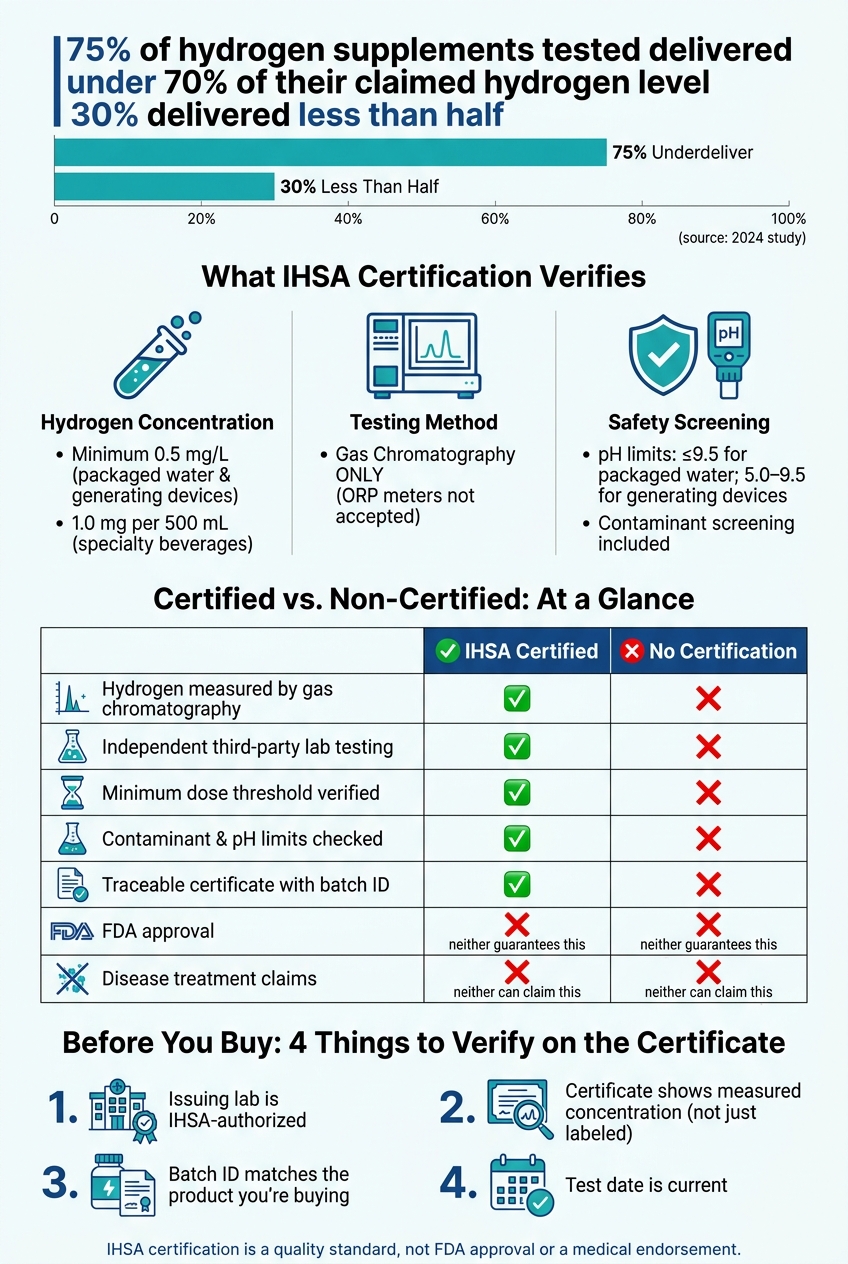
IHSA Certified vs. Non-Certified Hydrogen Supplements: What the Badge Really Tells You
THE BENEFITS OF HYDROGEN WATER TO FIGHT OXIDATIVE STRESS AND INFLAMMATION | 045 DR. PAUL BARATTIERO
What IHSA Certification Is
In practice, IHSA certification means a hydrogen product was tested against clear standards for hydrogen content and safety. More specifically, it means the product passed independent testing for hydrogen content, measurement accuracy, and contaminant limits.
The framework looks at three main things: how hydrogen is measured, how much hydrogen the product contains, and which contaminants must be absent. If a product meets all three, it earns certification.
What the Certification Is Designed to Show
Certification shows that the product was independently tested against published IHSA criteria.
To qualify, hydrogen levels must be measured with gas chromatography, the only testing method IHSA allows. Products also have to meet minimum dose thresholds, and those thresholds depend on the product category:
| Product Type | Minimum H2 per Serving | Minimum Concentration |
|---|---|---|
| Packaged Hydrogen Water | 0.5 mg per 1 L | 0.5 mg/L |
| Specialty Beverages | 1.0 mg per 500 mL | 0.5 mg/L |
| Generating Devices | 0.5 mg per 1 L | 0.5 mg/L |
Right now, IHSA certification applies only to hydrogen water products: packaged water, specialty beverages, and generating devices. IHSA has not yet issued certification standards for inhalation devices, skin creams, or bathing devices.
Those are the checks behind the label. The next step is understanding how the standard is applied and verified.
What IHSA Certification Does Not Mean
IHSA certification does not mean FDA approval. It also does not mean a product treats, cures, or prevents disease.
IHSA is a private quality standard, not FDA approval and not a medical endorsement.
Put simply, certification confirms that a product met IHSA's minimum standards. It does not prove that the product treats any condition.
What IHSA Certification Checks in a Hydrogen Supplement
IHSA certification means a product met published standards for hydrogen content, measurement, and safety.
Hydrogen Concentration and Minimum Dose
The first thing IHSA checks is simple: does the product meet the minimum hydrogen dose? For packaged products, hydrogen levels also need to stay at 0.5 mg/L or more throughout shelf life.
But hitting the dose target by itself isn't enough. The way that dose is measured has to follow IHSA rules too.
Testing Method and Product Stability
IHSA approves gas chromatography as the only measurement method because it measures hydrogen directly. By contrast, ORP meters do not measure hydrogen concentration.
That matters because hydrogen can escape after the product is exposed to air. So testing has to account for that loss, not just the number on paper.
After IHSA checks dose and the testing method, it also looks at whether the product is clean and safe.
Safety Screening for Contaminants
IHSA also screens for contaminants. For tablets and hydrogen-generating devices, that includes checking whether the materials and chemical reactions leave behind harmful byproducts.
There are pH limits too:
- Packaged hydrogen water must stay at or below pH 9.5
- Hydrogen-generating devices must fall between pH 5.0 and 9.5
Once those checks are done, the next step is to verify who issued the certification and what documents support it.
sbb-itb-6860cc4
How IHSA-Related Certification Is Granted and How to Verify It
Once you know what IHSA standards call for, the next step is simple: check the document that says the product meets them.
IHSA sets the standard. But the certification itself comes from an IHSA-authorized third-party lab through independent testing. That distinction matters. A badge on a package doesn't mean much on its own. It only means something if you can trace it back to a real, authorized lab.
Why the Issuing Body Matters More Than the Badge
A logo is easy to print. A real certificate is traceable.
If a company can't clearly say which lab issued the certification, that's a red flag. The name of the issuing body should be easy to find, and it should match an IHSA-authorized lab. If that trail goes cold, the badge starts to look like window dressing.
What to Look for on the Label or Certificate
When you review a certificate or lab report, check the details that show it's legitimate:
| Certificate Element | What to Check |
|---|---|
| Issuing lab | Must be IHSA-authorized |
| Product/batch ID | Specific product name and batch number |
| Measured result | Measured concentration, not labeled concentration |
| Date | Current test date |
If any of these details are missing, treat the certificate as incomplete.
Questions to Ask Before You Buy
Before you buy, ask the manufacturer three direct questions:
- Who issued the certification?
- Was the hydrogen measured in the finished product, ready to drink?
- Does the certificate match the batch you're buying?
That gives you a much clearer picture of what the document is actually saying - and whether it applies to the product in your hands.
With the certificate checked, the next step is figuring out how much weight it should carry in a product review.
How to Compare Certified and Non-Certified Hydrogen Supplements
What Certification Adds to a Product Review
Once you know what IHSA certification covers, the next step is figuring out how much weight to give it when you buy.
A certification badge tells you one clear thing: the product was measured by an independent third party against IHSA standards. That matters. GC measures hydrogen directly, instead of relying on indirect methods. So certification confirms that the product has enough hydrogen and that the measurement itself is accurate. It also points to third-party contaminant screening.
Where Certification Alone Is Not Enough
Certification gives you a minimum standard, not the top end. The IHSA minimum is 0.5 mg/L, but in day-to-day use, people often look for higher concentrations. That’s the catch: certification shows compliance, but not always the best result in practice. A product that just clears the minimum may not fit every use case.
A few other details are worth checking beyond the badge:
| Factor | What to Check |
|---|---|
| Added ingredients | Any stimulants, excess vitamins, or other additives? |
| Storage guidance | Should it be kept in sealed glass or stainless steel if not consumed right away? |
| Certificate details | Does the certificate match the product you're buying? |
Even a certified product can lose its edge if it isn’t handled well after opening. Dissolved hydrogen escapes fast, so timing changes the dose you actually get. In plain English: preparation and timing matter just as much as the certificate.
What IHSA Certification Means for Your Buying Decision
After you verify the certificate, use it as a practical filter. IHSA certification gives you an outside check when you're weighing a product's claimed hydrogen content and safety. It won't remove every risk, but it does help you tell the difference between performance that can be checked and plain marketing claims.
Key Takeaways for Shoppers Comparing Hydrogen Supplements
The badge is a starting point, not the finish line. It tells you the product contains enough hydrogen to line up with levels used in clinical studies, that the concentration was measured by gas chromatography, and that the product passed validated contaminant tests.
Before you buy, ask for the actual certificate. A valid document should name the certifying entity, show a certificate ID or lab accreditation number, and clearly state the testing method instead of leaning on vague wording like "tested by a named lab using a stated method".
Certification checks the floor, not always the dose you may want. Research doses often run higher than the 0.5 mg/L minimum threshold, so compare the serving dose with the levels used in studies, not just the minimum threshold.
FAQs
How can I verify an IHSA certificate?
Ask the manufacturer which exact organization issued the IHSA certification. Then reach out to that certifier yourself to confirm the certificate is valid and that it applies to the product you're checking.
That extra step matters. Some companies have falsely claimed IHSA certification, so checking the issuer and the status of the paperwork can help protect you.
Does IHSA certification apply to hydrogen tablets?
Right now, IHSA certification applies only to hydrogen water products. Hydrogen-generating additives, like tablets, may be added to future standards, but they are not included in the main program yet.
So what does that mean in practice? Tablets can still be tested by authorized labs. But at this time, they can't receive formal IHSA certification.
Edenvia Molecular Hydrogen continues to focus on high-quality tablets that dissolve into hydrogen-rich water to support wellness.
Why does gas chromatography matter?
Gas chromatography (GC) matters because it’s the gold standard for measuring molecular hydrogen concentration. Put simply, it gives the most accurate and reliable results.
Here’s why that matters: GC measures hydrogen gas directly after separating it from water. That makes it much easier to verify the actual therapeutic concentration instead of relying on rough estimates or indirect methods.
And that’s a big deal, because molecular hydrogen dissipates fast. If you don’t test it the right way, the numbers can look better on paper than they are in practice.
GC helps with two things:
- confirming that products meet IHSA certification standards
- giving consumers more confidence in a product’s quality and potency
In short, if a company wants to show that its hydrogen levels are legit, GC is the method people trust most.