

Hydrogen Water Tips for Long Flights and Road Trips
Long travel days dry you out fast, so my simple plan is this: drink before you leave, mix hydrogen water only when you’re ready to drink it, and pair it with movement every 1 to 2 hours.
If I were cutting this whole article down to the parts that matter most, I’d keep these points:
- Start hydrated: drink plain water early, then have 8–16 fl oz of hydrogen water 30–60 minutes before a flight or drive.
- For flights: bring an empty bottle through TSA, then mix it after security.
- For road trips: make a new serving at the start of each leg and again at rest stops every 2–3 hours.
- Drink it soon after mixing: dissolved hydrogen drops over time, and some sources note it can fall by about 50% within 2 hours in an open bottle.
- Use plain, safe water only: tablets add hydrogen, but they do not clean dirty water.
- Keep moving: ankle rolls, calf raises, short walks, and stretch breaks help with long hours of sitting.
- Pack enough: the article’s rule of thumb is 4 tablets per travel day, plus a small backup for delays.
- Store tablets away from heat, sun, and moisture: a hot car or damp bag can ruin them.
Here’s the short version: hydrogen water is still just part of a travel routine. I’d use it with plain water, light meals, and steady movement, not in place of them.
| Travel Type | Best Time to Mix | How to Use It | Main Watch-Out |
|---|---|---|---|
| Flight | After TSA | Sip during the trip | Don’t pre-mix too early |
| Road trip | At each driving leg or stop | Drink right after mixing | Don’t leave tablets in a hot car |
So if you want the article in one plain takeaway, it’s this: pack dry tablets, use safe water, mix close to drinking time, and keep a simple before-during-after routine.
Airport Hydration Hacks!
sbb-itb-6860cc4
Why Hydrogen Water Can Help During Long Flights and Road Trips
Cabin air, pressure changes, and long stretches of sitting can leave travel feeling draining. That’s why a simple hydration plan matters before you fly or hit the road.
One big problem on both flights and road trips is hours of sitting. Staying in the same position for too long can slow circulation. And that often leads to muscle stiffness and joint discomfort.
Hydrogen water can add one more layer of support when travel stress starts to pile up. Molecular hydrogen (H₂) may help reduce oxidative stress. Some research also links hydrogen-rich water with better attention in sleep-deprived people, which may be helpful on red-eyes and long drives when staying sharp feels harder than usual.
That said, hydrogen water works best as an add-on, not a substitute. Use it alongside plain water, regular movement, and balanced meals.
How to Set Up a Simple Pre-Trip Hydration Routine
Use that support before you leave so you board or drive already hydrated. The idea is simple: front-load your fluids before departure so your trip starts from a better baseline.
Start with plain water about 2–3 hours before departure. Then, 30–60 minutes before boarding or driving, mix 8–16 fl oz of hydrogen water.
Drop one Edenvia Molecular Hydrogen tablet into cool or room-temperature water, let it dissolve, and drink it right away. Avoid hot water since it speeds hydrogen loss.
That simple prep makes the next travel-day steps easier.
1. Pack Edenvia Molecular Hydrogen Tablets First

Pack your Edenvia Molecular Hydrogen tablets before anything else. If you do it at the start, they’re far less likely to get lost under chargers, snacks, and all the other stuff that ends up in a travel bag. Put them somewhere easy to reach so your first serving is ready before boarding.
Plan on 4 tablets per travel day. That gives you one serving before you leave, two during the trip, and one after you arrive. Keep the tablets in their original moisture-resistant packaging or in a pill case to help limit moisture exposure. After security, you should be able to grab them fast for your first mix.
Because the tablets are dry and TSA-friendly, they don’t count toward liquid limits.
Keep them in your carry-on, not your checked bag, so they’re easy to access during travel.
2. Front-Load Hydration Before You Leave
Start your travel day with 10–17 oz (300–500 ml) of hydrogen water as soon as you wake up. Then have another 10–17 oz (300–500 ml) about 2 hours before you leave.
That early head start can make the rest of the trip a lot easier. You’re getting fluids in before you’re stuck in a car, waiting at the gate, or dealing with dry cabin air.
It also helps to go easy on coffee before departure. Too much can mean extra bathroom stops before boarding or driving.
If you’re flying, bring the bottle with you but keep it empty until you get through security.
3. Bring an Empty TSA-Friendly Bottle for Flights
For flights, keep it simple: take the bottle through security empty, then fill it after screening.
Bring an empty bottle through the TSA checkpoint. If you use a battery-powered hydrogen bottle, pack it in your carry-on only. A compact 8- to 10-oz BPA-free Tritan bottle is light, shatter-resistant, and easy to carry through the airport.
Empty it before security. Then, once you're through screening, refill it and mix your first serving using molecular hydrogen tablets.
4. Mix Hydrogen Water Right After Security
Once your bottle is empty at security, fill it right away at a terminal water station or with filtered water.
Timing matters here. Molecular hydrogen (H₂) doesn’t stay in water forever. It starts to escape over time, and air exposure can make that happen faster. In an open bottle at room temperature, dissolved hydrogen can drop by about half within two hours.
That’s why you should mix it after security, not before you leave for the airport. Drop in one Edenvia Molecular Hydrogen tablet, close the lid firmly, and let it dissolve. Then drink it soon after.
The simple play: mix it at the gate, then drink it before boarding.
5. Sip on a 60- to 90-Minute Schedule During Flights
After your first serving at the gate, keep that same pace once you're in the air.
A good target is 8–10 oz (250–300 ml) every 60 to 90 minutes. Instead of drinking it all at once, take a few sips every 15–20 minutes. That approach helps keep your hydration steady and can spare you that bloated, too-full feeling that comes from chugging too much at one time.
One small trick makes this much easier to stick with: set an alarm on your phone or watch.
If you miss a window, start with still water, then mix a fresh serving.
6. Pair Hydrogen Water With Aisle Walks and Ankle Rolls
Sitting for long stretches can slow circulation, and airplane cabins are dry. So it helps to pair hydration with movement instead of thinking of them as two separate habits.
Tie your sipping routine to each movement break. In plain terms, every time you get up or move a bit, take a few sips of hydrogen water before sitting back down. That simple pattern can help support circulation and ease some of the strain that comes with long travel.
Keep seated movement easy:
- Ankle rolls
- Calf raises
- Shoulder rolls
These moves can help cut down on stiffness, and hydrogen water may help support comfort during long flights.
A simple rhythm works well here: set a reminder for every 30 to 40 minutes to take a few sips and do some seated movement. Then, when it’s safe to stand, walk the aisle every 1 to 2 hours. Stick with that same pattern through the rest of the flight.
7. Start Each Road Trip Leg With a Fresh Serving
Road trips give you more control, but the same rule still applies: freshness matters. Don’t mix one bottle in the morning and sip it all day. Instead, make a fresh serving at the start of each driving leg and drink it right away.
Drop an Edenvia Molecular Hydrogen tablet into filtered, bottled, or portable-filtered water. Let it dissolve fully, then drink it immediately.
This works well with rest stops, too. Every 2- to 3-hour stop is a good time to stretch, refuel, and mix a fresh serving. It’s a simple way to reset your hydration, movement, and focus in one step.
Use filtered, bottled, or portable-filtered water before adding the tablet.
8. Plan Rest Stops Every 2 to 3 Hours
On long drives, skipped breaks can wear you down fast. You get stiff, your energy dips, and the miles start to feel longer than they should.
A simple fix: treat each driving leg as a block, and use the next stop as your planned break.
At every stop, take a minute to stretch, refill your water, and mix a fresh serving before you head out again. That way, you’re back on the road with a fresh bottle and a body that feels a little less locked up.
Drink it right after mixing, because hydrogen escapes quickly. And since even mild dehydration can hurt focus and mood, keeping a steady stop rhythm can help you stay ahead of fatigue.
9. Keep Tablets Away From Heat and Direct Sunlight
Freshly mixed hydrogen water works best when the tablets stay protected before you use them. Storage matters. Heat and direct sunlight can weaken hydrogen tablets, which means less hydrogen when it’s time to drop one in water.
Molecular hydrogen escapes fast, and heat makes that problem worse. So don’t leave tablets in hot cars, on dashboards, in glove compartments, or anywhere they’ll sit in direct sun.
A better move is to store them in a cool, dark, sealed container - like inside a bag or under a seat. If you’ve already made hydrogen water, use an opaque bottle to help shield it from light. And heat isn’t the only thing to watch for. Moisture can ruin tablets too.
Keep tablets sealed until you’re ready to use them. If a tablet doesn’t fizz, replace it.
10. Use Trusted Water Sources Before Adding Tablets
Fresh tablets still need clean water. Hydrogen tablets add molecular hydrogen. They do not remove contaminants. If the water looks, smells, or tastes off, don’t count on the tablet to fix it.
Start with safe plain water as your base. That usually means filtered water, bottled water, or another source you already trust. If tap water quality is uncertain, use sealed bottled or filtered water.
Skip sports drinks, soda, and flavored water. Use plain water only. If tap water is questionable, filter or purify it first, then add the tablet.
With the water source handled, the next step is timing your servings.
11. Spread Servings Across Before, During, and After Travel
Once you have safe water and fresh tablets, the next step is when to drink them.
Timing matters. Dissolved hydrogen drops off fast, so it makes more sense to use smaller, fresh servings before, during, and after travel.
A simple way to handle it is to think in three phases. Before you leave, have your first serving early so you start the day hydrated. During a flight, take a few sips every 15–20 minutes after mixing at the gate. On a road trip, mix a fresh serving every 2–3 hours at rest stops. After you arrive, drink still water first, then have a fresh hydrogen-water serving to rehydrate and help with jet lag.
Aim for 2–3 full servings, plus small sips during travel. Here’s the basic schedule:
| Travel Phase | When | How Much |
|---|---|---|
| Before departure | One or two fresh servings before leaving | 8–16 oz per serving |
| During travel | Small sips on flights; fresh serving at road-trip stops | A few sips / 8–10 oz per stop |
| After arrival | One fresh serving upon arrival | 8–16 oz |
Always drink right after the Edenvia Molecular Hydrogen tablet finishes dissolving, since hydrogen concentration drops fast in an open bottle.
Use this timing pattern as the backbone of your travel-day routine.
12. Make Hydrogen Water Part of Your Full Travel Wellness Routine
Once you've got the timing down, use hydrogen water to support the rest of your travel-day routine.
Start the day with a fresh serving of hydrogen water, a few minutes of light stretching, and some morning sunlight. Research suggests hydrogen water can support alertness in sleep-deprived individuals, which can help on red-eyes and long drives.
Around meals, pair it with light snacks like nuts or fruit. You can also take it with your usual supplements. Every 1–2 hours, get up, do a few calf raises or shoulder rolls, and sip some hydrogen water right after. On a road trip, that often lines up nicely with gas and rest stops.
Before and after flights, a fresh serving may also help ease jet lag.
Keep it simple: hydrate, move, eat lightly, and sleep on schedule.
With that routine in place, travel hydration can stay simple from departure to arrival.
Travel Hydration Problems and Hydrogen Water Responses
Travel throws a few common hydration problems at you all at once: dry cabin air, long hours in one seat, jet lag, and times when clean water is hard to find. Hydrogen water can play a practical role in each case. Think of this as a quick reference you can use when travel plans shift.
| Travel Problem | What's Happening | Hydrogen Water Response |
|---|---|---|
| Dry Cabin Air | Dry cabin air pulls moisture from the body | Helps you stay hydrated during the flight |
| Long Sitting / Immobility | Long sitting slows circulation | Supports joint comfort during extended travel |
| Jet Lag | Time-zone changes can leave you tired | May help you stay on schedule after arrival |
| Limited Water Access | Clean water isn't always easy to find | Lets you use clean water wherever you are |
| Travel Fatigue | Travel can drain focus | Supports alertness without caffeine crashes |
| Oxidative Stress | Flying adds travel stress | Adds antioxidant support during travel |
Tablets are especially handy here. You can drop them into clean water and make fresh hydrogen water while you're on the move. This is a portable version of the morning hydrogen routine many use for daily energy. That gives you a simple option whether you're in an airport, on a plane, or stopping during a long drive.
Next, compare the flight and road-trip routines side by side.
Flight vs. Road Trip Routine: A Quick Comparison
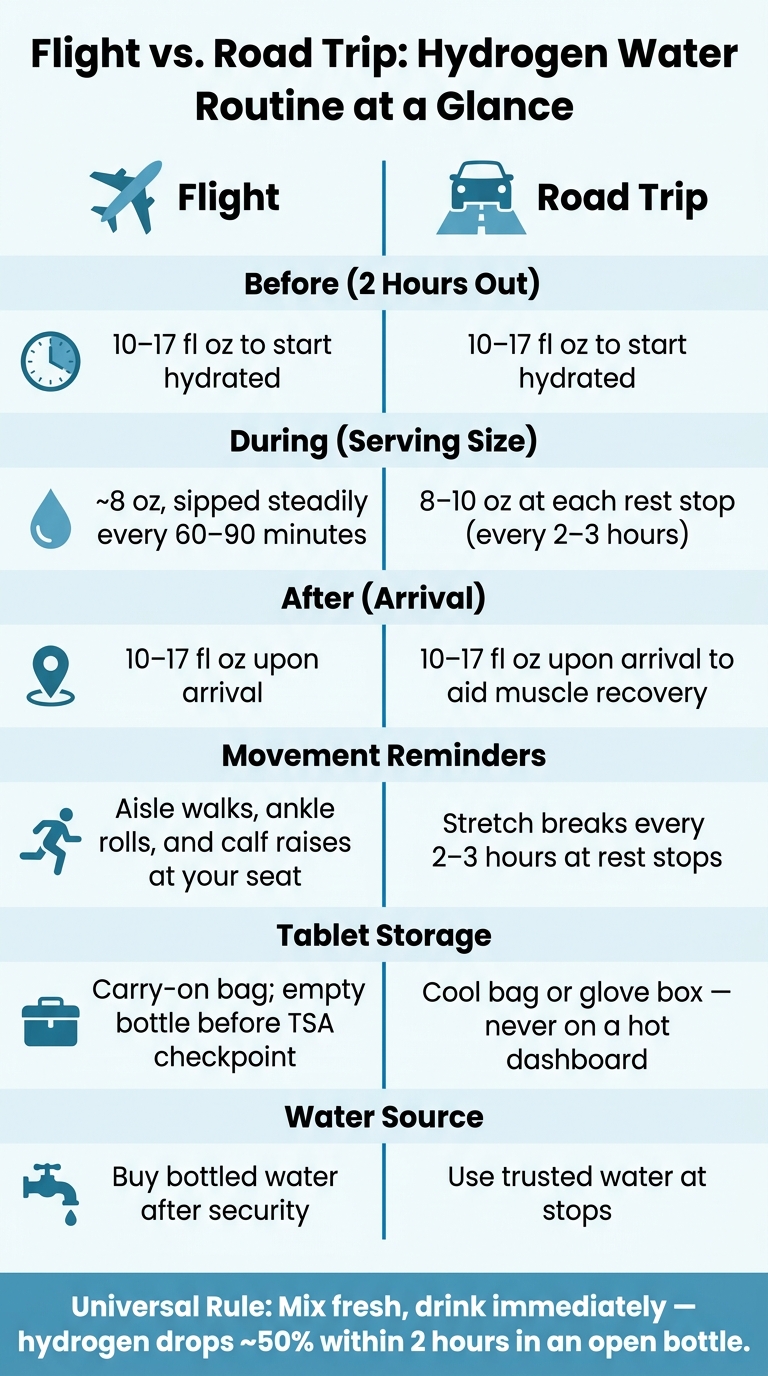
Flight vs. Road Trip Hydrogen Water Routine: A Side-by-Side Guide
The main habit stays the same: drink hydrogen water before, during, and after travel. What changes is the timing. So instead of overthinking it, just match your routine to the kind of trip you're taking.
| Phase | Flight Routine | Road Trip Routine |
|---|---|---|
| Before (2 hours out) | 10–17 fl oz to start hydrated | 10–17 fl oz to start hydrated |
| During (serving size) | ~8 oz, sipped steadily every 60–90 minutes | 8–10 oz at each rest stop |
| After (arrival) | 10–17 fl oz upon arrival | 10–17 fl oz upon arrival to aid muscle recovery |
| Movement reminders | Aisle walks, ankle rolls, and calf raises at your seat | Stretch breaks every 2–3 hours at rest stops |
| Tablet storage | Carry-on bag or personal item; empty your bottle before TSA | Cool bag or glove box, never on a hot dashboard |
| Water source | Buy bottled water after security | Use trusted water at stops |
This side-by-side view makes planning a lot easier. You can sort out your bottle, tablet count, and refill plan before you leave, whether you're heading to the airport or hitting the highway.
Packing Checklist for Travel Days
Once you know when to drink, the next step is simple: pack in a way that makes the routine easy to follow. Only bring what supports your before-, during-, and after-travel servings.
Edenvia Molecular Hydrogen tablets are the easiest thing to pack. A good rule is 4 tablets per travel day, plus a 15%–20% buffer in case of delays or if you end up sharing a serving. After you clear security, mix them with safe water.
| Item | Weekend (3 Days) | One Week (7 Days) | Two Weeks (14 Days) |
|---|---|---|---|
| Tablets | 12 (9 + 3 buffer) | 25 (21 + 4 buffer) | 50 (42 + 8 buffer) |
| Reusable Leakproof Bottle | 1 bottle | 1 bottle | 1 bottle |
| Dry Protective Case | 1 case | 1 case | 1–2 cases |
For flights, keep both your bottle and tablets in your personal item so they’re easy to grab. Bring the bottle empty through the airport, then fill it after security.
For road trips, keep that day’s tablets close by in the center console. Store the extras in a cool, dark glove box. Skip the dashboard for both items, since heat and light can be a bad mix.
A dry protective case helps keep tablets from pulling in moisture.
Next, match your packed items to storage and airline rules.
Safety, Storage, and Airline Rules to Know
Once your tablets and bottle are packed, a few simple travel-day rules can save you a headache.
Edenvia Molecular Hydrogen tablets are dry, which makes travel easy. You can pack them in either your carry-on or checked bag without any special handling. Just keep them in the original packaging, and keep them away from heat and direct sunlight, especially if a bag might sit in a parked car.
Your bottle matters too. If you're bringing a battery-powered hydrogen bottle, pack it in your carry-on ONLY. Devices with lithium-ion batteries need to stay in the cabin, not in checked luggage.
Water quality also matters. If you're not sure about the local water source, mix your tablets with sealed bottled water or water from a trusted filter. And timing counts: freshly mixed hydrogen water is best when you drink it soon after mixing. Aim to drink it within 10 to 20 minutes.
How to Use Hydrogen Water Consistently While Traveling
Once your tablets and bottle are packed, keep the routine simple. Aim for one fresh serving before you leave, one during the trip, and one after you arrive.
Stick with the same pattern every time you travel. Tie each serving to a set moment: leaving home, the middle of the trip, and arrival. That way, the habit stays steady without making travel days feel like a chore.
If you're on a fluid restriction, count each serving toward your daily intake and follow your clinician's guidance.
Conclusion
A hydrogen water travel routine works best when you keep it simple. Drink before you leave, sip at a steady pace while you're in transit, and have more after you arrive. That rhythm makes the habit easy to stick with from departure to arrival.
Edenvia Molecular Hydrogen tablets make the routine easy to carry and easy to follow. Once you've got the hydration part locked in, add a little movement to help you feel better on long travel days.
Pair each serving with a quick walk, ankle rolls, or a short stretch at a rest stop. Those small moves can help offset long hours of sitting. With that habit in place, the routine stays practical from departure to arrival. One bottle, one tube of tablets, and a set schedule are enough to make hydrogen water part of any travel day.
FAQs
Can I pre-mix hydrogen water before leaving?
Yes - but mix it shortly before you drink it if you want to keep as much hydrogen in the water as possible.
Hydrogen tends to dissipate fast, usually within 10 to 20 minutes after you prepare it. So if you wait too long, the water may lose part of what you mixed it for in the first place.
If you need to make it ahead of time, store it in a sealed glass or stainless steel container. That can help reduce hydrogen loss. Even then, for the best freshness and strength, it’s smart to drink it as soon as you can.
How much hydrogen water should I drink while traveling?
Start small with about 8 oz. (250 mL) a day. Then work your way up to 0.5–1.5 L (17–51 oz.) per day as your body gets used to it.
For travel, people often suggest 1–3 cups (300–500 mL) once or twice a day. If you’re on a flight or a long road trip, it helps to sip small amounts on a steady schedule, like every 15–20 minutes.
If you’re new to hydrogen water, go up slowly. That can help you avoid digestive discomfort.
Can I use hydrogen tablets with tap water?
Yes. You can use hydrogen tablets with clean, room-temperature tap water.
For the best results, let the tablet dissolve all the way before you drink it. That usually takes about 90 seconds to 3 minutes.
Then drink the hydrogen-rich water within 15 to 30 minutes.