

Top 5 Ways Hydrogen Water Reduces Inflammation
Hydrogen water may help lower inflammation in 5 main ways: it may cut oxidative stress, lower inflammatory cytokines, calm NF-κB signaling, help protect cartilage cells, and support joint movement.
If you want the short version, here it is:
- It targets harmful free radicals such as hydroxyl radicals and peroxynitrite
- It may lower inflammatory signals like TNF-α, IL-6, and IL-1β
- It may dial down NF-κB, a key pathway linked to long-term inflammation
- It may help protect chondrocytes, the cells that keep cartilage healthy
- It may support mobility, with small human studies in rheumatoid arthritis showing lower DAS28 scores and some remission results
Human research is still limited, but the article points to a few numbers worth noting: a review cited 23 randomized controlled trials on oxidative stress markers, many studies used 1.0 to 1.5 liters per day for 4 to 12 weeks, and one small rheumatoid arthritis study reported remission in 9 of 20 patients by the end of the trial.
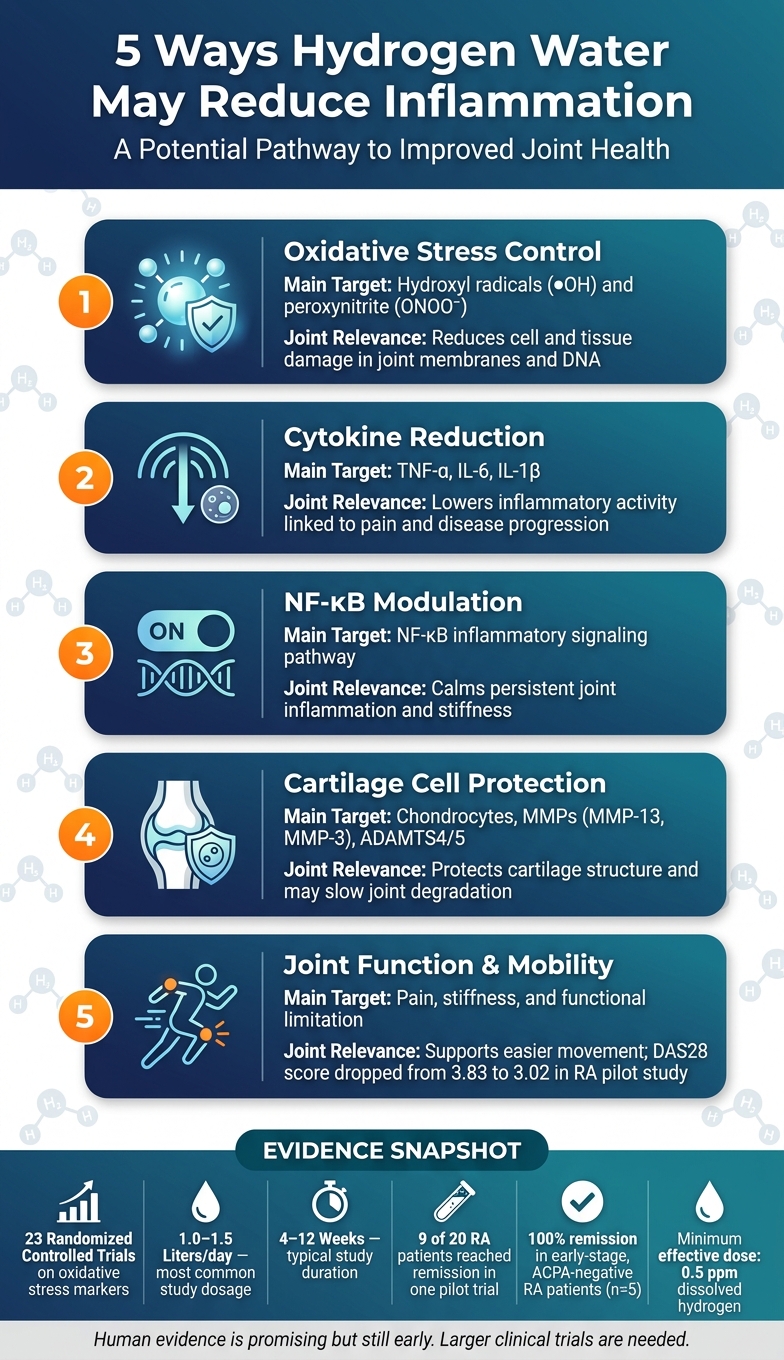
5 Ways Hydrogen Water Reduces Inflammation: Mechanisms & Evidence
What Makes Hydrogen Rich Water So Special for Your Health? | TUH #144
sbb-itb-6860cc4
Quick Comparison
| Way it may work | What it affects | What that may mean for joints |
|---|---|---|
| Oxidative stress control | Harmful ROS | Less cell and tissue damage |
| Cytokine reduction | TNF-α, IL-6, IL-1β | Less inflammatory activity |
| NF-κB control | Inflammatory gene signaling | Less long-term joint irritation |
| Cartilage cell support | Chondrocytes, MMPs | Less cartilage breakdown |
| Mobility support | Pain, stiffness, function | Easier movement in early studies |
I see the main takeaway this way: hydrogen water is not a cure, and the human data is still small, but the early research suggests it may help interrupt the stress-and-inflammation cycle that affects joints.
Why Inflammation and Joint Stress Often Go Together
Joints take a beating over time. Injury, repeated movement, and simple wear with age all add stress. Trouble starts when the body’s repair response doesn’t switch off on time. Instead of calming down, inflammation sticks around. That’s the cycle hydrogen water may help with.
Here’s the problem in plain English: ROS and inflammation feed each other. One sparks the other, and the loop keeps going.
That loop can switch on enzymes called matrix metalloproteinases (MMPs), which break down the cartilage matrix. The same stress can also activate NF-κB, a key driver of inflammatory signaling and cartilage damage.
Next, we’ll break down the five ways hydrogen water may interrupt this cycle.
1. Calming Oxidative Stress
The first mechanism is direct control of oxidative stress in joint tissue. H₂ goes after two of the most damaging reactive oxygen species: hydroxyl radicals (•OH) and peroxynitrite (ONOO⁻). These are major drivers of oxidative damage in joint tissue.
When H₂ neutralizes a hydroxyl radical, it turns into simple water (H₂O). That means no toxic residue is left behind. H₂ also switches on the Nrf2 pathway, which helps the body turn on its own antioxidant defenses, including glutathione, superoxide dismutase (SOD), and catalase. So H₂ may work in two ways: a fast direct effect and a longer-lasting antioxidant response.
Joint-Health Relevance
For joint tissue, this could matter in a few direct ways. Hydrogen water may lower 8-OHdG, reduce MMP activity, and help protect chondrocytes from oxidative damage.
Strength of Evidence
Human research lines up with this pattern. A systematic review of 23 randomized controlled trials found steady drops in oxidative stress markers, along with early joint-specific findings that look promising.
2. Lowering Inflammatory Cytokines
If oxidative stress is the spark, cytokines are the fuel that keeps inflammation going. Hydrogen water appears to act at the signaling level by lowering inflammatory cytokines. The big three here are TNF-α, IL-6, and IL-1β, which play a major part in joint tissue damage in conditions like rheumatoid arthritis (RA).
How H₂ Targets Cytokines
H₂ helps shut down NF-κB, a key inflammation switch. When NF-κB is turned on, it activates the genes that make TNF-α, IL-6, and IL-1β. When that switch is toned down, all three cytokines can drop together.
There’s also human data behind this. A 2020 randomized, double-blind, placebo-controlled trial found that drinking 1.5 liters per day of hydrogen-rich water for 4 weeks significantly downregulated the expression of IL-1β, IL-8, and IL-6 receptor genes in healthy adults.
H₂ also acts on the NLRP3 inflammasome. By lowering mitochondrial reactive oxygen species (mtROS), it can limit NLRP3 activation and block IL-1β maturation.
Joint-Health Relevance
For joint health, this matters because these cytokines don’t just show up in lab results. They help drive pain, stiffness, and tissue breakdown. TNF-α fuels synovial inflammation, IL-6 increases CRP and can make stiffness worse, and IL-1β pushes cartilage degradation.
Strength of Evidence
As of 2026, there are 23 published studies looking at molecular hydrogen in RA. In a 2012 crossover RCT, 20% of patients with early RA reached clinical remission based on DAS28 scores during the hydrogen-rich water treatment phase.
Across trials, the most common intake range was 1.0 to 1.5 liters per day, usually over 4 to 12 weeks.
3. Balancing NF-kB Signaling
NF-κB acts like a main inflammation switch. Once it turns on, it moves into the nucleus and switches on inflammatory genes. In chronic joint problems, that pathway can stay too active and keep the fire burning. And because NF-κB sits upstream from many other inflammatory signals, dialing it down can calm the whole chain reaction.
Primary Pathway
Hydrogen water seems to work upstream by turning down the TLR signaling pathway and the NF-κB cascade at several points. In a July 2020 randomized, double-blind, controlled trial published in Scientific Reports, 38 healthy adults ages 20 to 59 drank 1.5 liters per day of hydrogen-rich water (0.753 mg/L H₂) for 4 weeks. RNA sequencing of their peripheral blood mononuclear cells found lower expression of TLR1, TLR4, and MYD88, along with broader down-regulation of inflammatory and NF-κB gene networks. That matters system-wide, since this same pathway also helps drive inflammation inside joints.
Research also points to another step in the process: H₂ may block phosphorylation of IκBα, p50, and p65, which can help stop NF-κB from entering the nucleus and switching on inflammatory genes.
Inflammation Target
The end result is lower inflammatory gene activity without turning NF-κB off completely.
Joint-Health Relevance
Inside joint tissue, chronically active NF-κB signaling pushes the production of matrix metalloproteinases, especially MMP-13. That enzyme breaks down collagen and aggrecan in cartilage.
Strength of Evidence
One review of musculoskeletal conditions found 45 eligible studies - 25 preclinical and 20 clinical - that support H₂’s role in modulating the NF-κB and JNK signaling pathways. Preclinical models using LPS-induced inflammation also show down-regulation of NF-κB proteins.
That kind of upstream control may help curb cartilage damage, which leads into the next mechanism.
4. Protecting Cartilage Cells
Hydrogen water may do more than calm inflammation. It may also help protect chondrocytes, the cells that keep cartilage healthy. When these cells start to fail, cartilage breaks down faster. And once that happens, the inflammation cycle can keep feeding itself.
Primary Pathway
One main route appears to be the Nrf2-Keap1 pathway. When H₂ activates this pathway, the body increases protective enzymes such as heme oxygenase-1 (HO-1).
Inflammation Target
Hydrogen water may help lower compounds tied to cartilage breakdown, including MMP13, MMP3, ADAMTS5, and ADAMTS4. It may also reduce COX-2, iNOS, and nitric oxide while helping support production of type II collagen and aggrecan.
Joint-Health Relevance
This kind of cell-level protection has shown up in osteoarthritis models. In a rat osteoarthritis model, hydrogen-rich water reduced cartilage damage and chondrocyte apoptosis. It may also help support mitochondrial health in chondrocytes.
Strength of Evidence
Right now, most of the evidence comes from animal and cell studies. Human trials looking at cartilage protection in osteoarthritis are still limited.
"In the future, more in-depth studies and large-scale clinical trials are needed." - Fanxianzi Meng et al., Current Pharmaceutical Design
That kind of cell protection may help explain why hydrogen water is being studied for joint function, not only inflammation control.
5. Supporting Joint Function and Mobility
Put all of those cell-level effects together, and the day-to-day result may be less stiffness and smoother movement. That’s the practical upside seen in early RA research.
How It Shows Up in Joints
When inflammation and oxidative damage are kept in check at the cellular level, the payoff may show up where people feel it most: less tissue breakdown and easier movement, not just nicer-looking lab markers.
In osteoarthritis models, H₂ targets matrix-degrading enzymes while helping support cartilage structure. In rheumatoid arthritis settings, it suppresses the immune-driven signaling tied to joint destruction.
Joint-Health Relevance
A pilot study published in Medical Gas Research followed 20 RA patients at Haradoi Hospital who drank 530 mL of 4–5 ppm hydrogen water per day. After 4 weeks, the mean Disease Activity Score (DAS28) fell from 3.83 to 3.02. By the end of the 12-week trial, 9 out of 20 patients reached remission (DAS28 < 2.3). One detail stands out: 100% of the 5 early-stage, ACPA-negative RA patients achieved clinical remission.
Strength of Evidence
For joint symptoms, the best human data still comes from early rheumatoid arthritis trials. For oxidative stress reduction across the board, a meta-analysis of 23 randomized controlled trials found a steady effect.
For specific joint conditions like RA, the evidence is promising but still early. Most human studies are small, and larger placebo-controlled trials are still needed. For OA, most of the evidence still comes from animal research.
| Condition | Evidence Level | Key Outcome |
|---|---|---|
| Rheumatoid Arthritis | Moderate/Strong | Reduced DAS28 score; remission in early cases |
| Osteoarthritis | Emerging | Cartilage protection; reduced matrix degradation |
| General Joint Pain | Moderate | Reduced oxidative stress (8-OHdG); improved mobility |
Most studies used at least 0.5 ppm.
Here’s a quick mechanism-by-mechanism summary.
Mechanism Summary Table
The table below pulls the five mechanisms into one quick-reference snapshot.
| Mechanism | Main Target | Joint-Health Relevance |
|---|---|---|
| Selective Antioxidant Action | Hydroxyl radicals (•OH) and peroxynitrite (ONOO⁻) | Helps prevent oxidative damage to joint cell membranes and DNA |
| Cytokine Reduction | TNF-α, IL-6, IL-1β, and CRP as a downstream marker | Linked to lower pain and lower disease activity in rheumatoid arthritis |
| NF-κB Modulation | NF-κB inflammatory signaling pathway | Helps calm persistent joint inflammation and stiffness |
| Cartilage Protection | Matrix metalloproteinases (MMPs) and chondrocytes | Helps protect cartilage structure and may slow joint degradation |
| Supporting Joint Function and Mobility | Pain, stiffness, and functional limitation | Supports easier movement and less stiffness |
One detail matters more than it might seem: dose. 0.5 ppm dissolved hydrogen is generally recognized as the minimum threshold for clinical effects, and most studies use at least 0.5 ppm hydrogen and 4 to 12 weeks of daily use.
Conclusion
Taken together, these mechanisms point to a simple idea: hydrogen water may help ease inflammation by lowering oxidative stress, dialing down immune signaling, and helping shield joint tissue. That said, the human evidence is still in its early stages.
That point matters. The results from human studies look promising, but the data set is still small. Most studies have included only a limited number of people, and larger, long-term randomized controlled trials are still needed to confirm outcomes and pin down the best dosing protocols.
If you want to try it, the most common study protocols used 1.0 to 1.5 liters per day for 4 to 12 weeks, with at least 0.5 ppm dissolved hydrogen to support the body's anti-inflammatory response. Edenvia Molecular Hydrogen tablets can be used to make hydrogen-rich water at home.
FAQs
How long does hydrogen water take to work?
Hydrogen water is absorbed fast. In most cases, peak blood levels show up within 5 to 15 minutes.
That said, the effects people notice usually take longer.
With daily use, changes like less joint pain or better mobility are often seen after 7 to 10 days. More gradual effects tied to inflammation and cellular function may take 4 to 12 weeks of steady intake.
Is hydrogen water safe to drink every day?
Yes. Hydrogen water is considered safe for daily use, and human trials have reported no adverse effects. The FDA has also classified hydrogen gas as Generally Recognized as Safe (GRAS) for use in beverages.
Many people drink it each day to help manage oxidative stress and inflammation. Edenvia Molecular Hydrogen tablets make it easy to prepare hydrogen-rich water as part of a daily wellness routine. As with any new health habit, check with your healthcare provider.
Can hydrogen water help both RA and OA?
Research suggests molecular hydrogen may help with both rheumatoid arthritis (RA) and osteoarthritis (OA).
For RA, hydrogen-rich water has been linked to lower oxidative stress and reduced disease activity markers. That matters because both can play a part in how symptoms show up day to day. In plain terms, this may help support better symptom control for some people.
For OA, early research points to antioxidant and anti-inflammatory effects that may help ease pain and support mobility. It’s still early, but the first signals are promising.
Edenvia Molecular Hydrogen tablets offer a simple way to make hydrogen-rich water, which may support joint comfort and overall wellness.