

Hydrogen Water for Non-Alcoholic Fatty Liver Disease
My short answer: hydrogen-rich water may help a little with fatty liver, but it is not a proven treatment. In small human studies, people saw less liver fat, lower AST, and shifts in oxidative stress and mitochondrial markers. But the studies were small, short, and did not show that hydrogen water reverses NAFLD.
If I were putting this in plain English, here’s the takeaway:
- What it may help with: liver fat, AST, and some stress-related markers
- What it has not shown: reversal of disease, fibrosis improvement, or biopsy-proven liver repair
- How it’s used in studies: about 1 liter per day, usually split into 3 servings, for 4 to 8 weeks
- Safety so far: short-term use looks well tolerated, but long-term data are limited
- Best use right now: supportive care alongside weight loss, diet, exercise, and doctor follow-up
A few numbers stand out:
- One pilot study used 1,500 ppb hydrogen water for 28 days
- Another trial followed 30 patients for 8 weeks
- A meta-analysis from 2024 found AST was the liver marker most often improved
- NAFLD affects about 1 in 4 adults worldwide
What matters most is this: the signal is early, not settled. I’d look at hydrogen water as something people may add to a liver care plan, not something that should replace the basics that already matter most.
Quick view:
| Topic | What the article shows |
|---|---|
| Human evidence | Small trials with mixed but somewhat positive results |
| Main effects seen | Lower liver fat, lower AST, better oxidative stress markers |
| Main limits | Short duration, small sample sizes, no direct proof from liver tissue |
| Research dose | Around 1–1.5 L/day, often taken soon after making it |
| Bottom line | Promising, but not proven |
That’s the full picture in simple terms: some early upside, lots of unanswered questions, and no stand-alone role for treatment.
Beneficial Effects of Hydrogen Water on Subjects with NAFLD
sbb-itb-6860cc4
What Human Studies on Hydrogen-Rich Water in NAFLD Have Found
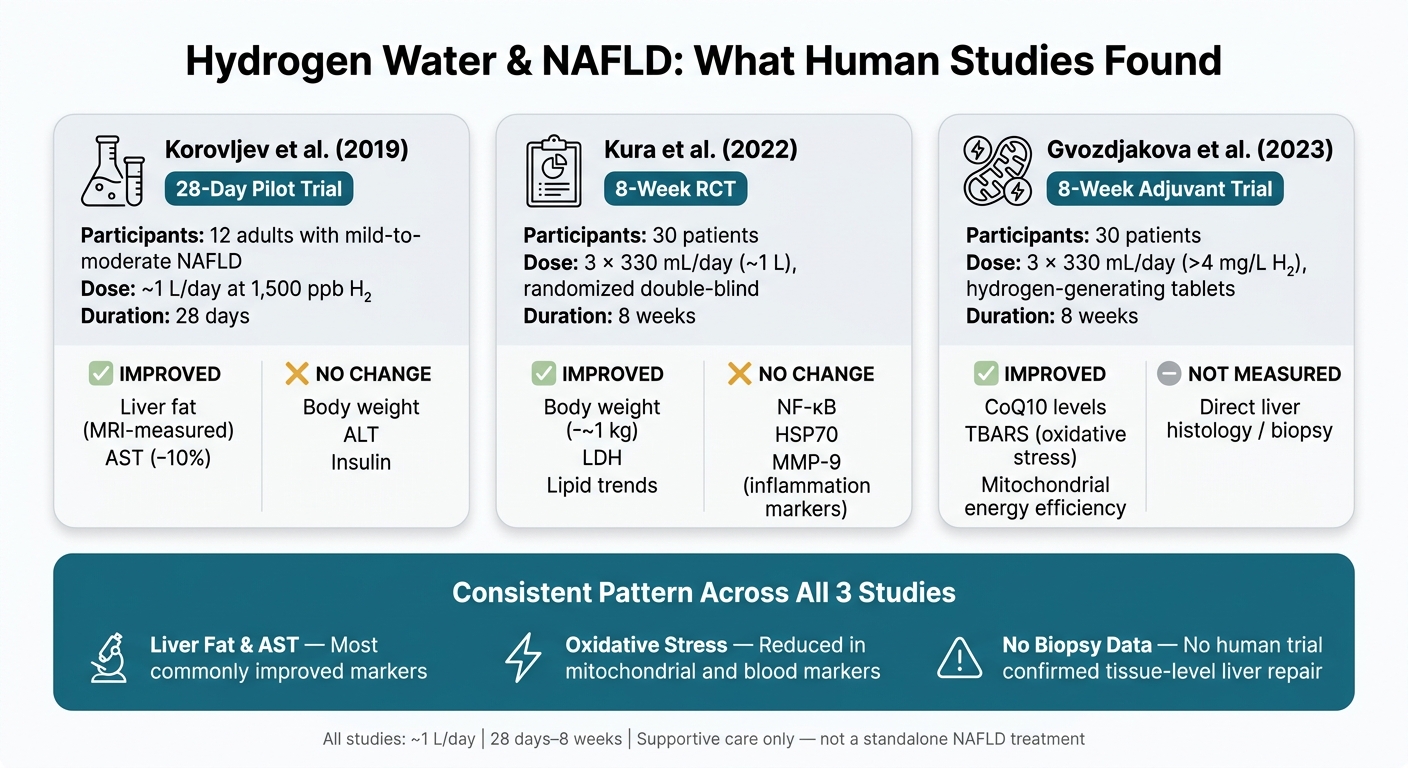
Hydrogen Water & NAFLD: What 3 Human Studies Actually Found
Human trials are still few, and the sample sizes are small. Even so, they give us a first look at what hydrogen-rich water might do in people with NAFLD. The pattern is pretty consistent: these studies do not show reversal of disease, but they do hint at changes in liver fat, oxidative stress, and mitochondrial function.
Pilot Trial: About 1 Liter per Day for 28 Days
In a 28-day pilot trial involving 12 adults with mild-to-moderate NAFLD, drinking about 1 liter per day of 1,500-ppb HRW reduced MRI-measured liver fat and lowered AST by about 10%. ALT, insulin, and body weight did not change.
That matters because the drop in liver fat was measured by MRI, not just guessed from blood work. At the same time, the lack of change in ALT, insulin, and weight shows the effect was limited rather than broad.
8-Week Trial: Three Daily Servings and Metabolic Markers
In an 8-week randomized, double-blind trial of 30 patients, about 1 liter per day was linked to a small drop in body weight and modest shifts in lipids and LDH. Inflammatory markers, however, did not change in a statistically meaningful way.
So the signal here looks mixed. A few metabolic markers moved in a good direction, but the inflammation data did not clearly budge.
Adjuvant Study: Mitochondrial Function, CoQ10, and Oxidative Stress
In an 8-week adjuvant trial of 30 patients, hydrogen-generating tablets increased CoQ10, lowered TBARS, and improved mitochondrial energy efficiency. Those findings came from blood and platelet markers, not from liver tissue itself.
That distinction is a big one. No liver biopsies were taken, so any direct effect inside liver tissue is still unproven.
The table below shows how the studies differ in dose, duration, and main outcomes.
| Study | Design | Daily Dose | Duration | Key Improved Outcomes | Not Significantly Changed |
|---|---|---|---|---|---|
| Korovljev et al. (2019) | Randomized, placebo-controlled | ~1 L (1,500 ppb) | 28 days | Liver fat (MRI); AST (−10%) | Body weight, ALT, insulin |
| Kura et al. (2022) | Randomized, double-blind, placebo-controlled | 3 × 330 mL/day (~1 L) | 8 weeks | Weight (−~1 kg), LDH, lipid trends | NF-κB, HSP70, MMP-9 |
| Gvozdjakova et al. (2023) | Adjuvant, randomized, placebo-controlled | 3 × 330 mL/day (>4 mg/L H2) | 8 weeks | CoQ10, TBARS, mitochondrial energy efficiency | Direct liver histology (not measured) |
Taken together, these studies suggest early movement in a few areas, especially liver fat, AST, and markers tied to oxidative stress and mitochondrial function. That sets up the next part: how molecular hydrogen may act on liver fat, oxidative stress, and mitochondria.
How Hydrogen May Affect Liver Fat, Oxidative Stress, and Mitochondria
The Role of Oxidative Stress and Inflammation in Fatty Liver
NAFLD tends to get worse as oxidative stress climbs. When fat builds up inside liver cells, hydroxyl radicals (·OH) and peroxynitrite (ONOO⁻) can pile up and injure hepatocytes. That damage can switch on the NF-κB pathway, which then increases TNF-α, IL-6, and IL-1β. Those signals can help move simple fatty liver toward NASH and fibrosis.
Hydrogen may help break that loop. H₂ appears to selectively target the most damaging radicals without shutting down normal redox signaling across the board. It may also work through other pathways. Research suggests H₂ can activate AMPK, which may lower hepatic fat buildup, and trigger the Nrf2 pathway, which supports the liver’s own defense systems, including SOD and glutathione.
What Animal Studies Add to the Picture
Animal studies help fill in a gap that human trials often leave open. Human studies can show changes in blood markers and other biomarkers, but animal models let researchers look at what’s happening in liver tissue itself.
That matters here. In a rat NAFLD model, hydrogen-rich saline both prevented and reversed hepatic steatosis. Researchers also saw better liver histology and lower TNF-α and IL-6. In another NAFLD model, hydrogen-rich water activated the Nrf2 pathway, reduced hepatic steatosis, and helped prevent cell aging, or senescence.
Put simply, the biomarker changes reported in humans line up with tissue-level shifts seen in animals.
Mechanisms Across Human and Animal Research: Comparison Table
Human trials mainly show biomarker movement. Animal and cell studies give a closer look at what may be driving those shifts.
| Study Type | Intervention | Dose & Duration | Mechanism Supported |
|---|---|---|---|
| Human Adjuvant (Sumbalová 2023) | HRW tablets (>4 mg/L) | 990 mL/day, 8 weeks | Increased platelet CoQ10; improved mitochondrial OXPHOS; decreased TBARS |
| Human Metabolic (8-week RCT) | HRW | 1.5–2 liters/day, 8 weeks | 39% increase in SOD; 43% decrease in TBARS |
| Animal - Rat (Liu 2011) | Hydrogen-rich saline | Daily, several weeks | Reduced hepatic steatosis; lower TNF-α and IL-6; improved liver histology |
| Animal - NAFLD model (Chen 2020) | Hydrogen-rich water | NAFLD model | Nrf2 activation; reduced hepatocyte senescence; lower oxidative stress |
| Cell Culture | H₂-rich medium | Variable | AMPK activation; reduced lipid accumulation; HO-1/Sirt1 upregulation |
Across both human and animal research, the clearest pattern is lower oxidative stress. Mitochondrial changes, especially in CoQ10 and OXPHOS efficiency, make that pattern easier to believe from a biological standpoint. What’s still missing is direct liver tissue proof from human trials. Those proposed mechanisms help explain why hydrogen keeps drawing attention in NAFLD research, and they set up the next issue: how dosing and day-to-day use may shape results.
Practical Use: How Hydrogen-Rich Water Fits Into a NAFLD Plan
How Hydrogen-Rich Water Is Used in Research Settings
Most NAFLD trials use about 1 liter per day, split into three 330 mL servings, for 28 days to 8 weeks. Because hydrogen dissipates fast, participants usually drink each serving within 15 to 20 minutes of preparation. That detail matters. Once the water is mixed, hydrogen levels can drop in a hurry. In these trials, concentrations have ranged from 0.5 mg/L to more than 4 mg/L.
In research, hydrogen-rich water is used as an adjuvant therapy, alongside standard care and lifestyle changes. Diet and exercise are kept steady so researchers can isolate the effect of hydrogen-rich water instead of mixing it up with other changes.
How Edenvia Molecular Hydrogen Fits In
Edenvia Molecular Hydrogen tablets dissolve in water to make hydrogen-rich water. For NAFLD, they should be used as an adjunct to diet, exercise, weight management, and clinician-guided care. The table below shows the gap between trial conditions and day-to-day use.
Research Trial Conditions vs. Everyday Use: Comparison Table
| Feature | Research Trial Parameters | Practical Everyday Use |
|---|---|---|
| Daily Volume | About 1,000 mL per day, split into three 330 mL servings | About 1–1.5 L per day, often in 3 servings |
| H₂ Concentration | 0.5 mg/L to more than 4 mg/L | Depends on the tablet and preparation |
| Freshness | Each serving consumed within 15–20 minutes of preparation | Prepare and drink right away; don’t let it sit |
| Lifestyle | Standard care with stable diet and exercise routines | Paired with weight management and medical follow-up |
| Monitoring | Frequent blood work and imaging | Periodic check-ins to track ALT, AST, and waist circumference |
One more thing: these trials were short. That means questions around safety and long-term use are still not fully settled.
Safety, Evidence Gaps, and Bottom Line
The early NAFLD signal looks promising, but safety and study quality still set the boundaries of what we can say with confidence.
What Short-Term Safety Data Show
In 4- to 8-week trials, HRW has generally been well tolerated. No serious adverse events were reported, even though researchers saw effects on oxidative stress markers. Since 2014, the FDA has classified molecular hydrogen as GRAS for beverages and allows hydrogen gas at up to 2.14%. A 2024 meta-analysis also found no serious adverse events across the included trials, and AST was the liver enzyme that improved most often.
There is one point worth slowing down for. A small 2023 crossover study in healthy adults found that HRW increased intraocular pressure more often than plain water did, 58% vs. 25%. So if someone has glaucoma or already deals with high eye pressure, it makes sense to talk with a clinician before trying it.
That brings up the bigger issue: not just does HRW help, but how much faith the current data deserves.
What Researchers Still Need to Answer
The main gaps are still pretty clear. Most human studies have looked at liver enzymes and imaging, not fibrosis or biopsy-confirmed liver change. And because these studies were short, they can't tell us whether HRW changes fibrosis or other tissue-level shifts in NAFLD over time.
| Evidence Gap | Current Status | What's Needed |
|---|---|---|
| Study size | Pilot trials of 12–30 participants | Large, multi-center randomized controlled trials |
| Duration | Short-term, usually 4–8 weeks; occasionally up to 24 weeks | Follow-up of 6–12+ months |
| Liver outcomes | Mostly serum enzymes and ultrasound imaging | Biopsy, FibroScan, and fibrosis staging |
| Dosing | Variable, typically 0.5–1.6 mg/L or higher | Standardized protocols for concentration and volume |
| Population diversity | Most data come from Asian and European cohorts | More research in diverse U.S. populations |
Conclusion: Early Promise, Not a Stand-Alone Treatment
Hydrogen-rich water shows early promise for improving liver enzymes and oxidative stress markers in NAFLD. But the human evidence is still limited and mixed, and there is no established ideal dose, concentration, or delivery method. For now, HRW fits best as supportive care alongside diet, exercise, and medical follow-up - not as a replacement for them.
FAQs
Can hydrogen water actually reverse fatty liver?
Research suggests hydrogen-rich water may help manage non-alcoholic fatty liver disease, but it is not a cure.
Some studies have found lower liver fat levels and better liver enzyme markers, including AST. That matters because AST can help show how the liver is doing.
How might it help? The main idea is pretty simple: it may lower oxidative stress and help support healthy inflammation and metabolic function in liver cells. In plain English, it may help the liver deal with some of the stress linked to this condition.
That said, hydrogen-rich water should be used alongside standard medical care, not instead of it. It can be part of the bigger picture, but it shouldn't replace your doctor, your treatment plan, or other medical advice.
How long would I need to drink it to see results?
Some biochemical changes may show up within 4 to 8 weeks of daily use. But for non-alcoholic fatty liver disease, the more meaningful and lasting gains usually take 3 to 6 months of steady supplementation.
Many studies use 1,000 to 1,800 milliliters per day. That said, timing can differ from person to person. Your starting health, daily habits, and how consistently you stick with it all play a part, which is why regular check-ins with your physician matter.
Who should talk to a doctor before trying hydrogen water?
Talk to your doctor before adding hydrogen-rich water if you have NAFLD, NASH, take prescription medications, are pregnant or nursing, or have other health concerns.
Hydrogen water can fit into a wellness routine, but it shouldn't take the place of standard medical care. Your healthcare provider should oversee your full treatment plan.