

Hydrogen Water for Nerve Pain: What Studies Show
Short answer: hydrogen water is not a proven treatment for nerve pain. Most research so far comes from animal studies, where it lowered pain-like behavior and markers of oxidative stress and inflammation. But as of July 14, 2026, there are no large human trials showing that it helps people with sciatica, diabetic neuropathy, or chemotherapy-related nerve pain.
If you want the quick take, here it is:
- What looks promising: animal studies on sciatic nerve injury, diabetic neuropathy, and chemotherapy-related nerve pain
- How it may work: by lowering oxidative stress, calming inflammatory signals, and reducing glial cell activity
- What’s missing: human studies that test pain, sleep, function, and quality of life
- What this means for you: hydrogen water may be a possible add-on, but it should not replace standard care
One more point matters: some animal studies showed better results when hydrogen was started early, sometimes before pain became established. That does not prove it works the same way in humans, but it helps explain why the lab data gets attention.
Here’s the bottom line in plain English: the biology looks interesting, the animal signal is fairly consistent, and the human proof is still not there. If you’re thinking about trying it, treat it like a wellness experiment to discuss with your doctor, not a fix for neuropathic pain.
Using Molecular Hydrogen an Analgesic?
sbb-itb-6860cc4
How Molecular Hydrogen May Influence Pain Pathways
In preclinical nerve pain models, molecular hydrogen seems to disrupt oxidative stress and inflammation through a few main routes. Most of the lab evidence points to hydrogen acting as a selective antioxidant, though human data on these pathways are still limited. Broadly, the proposed effects fit into three areas: redox control, inflammation, and glial modulation.
Antioxidant Effects and Inflammation Reduction
In rodent nerve injury models, hydrogen-rich saline and hydrogen-rich water lowered oxidative stress markers such as malondialdehyde (MDA), myeloperoxidase (MPO), and protein carbonyls in nerve and spinal tissue. Studies also linked hydrogen treatment to higher levels of the body’s own antioxidant enzymes, including superoxide dismutase (SOD), catalase (CAT), and glutathione peroxidase (GPx).
On the inflammation side, animal studies report lower TNF-α, IL-1β, and HMGB1, a signaling protein tied to chronic pain states. In one rat study, intrathecal hydrogen-rich saline suppressed all three markers in the spinal cord and, at the same time, reduced pain sensitivity. Hydrogen has also been shown to inhibit NF-κB signaling and NLRP3 inflammasome activation, two pathways that help keep inflammatory signaling going in neuropathic pain.
Glial Activity, Nrf2/HO-1, and Cellular Stress Responses
Hydrogen may do more than act on oxidative stress directly. It may also affect immune-like cells in the nervous system. In sciatic nerve injury models, hydrogen-rich saline reduced microglial and astrocyte activation in the spinal dorsal horn, which was tied to lower pain signaling. Some studies suggest hydrogen may push microglia away from a pro-inflammatory state, though that part is still being worked out.
The Nrf2/HO-1 pathway adds another piece to the picture. Nrf2 is a transcription factor that switches on antioxidant genes, including HO-1. In chronic constriction injury models, hydrogen activated Nrf2 and increased HO-1 expression alongside lower oxidative damage and less pain behavior. One study found that blocking HO-1 reduced hydrogen’s pain-relieving effect, which suggests this pathway is part of what’s happening. More recent studies also connect hydrogen with autophagy-related stress responses.
These mechanisms come through most clearly in animal work across different nerve pain models.
What Animal Studies Show Across Different Nerve Pain Models
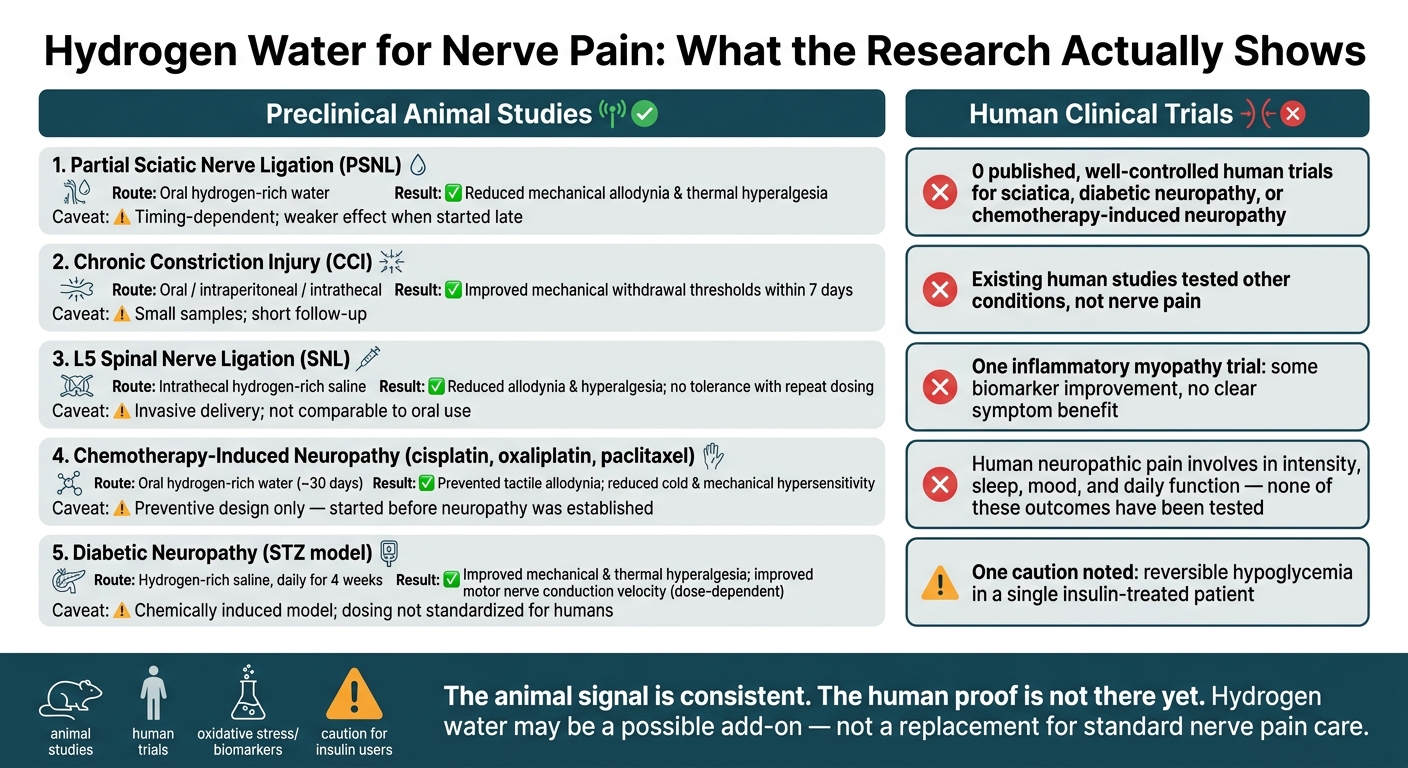
Hydrogen Water for Nerve Pain: Animal Evidence vs. Human Evidence
Animal studies have tested hydrogen-rich water and hydrogen-rich saline in several neuropathic pain models, and the pattern is pretty consistent: less pain behavior and less oxidative damage.
Sciatic Nerve Injury and Spinal Nerve Ligation Studies
In partial sciatic nerve ligation (PSNL) mouse studies, oral hydrogen-rich water given from day 0 through day 21 led to clear drops in both mechanical allodynia and thermal hyperalgesia. When treatment started later, from days 4–21, it still helped thermal hyperalgesia, but its effect on already-established mechanical allodynia was weaker. That points to an important detail: hydrogen may work better when used early, before pain sensitization gets locked in.
A similar trend showed up in other injury models. In chronic constriction injury (CCI) rats, hydrogen treatment lowered spinal cord myeloperoxidase, malondialdehyde, and protein carbonyl levels within 7 days of injury, while also improving mechanical withdrawal thresholds. In L5 spinal nerve ligation (SNL) rats, intrathecal hydrogen-rich saline reduced pain behaviors and cut down cells marked by oxidative DNA damage in the spinal dorsal horn. It also reduced astrocyte and microglial activation. Repeated dosing did not lead to tolerance.
Chemotherapy and Diabetic Neuropathy Models
Chemotherapy-related nerve pain models showed the same general pattern. In cisplatin-induced neuropathy, prophylactic hydrogen-rich water given for about 30 days prevented tactile allodynia from developing in both male and female mice. Oxaliplatin and paclitaxel models showed similar protection against cold and mechanical hypersensitivity. One catch: these were preventive studies, so hydrogen was started before or at the same time as chemotherapy, not after neuropathy was already in place.
In streptozotocin-induced diabetic neuropathy rats, daily hydrogen treatment for 4 weeks improved both mechanical and thermal hyperalgesia. It also improved motor nerve conduction velocity in a dose-dependent way. Alongside those pain-related gains, researchers reported less neuronal apoptosis and lower inflammatory signaling.
What Preclinical Results Mean and Where They Fall Short
Here’s the big picture across the main models:
| Model | Route | Main Pain Outcomes | Oxidative Stress / Inflammation Findings | Key Limitations |
|---|---|---|---|---|
| Partial sciatic nerve ligation (PSNL) | Oral hydrogen-rich water | Reduced mechanical allodynia and thermal hyperalgesia; later treatment period helped hyperalgesia more than allodynia | Reduced oxidative stress markers in spinal cord and dorsal root ganglion tissue | Small animal study; timing-dependent; limited human relevance |
| Chronic constriction injury (CCI) | Oral, intraperitoneal, or intrathecal hydrogen treatment | Improved mechanical withdrawal thresholds; reduced pain behaviors | Lower spinal cord myeloperoxidase, malondialdehyde, and protein carbonyl levels | Small samples; route differences; short follow-up |
| L5 spinal nerve ligation (SNL) | Intrathecal hydrogen-rich saline | Reduced mechanical allodynia and thermal hyperalgesia; no tolerance with repeated dosing | Lower oxidative DNA damage markers; reduced astrocyte and microglial activation | Invasive delivery; rat model; not comparable to oral use |
| Oxaliplatin/cisplatin/paclitaxel neuropathy | Oral hydrogen-rich water | Protective effect on chemotherapy-induced pain behaviors; reduced cold and tactile hypersensitivity | Reduced neuropathy-related oxidative and inflammatory injury | Preventive design only; animal-only evidence |
| Streptozotocin (STZ)-induced diabetic neuropathy | Hydrogen-rich saline, daily for 4 weeks | Improved mechanical and thermal hyperalgesia; improved motor nerve conduction velocity | Reduced neuronal apoptosis; lower inflammatory signaling; dose-dependent benefit | Chemically induced diabetes model; dosing not standardized for humans |
Across these models, hydrogen improved pain behavior and reduced markers tied to oxidative stress. That sounds promising. But there’s a gap between a rat study and day-to-day human treatment.
Most of these studies used small animal groups, short follow-up periods, and in some cases delivery routes that don’t match normal human use, like intrathecal dosing. So while the preclinical signal is consistent, it doesn’t tell us what will happen in people. That’s why the human data matters so much.
Human Evidence, Safety, and Practical Use
Animal results look promising. But when it comes to human neuropathic pain, the answer is still unsettled. The lab and rodent data point in an interesting direction, yet the clinical question is still open.
Why Applying Animal Findings to Humans Remains Uncertain
Right now, there are no published, well-controlled human clinical trials that test hydrogen-rich water for neuropathic pain conditions such as sciatica, diabetic neuropathy, or chemotherapy-induced neuropathy. The human studies that do exist looked at other health issues, not nerve pain, so they don't give us nerve pain-specific results.
One human trial in inflammatory myopathy found no clear symptom benefit, even though some biochemical markers improved and no serious adverse events were reported. That study did note one case of reversible hypoglycemia in an insulin-treated patient. In plain English: hydrogen may affect oxidative stress markers, but that has not led to proven nerve pain relief.
There's also a gap between what rodent studies measure and what people actually live with. In animals, researchers often track reflex responses. Human neuropathic pain is much messier. It affects pain intensity, sleep, mood, and daily function, and hydrogen-water trials have not tested those outcomes.
Safety Profile and Day-to-Day Hydrogen Water Use
The safety picture is more reassuring. Reviews of clinical studies consistently report that molecular hydrogen has a favorable safety profile, with no serious adverse events linked to hydrogen itself across trials using drinking water, inhalation, and saline. The main caution in the human literature is the reversible hypoglycemia seen in that single insulin-treated patient. So if you're managing insulin-dependent diabetes, this is one to take seriously.
There’s also no dosing standard for neuropathic pain. And that matters. A good safety record does not mean it relieves pain.
If you have diagnosed nerve pain, take several medications, or deal with major comorbidities, talk with your healthcare provider before adding hydrogen water to your routine. Think of it as a possible add-on, not a swap. It should complement established care, such as:
- medications like duloxetine or gabapentinoids
- physical therapy
- lifestyle changes
Where Edenvia Molecular Hydrogen Fits
For readers who want a home-use option, Edenvia Molecular Hydrogen fits that wellness use case. Edenvia Molecular Hydrogen offers tablets that dissolve in water to create hydrogen-rich water for antioxidant support and cellular health.
Conclusion: Promising Early Research, but Not a Proven Nerve Pain Treatment
Put it all together, and the picture is pretty clear: the animal research looks encouraging, but it does not show that hydrogen-rich water helps people with nerve pain.
So far, hydrogen-rich water has shown early promise in animal studies. In those studies, it reduced pain-like behaviors and markers tied to oxidative stress. But there’s still a big gap here: no large human trials have tested it for neuropathic pain.
That’s the key point. Promising biology and steady animal findings are not the same thing as proven clinical benefit. Biological plausibility is not clinical proof. What this area needs now are rigorous human trials that measure outcomes people actually care about, such as pain intensity, sleep, and daily function - not just biomarker shifts.
For a home-use option, Edenvia Molecular Hydrogen tablets dissolve in water to create hydrogen-rich water for antioxidant support. Right now, hydrogen water looks like a plausible add-on, not a proven treatment for nerve pain.
FAQs
Can hydrogen water help prevent nerve pain better than treat it?
Hydrogen water seems to work mainly as an antioxidant that gets ahead of the problem, helping lower oxidative stress and support the body’s own defense pathways. That may help protect nerve health before major damage sets in.
With steady use, the effects may build over time, which means it could help prevent nerve-related problems instead of only giving short-term relief.
Why haven’t animal results translated to human proof yet?
Animal studies keep pointing in the same direction: molecular hydrogen may help lower oxidative stress and inflammation. That’s a strong signal.
But the human research is still in its early stages. Trials vary a lot in how hydrogen is given, how long people use it, and which health issues researchers look at. That makes the results harder to compare side by side.
So the animal data looks promising, but more long-term human trials with stronger study design are still needed before those effects can be confirmed in clinical care.
Is hydrogen water safe with diabetes or nerve pain medications?
If you have diabetes and take medication for nerve pain, talk with your healthcare professional before adding hydrogen-rich water.
Molecular hydrogen is generally considered safe. Still, it may improve insulin sensitivity and affect blood sugar levels.
That matters because your doctor may need to adjust your medication dose to help keep your blood sugar stable and safe.