

Hydrogen Water and Mitochondrial Health
Hydrogen-rich water (HRW) is regular water infused with molecular hydrogen (H₂), offering potential benefits for cellular health, particularly mitochondria - the energy producers of cells. Research suggests HRW may reduce oxidative stress, improve energy production, and support mitochondrial repair processes. It selectively targets harmful reactive oxygen species (ROS) while preserving essential signaling molecules. Key findings include:
- Oxidative Stress Reduction: HRW neutralizes harmful ROS and activates internal antioxidant defenses, such as SOD and glutathione.
- Energy Efficiency: Enhances ATP production by improving mitochondrial function and reducing electron leakage.
- Cellular Repair: Regulates mitochondrial fusion, fission, and mitophagy (removal of damaged mitochondria).
Clinical and preclinical studies highlight its potential in improving cardiometabolic health, reducing fatigue, and aiding recovery. However, more research is needed to establish standardized dosing and long-term effects.
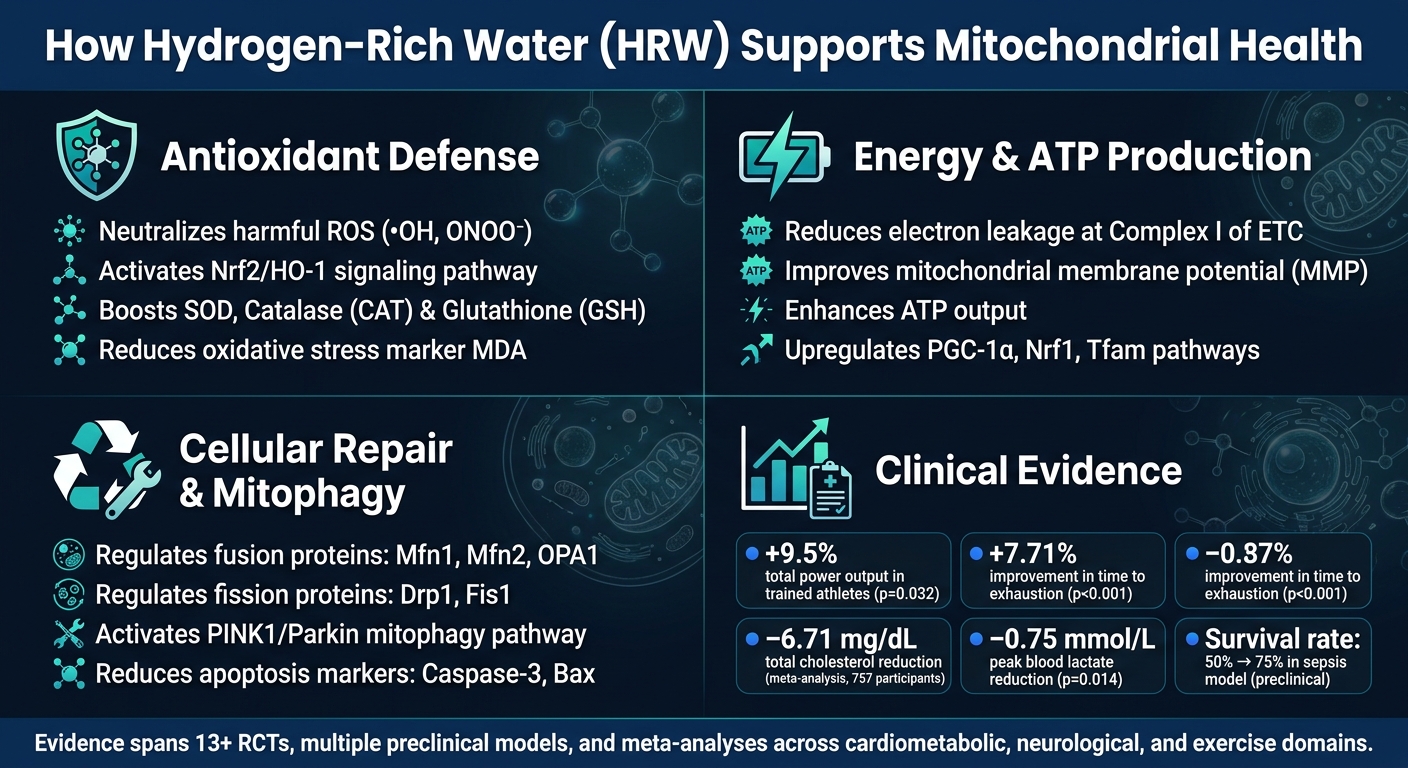
How Hydrogen-Rich Water Supports Mitochondrial Health: Key Mechanisms & Clinical Results
How Hydrogen Water Affects Mitochondria
Antioxidant Action and mtROS Reduction
Mitochondria are the powerhouses of the cell, but their energy production comes with a cost - they release reactive oxygen species (ROS) as a byproduct. While some ROS are essential for cell signaling, excessive amounts can damage mitochondrial components. This is where hydrogen water (HRW) steps in. It targets the most harmful ROS, such as hydroxyl radicals (•OH) and peroxynitrite (ONOO⁻), while sparing the less harmful ones that are vital for cellular functions.
"Hydrogen acts as a therapeutic antioxidant by selectively reducing cytotoxic oxygen radicals." - Ohsawa I., et al., Nature Medicine
In addition to directly neutralizing harmful ROS, HRW activates the Nrf2/HO-1 signaling pathway, which ramps up the production of the body’s own antioxidant defenses. These include Superoxide Dismutase (SOD), Catalase (CAT), and Glutathione (GSH). HRW also reduces markers of oxidative stress, like Malondialdehyde (MDA), which is associated with lipid damage. This dual action - direct scavenging and boosting internal defenses - sets the stage for healthier mitochondrial function.
Effects on Mitochondrial Energy Output
Hydrogen water doesn’t just protect mitochondria; it also helps them work more efficiently. By reducing superoxide generation at Complex I of the electron transport chain (ETC), HRW prevents electron leakage, which would otherwise lead to excess ROS production. This action improves mitochondrial membrane potential (MMP) and enhances the activity of mitochondrial complexes, resulting in better ATP production.
"Mitochondria, known for ATP production, also play crucial roles in diverse cellular functions... H₂ may regulate mitochondrial quality control through diverse pathways in response to varying degrees of mitochondrial damage." - Xiaoyue Zhang, Faculty of Environment and Life, Beijing University of Technology
Interestingly, these energy-boosting effects are most noticeable under stress or disease conditions. In healthy cells, HRW's influence on energy production is more subtle. This adaptability highlights its potential to support cells when they need it the most.
But HRW’s benefits go beyond energy production - it also plays a role in maintaining and repairing mitochondrial structure.
Mitochondrial Dynamics and Cellular Repair
Mitochondria are constantly in motion, adapting to cellular needs through processes called fusion and fission. Fusion helps mitochondria share resources and maintain energy efficiency, while fission removes damaged parts. When this balance is disrupted, it can lead to dysfunction - too much fission fragments mitochondria, and insufficient fusion limits energy distribution.
HRW helps regulate these processes by modulating key proteins like Mfn1, Mfn2, OPA1 (for fusion), and Drp1, Fis1 (for fission), ensuring that mitochondria remain functional and efficient. It also activates mitophagy, a quality-control process that removes damaged mitochondria, through the PINK1/Parkin pathway.
A study published in PLOS ONE in February 2025 by Q. He et al. demonstrated HRW’s long-term benefits. After seven months of HRW treatment (0.5 mg/ml) in stressed mice, researchers observed improvements in mitochondrial biogenesis markers (PGC-1α, Nrf1, Tfam), normalization of mitochondrial quality markers (PINK1, Parkin), increased ATP production, and restored liver enzyme levels (AST, ALT).
"HRW improves mitochondrial biogenesis, function, and ATP production, and attenuates apoptosis by modulating related proteins." - He Q., et al., PLOS ONE
Here’s a quick summary of HRW’s key actions on mitochondria:
| Mechanism | Key Proteins/Markers | Effect |
|---|---|---|
| Antioxidant Defense | SOD, CAT, GSH, Nrf2, HO-1 | Reduces mtROS; boosts internal antioxidants |
| Energy Metabolism | PGC-1α, Tfam, Complex I–V | Enhances ATP production; improves ETC |
| Fusion/Fission Balance | Mfn1, Mfn2, OPA1, Drp1, Fis1 | Maintains mitochondrial structure |
| Cellular Repair | PINK1, Parkin, LC3 I/II, Bcl-2 | Clears damaged mitochondria; reduces apoptosis |
sbb-itb-6860cc4
Tyler LeBaron: Hydrogen Water, Mitochondrial Health, Selective Antioxidants, & Longevity | TUH #265
What Preclinical Studies Show
Preclinical studies using animal and cell models highlight HRW's role in supporting mitochondrial function. These findings expand on earlier discussions of cellular mechanisms, showing HRW's potential benefits across a variety of conditions.
Neurological and Neurodegenerative Models
Research on neurological conditions has shown promising results for HRW in improving outcomes related to sepsis-associated encephalopathy (SAE). A study published in December 2025 by Tianjin Medical University in the European Journal of Medical Research examined SAE in C57BL/6J mice. Using a cecal ligation and puncture model to mimic sepsis, researchers found that inhaling 2% hydrogen for one hour at one and six hours post-surgery increased the 7-day survival rate from 50% to 75%. Additionally, cognitive performance, as measured by the Morris water maze, showed marked improvement.
The study also highlighted that hydrogen boosted SIRT1 expression, which activated PINK1/Parkin-mediated mitophagy in the hippocampal CA1 region. This process reduced levels of pro-inflammatory cytokines (IL-1β, IL-6, TNF-α) and minimized neuronal apoptosis.
"SIRT1-mediated regulation of PINK1-dependent mitophagy [is] the core mechanism through which H₂ attenuates SAE-associated neuroinflammation and neuronal apoptosis." - European Journal of Medical Research
One of hydrogen's key advantages is its ability to cross the blood-brain barrier, allowing it to reach mitochondria in the central nervous system more effectively than most antioxidants.
Cardiometabolic and Exercise Models
HRW has also demonstrated notable effects on metabolic health and physical performance. In a November 2022 study published in Genomics, Sprague-Dawley rats underwent a two-week treadmill training protocol. Molecular hydrogen was shown to improve exercise tolerance and promote mitochondrial biogenesis through the Pparγ/Pgc-1α/Tfam pathway, while also reprogramming skeletal muscle glucose metabolism.
"Hydrogen significantly upregulated genes related to mitochondrial biogenesis, possibly via the Pparγ/Pgc-1α/Tfam pathway." - Genomics
In another study, researchers at Northeast Agricultural University examined Kunming mice over seven months of HRW consumption (0.5 mg/ml) under Chronic Unpredictable Mild Stress (CUMS) conditions. The long-term use of HRW normalized liver enzyme levels (AST and ALT), boosted ATP production, and reduced markers of lipid peroxidation like MDA and 4-HNE. Behaviorally, it alleviated anxiety linked to chronic stress.
"Hydrogen-rich water (HRW) is a promising non-invasive intervention for preventing and treating stress-related liver disorders by targeting oxidative stress and mitochondrial dysfunction." - He et al.
Common Metrics and Outcomes
Across different models, HRW consistently improves several key markers tied to mitochondrial health. The table below outlines these metrics and their observed effects:
| Metric Category | Key Markers | Effect of HRW |
|---|---|---|
| Mitochondrial Biogenesis | PGC-1α, Nrf1, Tfam | Upregulated |
| Energy Metabolism | ATP content, Membrane Potential (MMP) | Increased / Restored |
| Oxidative Stress | ROS, MDA, 4-HNE | Decreased |
| Antioxidant Capacity | SOD, CAT, GSH | Increased |
| Mitophagy | PINK1, Parkin, LC3-II | Promoted |
| Cell Death | Caspase-3, Bax | Decreased / Inhibited |
These consistent outcomes highlight HRW's ability to enhance mitochondrial biogenesis, support energy metabolism, reduce oxidative stress, increase antioxidant defenses, promote mitophagy, and limit cell death. Together, these findings underscore HRW's potential to strengthen mitochondrial function and improve cellular energy processes.
Clinical Evidence: HRW and Human Mitochondrial Health
Recent studies have shown that hydrogen-rich water (HRW) can positively influence mitochondrial function. The findings span areas such as cardiometabolic health, physical performance, and fatigue reduction.
Cardiometabolic Health Improvements
A meta-analysis published in 2026 reviewed 13 randomized controlled trials (RCTs) involving 757 participants and found that HRW consumption led to reductions in total cholesterol by 6.71 mg/dL and LDL cholesterol by 3.21 mg/dL. These changes are believed to help protect mitochondrial membranes from oxidative stress.
One notable study, the HYDRAPPET trial, was conducted at the Applied Bioenergetics Lab at the University of Novi Sad under the leadership of Sergej M. Ostojic. Between April and December 2024, 36 obese participants consumed 1.0 L of HRW daily, delivering 15 mg of molecular hydrogen (H₂), over an eight-week period. The results showed significant reductions in total cholesterol (p = 0.02) and LDL cholesterol (p = 0.04), along with increased plasma GLP-1 levels (p = 0.05).
Another double-blind RCT involving 50 individuals with type 2 diabetes demonstrated that electrolyzed HRW reduced serum lactate, lowered fasting plasma glucose, and improved insulin sensitivity.
These findings suggest that HRW not only supports lipid metabolism but also boosts energy levels and combats fatigue.
Energy Levels and Fatigue Reduction
Clinical trials also highlight HRW's ability to alleviate both physical and perceived fatigue. A meta-analysis of 17 studies revealed that H₂ supplementation reduced the Rating of Perceived Exertion (RPE) by 0.38 (SMD) and decreased blood lactate levels by 0.42 (SMD).
In October 2024, a study led by Yubo Wang and Wenhui Jiao at Beijing Sport University tested the effects of HRW in 18 trained male students (average age 19.7). Over eight days, participants consumed HRW at 1,600 ppb and completed six sets of half-squats at 70% of their one-repetition maximum. The HRW group completed 78.2 total repetitions compared to 70.3 in the placebo group and achieved a total power output of 50,866.7 W versus 46,431.0 W - a 9.5% improvement (p = 0.032).
Another trial, conducted in December 2023 by Nidhal Jebabli and colleagues, involved 22 male amateur middle-distance runners in Tunisia. Participants drank 500 mL of HRW 30 minutes before a Vameval test. Results showed a 7.71% improvement in time to exhaustion (p < 0.001) and a lower RPE compared to the placebo group. These benefits are attributed to hydrogen's ability to diffuse rapidly into mitochondria, where it reduces oxidative stress during exercise.
"H₂, owing to its small size and nonpolar nature, can rapidly and passively diffuse into cells and organelles, including mitochondria, which are the primary sites of ROS production during exercise." - Frontiers in Nutrition
These findings highlight HRW's potential to enhance exercise performance and recovery.
Early Findings and Active Trials
Preliminary trials have begun to explore HRW's role in improving exercise efficiency. For instance, a 2025 pilot trial led by Yuki Muramoto at Keio University School of Medicine studied 50 healthy adults consuming hydrogen-rich jelly (HRJ). Participants took 10 g of HRJ at three intervals before a 30-minute cycling session at 120% of their anaerobic threshold. Results showed the HRJ group had significantly lower peak blood lactate levels (mean difference: -0.75 mmol/L, p = 0.014) and reduced peak VO₂ (difference: -1.17 mL/kg/min, p = 0.017), suggesting greater exercise efficiency.
"HRJ reduced peak blood lactate and VO2, suggesting suppressed metabolite accumulation and improved exercise efficiency." - medRxiv
These early results align with preclinical research on mitochondrial biogenesis and ATP production. Larger, long-term studies are needed to refine dosing strategies and confirm these effects across diverse populations.
Conclusion: HRW and Mitochondrial Health
Key Takeaways from the Research
Studies, both preclinical and clinical, suggest that hydrogen-rich water (HRW) can enhance mitochondrial function. It does this by targeting harmful reactive oxygen species (ROS) and promoting mitochondrial biogenesis through the Pparγ/Pgc-1α/Tfam pathway. Regular use of HRW has been linked to higher ATP production, fewer markers of muscle damage, and better endurance.
"The ability of H2 to sustain redox homeostasis serves to protect against the structural and functional disruption of muscle tissue and reduce fatigue, leading to an improvement in exercise endurance." - Frontiers in Nutrition
What Future Research Needs to Address
Although the findings are encouraging, much of the evidence comes from animal studies and smaller human trials. Key areas needing further exploration include standardized dosing, differences in responses based on sex, and precise measurements of hydrogen bioavailability. While the proposed molecular pathways are promising, more rigorous research is essential to confirm these mechanisms and establish clear clinical guidelines. These gaps highlight exciting opportunities for advancing wellness solutions.
Edenvia Molecular Hydrogen: Supporting Cellular Health

For those looking to incorporate HRW into their daily lives, options like Edenvia Molecular Hydrogen provide an easy way to tap into its potential benefits. These tablets dissolve in water to create HRW, designed to target harmful ROS - the very mechanism highlighted in current studies. With third-party lab testing and a focus on reducing oxidative stress and aiding recovery, Edenvia offers a practical approach to supporting cellular health. Plus, their 30-day money-back guarantee ensures peace of mind for first-time users.
FAQs
How much hydrogen-rich water should I drink per day?
Research indicates that the ideal daily intake of hydrogen-rich water varies based on health goals. Studies often suggest consuming between 0.6 and 1.5 liters per day. For instance, drinking 1.5 liters daily has been associated with reducing chronic fatigue, while approximately 0.9 liters may help support metabolic health. With Edenvia Molecular Hydrogen tablets, you can easily prepare hydrogen-rich water, which may promote cellular health and help fight oxidative stress.
How fast does hydrogen-rich water leave the body after you drink it?
Molecular hydrogen's exact rate of exit from the body isn't clearly defined by research. However, due to its small size and nonpolar nature, it swiftly diffuses into cells and organelles. Acting as a selective antioxidant, it neutralizes harmful free radicals, turning them into water. Edenvia Molecular Hydrogen enhances this process by producing hydrogen-rich water, which helps combat oxidative stress and supports cellular health, contributing to overall well-being.
Who should avoid hydrogen-rich water or ask a doctor first?
Molecular hydrogen is considered safe for most people. However, some individuals should check with a healthcare provider before consuming hydrogen-rich water, particularly if it includes magnesium salts. These groups include:
- Pregnant or breastfeeding women
- Children under 18
- Individuals with kidney disease, as they may need to monitor fluid intake
- People with diabetes, since it could influence insulin sensitivity
If you're uncertain, it's always a good idea to consult a medical professional.