

Hydrogen Water and Mitochondria: Energy and Nutrient Synergy
Here’s the short answer: hydrogen-rich water may help with energy, recovery, inflammation, and nutrient use - but the best human data so far points more to metabolic markers and exercise recovery than to direct proof of better mitochondrial output.
If I strip the article down to what matters most, this is it:
- Hydrogen water is plain water with dissolved H2
- H2 may help lower damage from hydroxyl radicals and support redox balance
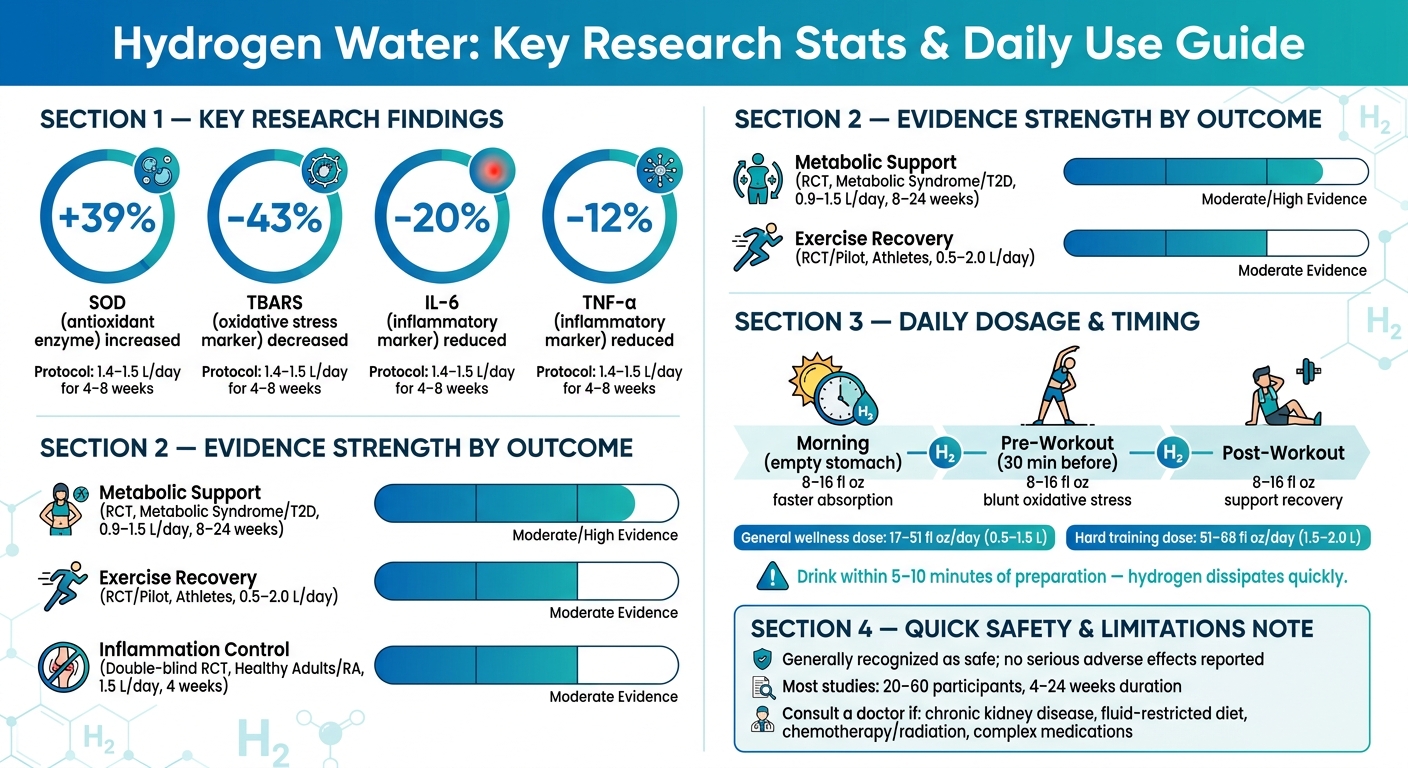
- Studies have linked it with lower lactate, less muscle damage, and shifts in markers like SOD (+39%) and TBARS (-43%)
- Some trials also reported lower inflammatory markers like IL-6 (-20%) and TNF-α (-12%)
- Most studies used 0.5 to 1.5 liters per day, with some exercise studies going up to 2.0 liters
- The research is still limited by small sample sizes and short study periods
What this means for you: if you want to try hydrogen water, the most sensible use case is as a small add-on for training recovery, metabolic support, or daily wellness - not as a fix-all.
A few practical takeaways stand out right away:
- Drink it soon after it’s made, since dissolved hydrogen fades fast
- Use it consistently for weeks, because that’s how studies were run
- Morning use or pre-/post-workout timing is the most common setup
- If you have kidney disease, fluid limits, cancer treatment, or a complex medication plan, talk to your clinician first
I’d frame the article’s main idea like this: hydrogen water may support how your cells handle stress, and that can affect energy, recovery, gut comfort, and nutrient handling. But the evidence is still early, so it makes more sense to view it as one part of a basic routine built on sleep, food, and movement.
Hydrogen Water: Key Research Stats & Daily Use Guide
How Molecular Hydrogen May Support Mitochondrial Energy
Mitochondria, ATP, and Oxidative Stress in Plain Terms
Mitochondria take the food you eat and the oxygen you breathe and turn them into ATP, the cell’s main energy supply. It’s a bit like a power plant running all day inside your cells.
But the system isn’t perfect. When electrons slip out of the electron transport chain, they form ROS, which can damage mitochondrial membranes and DNA. Mitochondrial DNA is hit especially hard by oxidative damage. When ROS builds up too much, energy production can get less efficient, fatigue can creep in, and apoptosis can start.
How Hydrogen May Protect the Electron Transport Chain and Redox Balance
Molecular hydrogen works in a selective way. It targets the most harmful free radicals, especially hydroxyl radicals (·OH) and peroxynitrite (ONOO⁻), while leaving helpful ROS alone.
That’s a big deal because the body still uses some ROS for immune signaling and cell adaptation. If you wipe out all ROS, you can create a new problem. H₂ moves fast through cell membranes and may help keep mitochondrial redox balance steady.
With repeated H₂ exposure, research also points to activation of the Nrf2 pathway. That pathway helps the body step up its own antioxidant systems, including glutathione and superoxide dismutase. And that kind of redox support may reach beyond energy production alone. It may also affect gut function, which is where nutrient absorption starts.
What Better Mitochondrial Function Can Mean Day to Day
On a day-to-day level, this may show up in ways people can feel. In studies, H₂ has been linked to lower exercise lactate, less perceived effort, and smaller post-workout damage markers, including creatine kinase, for up to 72 hours after exercise.
That same steadier redox state may also help support digestion and how the body uses nutrients.
sbb-itb-6860cc4
Tyler LeBaron: Hydrogen Water, Mitochondrial Health, Selective Antioxidants, & Longevity | TUH #265
Nutrient Synergy: Gut Function, Absorption, and Metabolic Support
Energy relies on ATP production, nutrient use, and gut health all pulling in the same direction. That’s most clear in the places where the body absorbs nutrients and puts them to work.
How Redox Balance May Improve Nutrient Use
In people with metabolic syndrome, hydrogen water intake led to a 39% increase in superoxide dismutase (SOD) and a 43% decrease in TBARS, a marker of oxidative stress. Human trials have also shown measurable improvements in fasting glucose and LDL oxidation.
Taken together, these changes point to cleaner fuel handling. The body may be dealing with less cellular wear, which can leave more room for day-to-day metabolic work instead of using extra energy to manage stress.
Hydrogen Water, Gut Barrier Health, and Nutrient Absorption
That same shift may help the gut barrier, where nutrient absorption starts. H₂ is absorbed across the gut epithelium within 5 to 10 minutes of consumption. Research also suggests it may reduce intestinal inflammation by lowering cytokines like IL-6 and TNF-α - down 20% and 12%, respectively, after drinking 1.4 to 1.5 liters of hydrogen-rich water daily for 4 to 8 weeks.
Lower gut inflammation may help the barrier do its job better, which can support nutrient handling. H₂ also appears to support liver transport proteins that help clear toxins from the liver into bile. That links the gut-liver axis with smoother nutrient use across the system.
How This Connects to Inflammation, Comfort, and Recovery
For adults dealing with joint discomfort, slower recovery, or fatigue, this chain of effects matters. If systemic inflammation drops, the body may be able to put more energy toward repair and movement instead of stress response. That loops back to steadier energy production and the day-to-day vitality linked with healthy mitochondrial function.
The next section separates these mechanisms from the human evidence.
What the Research Shows and How to Use Hydrogen Water Daily
Human and Animal Research on Energy, Fatigue, and Metabolic Markers
Human research is growing. Right now, the strongest support points to recovery and metabolic markers.
The findings tend to fall into three practical buckets:
| Outcome Area | Study Type | Population | Typical Protocol | Strength of Evidence |
|---|---|---|---|---|
| Metabolic Support | RCT | Metabolic Syndrome / Type 2 Diabetes | 0.9–1.5 L/day for 8–24 weeks | Moderate/High |
| Exercise Recovery | RCT / Pilot | Athletes / Active Adults | 0.5–2.0 L/day; pre- and post-workout | Moderate |
| Inflammation | Double-blind RCT | Healthy Adults / RA Patients | 1.5 L/day for 4 weeks | Moderate |
Put simply, the best human data center on metabolic health, exercise recovery, and inflammation control. Of those, the most steady support shows up in metabolic health and exercise recovery.
Safety, Evidence Limits, and When to Talk to a Clinician
Before you make hydrogen water a daily habit, it helps to look at both safety and the gaps in the research.
Molecular hydrogen is generally recognized as safe and well tolerated. Across dozens of human trials, researchers have not reported serious adverse effects. Your body also makes hydrogen on its own, which may help explain why people tend to tolerate it well.
Still, there are some clear limits. Most human studies include 20 to 60 participants and last 4 to 24 weeks. And while the mechanism looks promising, direct measurement of mitochondrial respiration in human tissue is still missing. So the science has a solid mechanistic story, but large-scale clinical proof is still not in hand.
Talk with your doctor before adding hydrogen water if you:
- have chronic kidney disease
- follow a fluid-restricted diet
- are undergoing chemotherapy or radiation
- manage a complex medication schedule
Daily Intake, Timing, and Meal Pairing for U.S. Readers
Once safety and evidence are on the table, daily use mostly comes down to timing and sticking with it.
For general wellness, most studies use 0.5 to 1.5 liters per day, or about 17 to 51 fl oz. For hard training, some exercise studies go up to 1.5 to 2.0 liters per day, which is about 51 to 68 fl oz.
Timing matters more than many people think. Drinking it on an empty stomach first thing in the morning may allow faster absorption. If you're training, having 8 to 16 fl oz about 30 minutes before exercise may help blunt oxidative stress during the session. Then another serving after training may help with recovery.
One practical detail matters a lot: drink hydrogen water soon after it's prepared. Dissolved hydrogen can dissipate within 5 to 10 minutes, so if it sits too long, you get less of what you're paying for.
And this part is easy to miss: the changes seen in research come from weeks of steady use, not a few days here and there.
Using Edenvia Molecular Hydrogen for a Simple Daily Routine
How Edenvia Tablets Fit an Energy and Recovery Routine
If you want a routine that doesn't add friction to your day, Edenvia makes the habit pretty easy. The tablets turn plain water into hydrogen-rich water in a simple, everyday format. Drop one tablet into 8 to 16 fl oz of water, wait about 3 minutes for it to dissolve, and drink it within 10 to 15 minutes.
Most people use one tablet once or twice a day. Common times include the morning, before a walk or workout, or with a main meal. That gives you a simple way to work it into an energy and recovery routine without overthinking it.
If you're after the bare-bones setup, the main things to look at are dose and price.
Product Details U.S. Readers May Want to Know
Edenvia tablets are third-party lab tested for quality and hydrogen concentration. Orders also come with a 30-day money-back guarantee.
- Single purchase: $33.95
- Buy 1, Get 1 Free: $16.98/unit
- Buy 2, Get 2 Free: $12.76/unit
Those basics make it easier to stick with the routine day after day.
Key Takeaways on Hydrogen Water, Mitochondria, and Nutrient Synergy
The main point is straightforward: Edenvia lines up with this guide's core idea - molecular hydrogen may help support energy, recovery, and nutrient use through redox balance. The research looks promising, especially around metabolic health, exercise recovery, and inflammation control, but it's still taking shape.
A practical way to use it is simple: take the tablets on a steady basis, pair them with meals or workouts, and treat them as one part of a broader energy routine built on solid sleep, a nutrient-dense diet, and regular movement.
FAQs
Can hydrogen water really boost cellular energy?
Yes. Hydrogen water may help support cellular energy production by helping maintain mitochondrial function. Molecular hydrogen can reach the mitochondria and work as a selective antioxidant, which may help limit free radical damage to mitochondrial membranes, DNA, and the electron transport chain.
Research also suggests it may help support ATP synthesis by lowering excess superoxide production and supporting electron transport. In plain terms, that can help cells make energy more efficiently.
How long does it take to notice results?
Molecular hydrogen is absorbed fast and may show up in the breath within 1 minute of consumption.
Some people may notice short-term effects soon after taking it, especially around exercise recovery or post-meal oxidative stress.
For more measurable support for energy, metabolic markers, and mitochondrial function, consistent daily use for 1 to 2 weeks is usually needed.
Who should avoid hydrogen water or ask a doctor first?
Talk to a healthcare provider before using hydrogen water if you're pregnant or breastfeeding, under 18, or have kidney disease or diabetes.
You should also check with a doctor if you take blood pressure or diabetes medication, or if you keep having bloating, gas, or diarrhea after drinking it.