

Science Behind Hydrogen Water and Mindfulness
Here’s the short answer: mindfulness has stronger human research for stress, attention, and mood, while hydrogen-rich water (HRW) shows early but limited human results, mostly for mental fatigue and a few cognitive markers.
If you want the plain version, this article comes down to four points:
- Mindfulness has better support for stress control, attention, and emotional regulation.
- HRW is still being studied, with small human trials and stronger animal data.
- Some pathways overlap, like inflammation, oxidative stress, and autonomic balance.
- There is no solid proof yet that using HRW and mindfulness together works better than either one alone.
A few data points stand out:
- In a 1-year study of 73 adults with mild cognitive impairment, HRW showed no overall cognitive gain, though a very small subgroup showed some improvement.
- In a 24-hour sleep-loss trial with 16 young adults, a single 500 mL dose of 8 ppm HRW was linked to better test performance for attention and mental fatigue.
- In a 3-month panic-disorder trial, HRW did not beat psychological treatment for anxiety, though some inflammation markers went down.
If I boil it down even more, it’s this: <u>mindfulness looks like the more proven option for day-to-day stress support</u>, and HRW looks more like an optional add-on with limited human evidence so far.
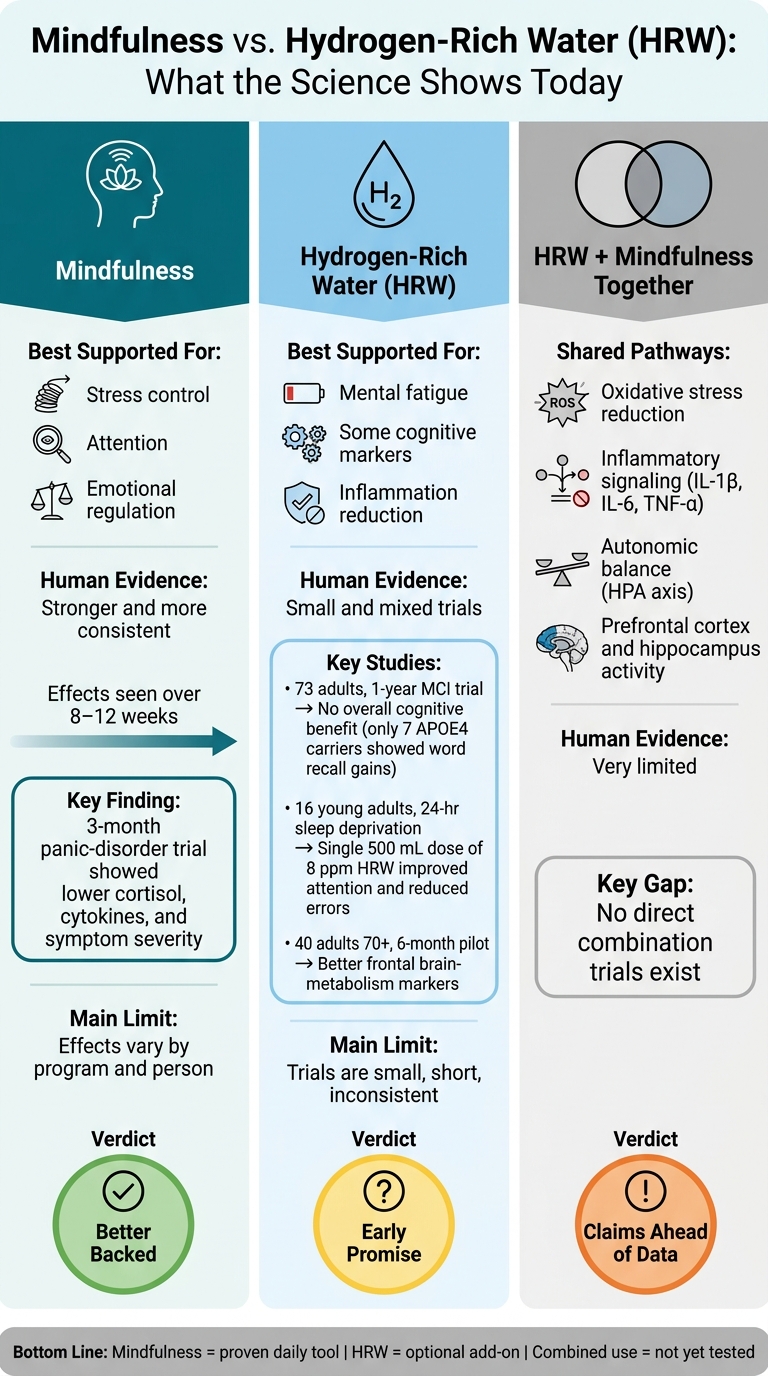
Mindfulness vs. Hydrogen Water: What the Science Actually Shows
What You Need to Know About HYDROGEN with Dr. Shigeo Ohta
sbb-itb-6860cc4
Quick comparison
| Topic | What research supports best | Human evidence | Main limit |
|---|---|---|---|
| Mindfulness | Stress, attention, emotion regulation | Stronger and more consistent | Effects still vary by program and person |
| Hydrogen-rich water | Mental fatigue, a few cognitive signals, inflammation markers | Small and mixed | Trials are small, short, and not consistent |
| HRW + mindfulness together | Shared stress-related pathways | Very limited | Direct combo trials are missing |
So if you’re reading this to figure out what the science says today, the answer is simple: mindfulness is better backed, HRW is still early, and combined claims are ahead of the data.
Hydrogen-Rich Water and Brain Health: What Studies Report
The evidence here comes from animal work, small pilot studies, and a handful of randomized trials. Human results are still early, and they don't line up as neatly as the animal data. So far, the clearest signs in people show up in cognition and short-term mental fatigue.
Cognitive Function, Memory, and Mild Cognitive Impairment
Some of the clearest human data comes from a 1-year randomized study of 73 adults with mild cognitive impairment (MCI). In that trial, participants drank about 300 mL of HRW per day. There was no overall cognitive benefit, but APOE4 carriers showed gains in word recall and ADAS-cog scores. That's interesting, but there's a catch: the finding came from only 7 people, so it needs to be repeated before much weight is put on it.
Animal studies show a broader pattern. In aging mouse models (SAMP8), 26 to 28 weeks of HRW treatment improved spatial working memory and lowered brain IL-6 levels. In DAL101 mice, HRW lowered oxidative stress markers and reduced hippocampal damage and glial activation. Those results are promising, but animal data doesn't automatically carry over to people. That's where things often get messy.
A separate 6-month pilot study looked at 40 adults age 70 and older. In that study, drinking 0.5 liters of 15 ppm HRW daily was linked to better frontal brain-metabolism markers and a nonsignificant trend toward better sleep.
Mood, Stress, Sleep, and Mental Fatigue
The stress-related research follows a similar pattern. Animal findings look stronger, while human results are more mixed.
In a chronic unpredictable mild stress (CUMS) mouse model, 4 weeks of HRW treatment at 0.8 ppm prevented depressive-like behavior and suppressed elevated IL-1β protein levels in the hippocampus and cortex.
The human data looks more solid when the focus shifts to acute mental fatigue. In a randomized crossover trial, 16 healthy young adults with a mean age of 24 stayed awake for 24 hours and then drank a single 500 mL dose of 8 ppm HRW. Compared with a control drink, they finished the Trail-Making Test much faster and made fewer errors on the Symbol Digit Modalities Test (SDMT).
MRI spectroscopy added another piece to the picture. It showed higher choline-to-creatine ratios in the frontal white and gray matter, which suggests a positive effect on region-specific metabolism tied to executive function and attention. Since those brain systems also overlap with stress response, the next step is to ask whether mindfulness and hydrogen water act on some of the same stress pathways.
Mindfulness Research and Biological Overlap With Hydrogen Water
How Mindfulness Affects Stress, Attention, and Emotional Regulation
This overlap matters because mindfulness may act on some of the same stress systems seen in hydrogen-water research. In controlled studies, mindfulness programs have shown steady gains over 8–12 weeks, with lower cortisol and inflammatory markers, plus better attention and emotion regulation. In a 3-month panic-disorder trial, psychological treatment lowered CAR, cytokines, and symptom severity.
Shared Mechanisms: Oxidative Stress, Inflammation, and Autonomic Balance
Mindfulness and hydrogen water seem to touch a few of the same biological pathways. The main ones are oxidative stress, inflammatory signaling, and HPA-axis activity.
Molecular hydrogen has been reported to lower pro-inflammatory cytokines such as IL-1β, IL-6, and TNF-α. It has also been linked with antioxidant defenses like SOD and catalase.
Autonomic balance is another point of overlap. Mindfulness is linked with better autonomic balance and lower sympathetic tone. Hydrogen research points in a similar direction, with shifts in autonomic balance and heart rate, including a short-lived autonomic shift followed by recovery and a lower heart rate.
That shared biology - reaching across areas like the prefrontal cortex and hippocampus - helps explain why this comparison stands out. At the same time, direct evidence on using both together is still limited.
What Researchers Can and Cannot Conclude Today
Where the Evidence Looks Most Promising
Taken together, the findings show early promise, not proof. Animal studies point to neuroprotection, but the human data is still thin. In one small sleep-deprivation trial, people showed better attention after a single dose of hydrogen-rich water, but the study included just 16 participants. Brain imaging in that same line of research also pointed to short-term metabolic shifts in frontal regions.
Mindfulness fits into this picture for a simple reason: both mindfulness and hydrogen water have been linked to oxidative stress and autonomic balance. That said, the shared ground is still just that - shared ground. Researchers have not yet tested them as a paired intervention.
Current Gaps, Study Limits, and Why Combined Claims Are Premature
Right now, the main problem is the evidence base itself. Most trials are small, short, and uneven in dose, delivery method, and control design. There is still no large-scale, long-term randomized controlled trial testing hydrogen water and mindfulness together.
As Sergej M. Ostojic of the University of Novi Sad put it:
"Before recommending water infused with hydrogen to the general public, further robust randomized controlled trials are obligatory... to detect any rare and/or long-term adverse events over a large patient population."
So where does that leave things? Preclinical neuroprotection looks strongest. Human cognitive results are still early. Mood findings are mixed. And the combo of hydrogen water plus mindfulness has not been tested head-on. That's the key gap, especially if you're trying to turn lab findings into something people can use in a daily mindfulness routine.
Practical Takeaways for a Mindfulness-Oriented Wellness Routine
How Hydrogen Water Is Used in Research and Daily Wellness Contexts
Research has looked at both daily use over several weeks and single, short-term doses. That pattern points to HRW being studied more like a steady routine than a one-off fix.
Human trials have also reported few short-term side effects, which is one reason HRW is fairly easy to try in wellness settings. Still, some groups don't show up much in the research. If you're pregnant, have a chronic condition, or take medication on a regular basis, it's smart to check with a clinician before trying HRW.
So the main question isn't just about biology. It's more practical: what does the evidence support for day-to-day use?
Conclusion: The Key Points Readers Should Take Away
The main takeaway is straightforward. Mindfulness has stronger direct evidence for stress, attention, and emotional regulation. HRW still looks promising, but its use alongside mindfulness hasn't been tested in large clinical trials.
Use HRW as an optional wellness add-on, not as a replacement for medical care or mental health treatment.
FAQs
Is hydrogen water worth trying for stress?
Yes. Early research suggests hydrogen-rich water may help with stress by lowering oxidative stress and neuroinflammation, two issues that can play a part in anxiety and mental fatigue.
Some studies also report better mood, less anxiety, and improved autonomic nervous system function during periods of daily stress. Edenvia Molecular Hydrogen tablets offer a simple way to make hydrogen-rich water as part of an overall wellness routine.
Can hydrogen water replace mindfulness practice?
No. Hydrogen water cannot replace mindfulness practice.
Some studies suggest molecular hydrogen may help support mental well-being by lowering oxidative stress and neuroinflammation. But that doesn't make it a mental health treatment.
Think of hydrogen-rich water as a support tool, not a substitute. It may help support the body’s biological environment, but it should be used alongside mindfulness and other established mental health strategies - not instead of them.
Who should talk to a doctor before using HRW?
Talk to your doctor before using hydrogen-rich water if you're pregnant, breastfeeding, under 18, or have kidney disease or diabetes.
If you have kidney problems, you may need to watch your total fluid intake. If you have diabetes, a doctor may need to monitor your medications and make changes if needed. Before adding any new supplement to your routine, get medical advice.