

How Hydrogen Water Helps Manage Blood Sugar
Hydrogen-rich water may help support blood sugar control, but it is not a treatment on its own. In studies, it was linked with lower fasting blood glucose, lower HbA1c, and better markers of inflammation and oxidative stress in some adults with metabolic syndrome or impaired fasting glucose.
Here’s the short version:
- Diet, exercise, sleep, and medication still come first
- Hydrogen water may help lower oxidative stress, which can affect insulin function
- Some studies lasted 12 to 24 weeks and showed drops in glucose markers
- It seems to work best as an add-on habit, not as a replacement for care
- If you take insulin or blood sugar drugs, talk with your clinician before using it daily
A few numbers stand out. One 24-week trial found lower fasting glucose and HbA1c in people using high-dose hydrogen-rich water. Another 3-month trial with 181 participants found blood sugar markers went down in the hydrogen water group and went up in the control group.
So if you want the plain answer: hydrogen water may help some people support blood sugar balance by lowering oxidative stress and inflammation, but the research is still limited, and results can vary.
What matters most is how I’d use that information: keep expectations realistic, use it with standard care, drink it soon after making it, and track glucose, meals, and activity for 8 to 12 weeks before judging whether it helps.
Why I Changed My Mind About Hydrogen Water (with Tyler LeBaron)
sbb-itb-6860cc4
Why Blood Sugar Balance Is Hard to Maintain
Blood sugar control usually doesn't go off track all at once. It tends to slip bit by bit, shaped by what you eat, how much you move, how well you sleep, and the metabolic strain your body is dealing with in the background.
About 37.4 million Americans have impaired fasting glucose (IFG), which is one sign that blood sugar control is starting to drift. This shift often builds over years, not days. Biology plays a part, but daily habits matter too. Common drivers include eating too many refined carbs, drinking sugary beverages, sitting too much, and not getting enough sleep.
Over time, those habits can feed chronic low-grade inflammation and oxidative stress. And that can slowly wear down the body's ability to regulate glucose. As that strain builds, insulin signaling, inflammation, and oxidative stress can start pushing each other in the wrong direction.
How Insulin Resistance, Inflammation, and Oxidative Stress Are Connected
When you eat, your pancreas releases insulin to help move glucose from your bloodstream into your cells. In a healthy system, that process runs smoothly. But when cells stop responding well to insulin - a condition called insulin resistance - glucose stays in the blood longer than it should.
That matters because high blood sugar doesn't just sit there quietly. Hyperglycemia can trigger mitochondrial electron leaks, which create reactive oxygen species (ROS) that interfere with insulin signaling. Excess ROS can impair insulin signaling and damage pancreatic beta cells. Then the cycle gets harder to break: high glucose drives more ROS, and more ROS further disrupts insulin signaling and beta-cell function.
Chronic inflammation can make that problem even worse by further interfering with how the body manages glucose. So you're not looking at one isolated issue. You're looking at a feedback loop where insulin resistance, inflammation, and oxidative stress keep adding pressure. Those same pressures are what hydrogen-rich water may help address.
Why Many Adults Want Extra Support on Top of Standard Care
A lot of people aren't looking to replace standard care. They want something simple they can add to daily life. Something that fits into a routine without turning everything upside down.
Researchers link metabolic syndrome to oxidative stress, inflammation, and disrupted cellular balance. That helps explain why many adults are interested in extra support. For most people, the goal isn't perfection. It's building small habits they can stick with that support blood sugar control alongside standard care.
That's where hydrogen-rich water enters the conversation.
How Hydrogen Water May Support Blood Sugar and Metabolic Health
What Hydrogen-Rich Water Is and Why It Matters
Hydrogen-rich water (HRW) is just water with dissolved molecular hydrogen (H2). That dissolved hydrogen can cross cell membranes and reach the mitochondria.
That’s a big part of the interest around it. Unlike many standard antioxidants, molecular hydrogen works in a selective way. It targets harmful reactive oxygen species (ROS) tied to cell damage, while leaving normal signaling molecules alone. And that matters because blood sugar control depends on tight, well-timed signaling. So the practical question is simple: what does the research show?
What Research Suggests About Glucose, Insulin Sensitivity, and Inflammation
In a 24-week randomized, double-blind, placebo-controlled trial led by LeBaron et al. (2020), 60 participants with metabolic syndrome consumed high-dose HRW delivering more than 5.5 mmol of H2 per day. The result was a significant drop in fasting blood glucose and HbA1c, along with better inflammation and redox biomarkers compared with the placebo group.
A separate 3-month randomized, placebo-controlled, double-blind trial in Susaki City, Japan, involving 181 participants found that drinking 1,050 mL of electrolyzed hydrogen water daily was linked to decreases in blood glucose and HbA1c. In the filtered-water group, those markers went up.
Taken together, those results suggest HRW may do more than affect glucose alone.
How Cellular and Mitochondrial Support May Affect Metabolism
One reason researchers keep looking at H2 is that it can reach the mitochondria. And mitochondria are where cells turn glucose into usable energy. If that system is under stress, blood sugar handling can suffer.
H2 may help by lowering oxidative stress at the cellular level, which can affect how well the body processes glucose. In plain English: if cells are working under less stress, metabolism may work more smoothly too.
So far, the strongest evidence appears to be in people with impaired fasting glucose or metabolic syndrome.
Next: how to fit hydrogen-rich water into a simple daily routine.
How to Add Hydrogen-Rich Water to a Daily Blood Sugar Routine
When to Drink Hydrogen Water: Mornings, Meals, and Exercise
Timing matters here because dissolved hydrogen fades fast. Once you make it, drink it right away - ideally within a few minutes.
The easiest way to do this is to tie it to habits you already have. A serving first thing in the morning, before breakfast, is a common place to begin. Then you can add another serving before a meal or around a walk or workout, whichever fits your day best.
Clinical studies usually have people drink about 0.9 to 2 liters per day. But if you're just getting started, one or two 8 to 16 fl oz servings is a simple way in.
Hydrogen water can support your routine, but it doesn't replace fiber, portion control, or better meal quality. Think of it as one piece of the puzzle, not the whole thing.
Using Edenvia Molecular Hydrogen Tablets to Make Hydrogen-Rich Water

Preparation is simple. Drop one Edenvia Molecular Hydrogen tablet into a standard 8 to 16 fl oz glass of water, let it dissolve all the way, and drink it right away.
For a practical target, the dissolved hydrogen concentration should reach at least 1.0 ppm (parts per million).
Tracking Daily Habits and Glucose Trends Without Overcomplicating Things
You don't need a big tracking system or a color-coded spreadsheet. A basic daily log in a notebook or phone app is enough. Just track four things:
- when and how much hydrogen water you drank
- what you ate
- how much you moved
- your glucose readings, if you use a glucometer or CGM
Stick with it for 8 to 12 weeks so you and your clinician can spot patterns. That gives your provider something useful to review. And if your glucose trends start to shift, share the data instead of changing any medication on your own.
| Habit to Track | What to Note | Why It Helps |
|---|---|---|
| Hydrogen water intake | Time of day and volume (8–16 oz) | Confirms consistency and helps identify your best timing |
| Meals | Meal timing, carbs, and portion size | These remain the primary drivers of glucose control |
| Physical activity | Timing of walks or workouts | Shows whether exercise timing lines up with better glucose readings |
| Glucose readings | Glucometer or CGM data | Gives your provider real data to work with |
Before making it a long-term habit, review safety limits and who should use it cautiously.
Safety, Limits, and Long-Term Use
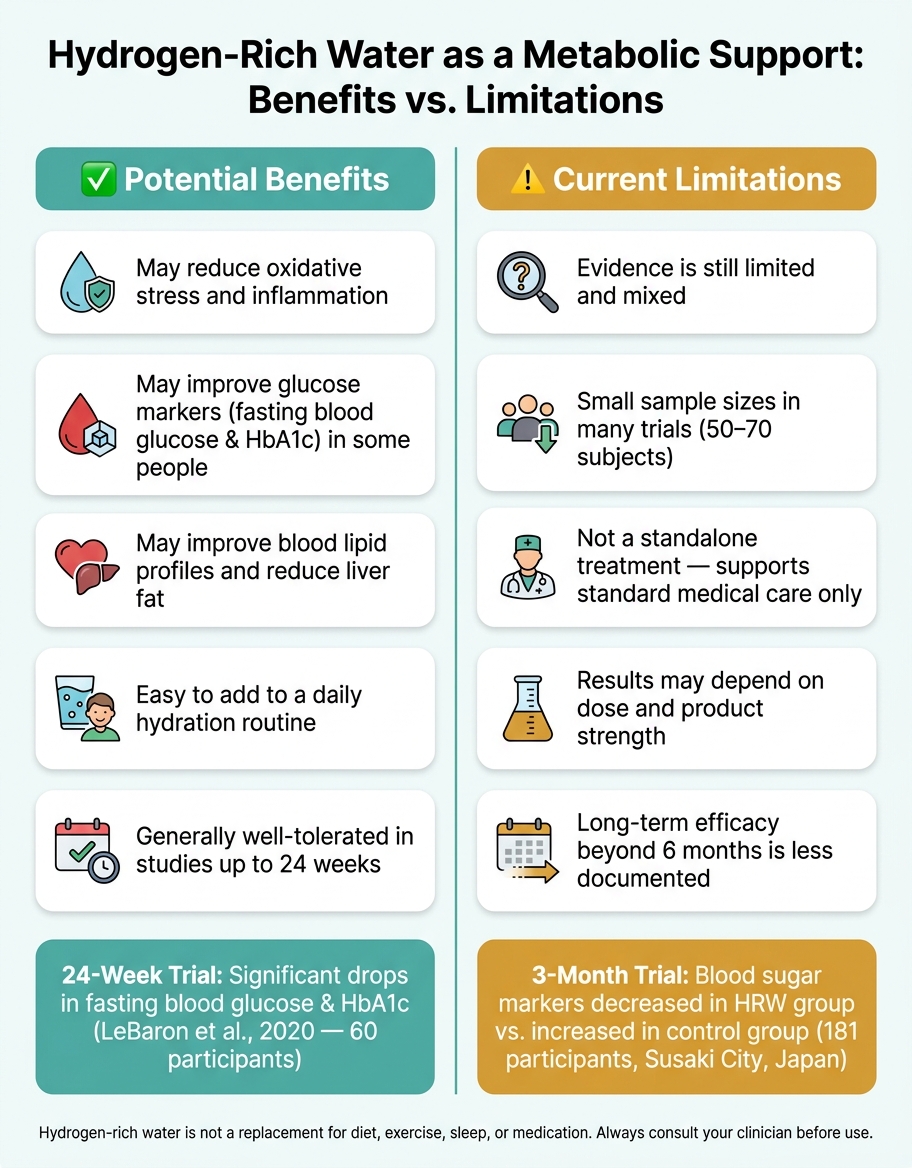
Hydrogen-Rich Water for Blood Sugar: Potential Benefits vs. Current Limitations
Once you start tracking glucose trends, the next step is simple: look at safety and how this fits over time.
If you plan to drink hydrogen-rich water every day, safety and limits matter just as much as any upside. So far, research shows hydrogen-rich water has been well-tolerated, including in studies that lasted 24 weeks. But the long-term effects still need more research.
Who Should Be Careful and What to Watch
If you're managing diabetes or prediabetes - or you take insulin or any glucose-lowering drug - talk with your clinician before using it every day. Hydrogen-rich water may lower glucose more, which could change your medication needs. That's why close monitoring is a sensible step.
You should also check with your clinician before use if you're pregnant, have kidney disease, or manage more than one chronic condition. Research in these groups is still limited.
That matters because the current evidence points to possible help, not a sure outcome.
Potential Benefits vs. Current Limitations
| Hydrogen-Rich Water as a Metabolic Support: Benefits and Limitations | |
|---|---|
| Potential Benefits | Current Limitations |
| May reduce oxidative stress and inflammation | Evidence is still limited and mixed |
| May improve glucose markers in some people | Small sample sizes in many trials (50–70 subjects) |
| May improve blood lipid profiles and reduce liver fat | Not a standalone treatment; supports standard medical care |
| Easy to add to a daily hydration routine | Results may depend on dose and product strength |
| Generally well-tolerated | Long-term efficacy beyond 6 months is less documented |
Conclusion: Where Hydrogen Water Fits in Blood Sugar Management
Oxidative stress and chronic inflammation are closely tied to how your body handles glucose. That’s where hydrogen-rich water may offer practical support.
Edenvia Molecular Hydrogen tablets make it easy to prepare fresh hydrogen-rich water as part of your day. When used with consistency - and with your clinician in the loop - it can work as a simple add-on to a blood sugar plan. A good way to judge it is to track your response for 8 to 12 weeks, then review those results with your clinician.
FAQs
Can hydrogen water replace diabetes treatment?
No. Hydrogen water may support metabolic health and insulin sensitivity, but it is not a substitute for prescribed diabetes treatment.
Because it may affect blood sugar levels, people with diabetes should talk with their doctor before adding it. Edenvia Molecular Hydrogen tablets can support overall wellness, but only as part of your doctor-directed treatment plan.
How long should I try hydrogen water before judging the results?
Research on hydrogen-rich water often uses 8 weeks to check metabolic markers such as fasting blood glucose and lipid profiles. Longer studies on metabolic syndrome markers have run for up to 24 weeks.
If you use Edenvia Molecular Hydrogen tablets, daily use for at least 8 weeks may give its antioxidant and anti-inflammatory effects time to support cellular health and metabolic function.
Who should talk to a clinician before using it daily?
Talk to a clinician before drinking hydrogen water every day if you’re pregnant or breastfeeding, under 18, or have kidney disease or diabetes.
If you have diabetes, get medical supervision. Better insulin sensitivity may mean your current medications need to be adjusted.