

Hydrogen Water for Inflammation and Oxidative Stress
Hydrogen water may help lower oxidative stress and calm some inflammation signals, but the human research is still small and short. If I wanted the short answer, it would be this: it looks safe for most adults, it may help with recovery and joint comfort, and it makes the most sense as a daily habit, not a cure.
Here’s the article in plain English:
- What it is: regular water with dissolved molecular hydrogen gas (H2)
- Why people use it: to help with oxidative stress, soreness, recovery, and day-to-day joint comfort
- How it may work: H2 appears to react with some of the most damaging free radicals while leaving normal cell signaling alone
- What the studies show: small human trials report changes in markers tied to inflammation, antioxidant status, cholesterol, BMI, lactate, and joint symptoms
- What the studies do not show: proof that hydrogen water treats or reverses any disease
- How it’s used: many studies used 0.5 to 1.5 liters per day for 4 to 12 weeks
- Why timing matters: hydrogen gas leaves water fast, so it should be consumed soon after mixing
- Safety: hydrogen gas in beverages has FDA GRAS status, and studies have not reported serious side effects; mild stomach upset may happen with some tablet products
If I strip it down even more, the main point is simple: hydrogen water is aimed at the oxidative stress + inflammation cycle that can affect joints, recovery, and how you feel day to day after 45. The idea is promising, but the evidence is not settled.
A few numbers stand out:
- 1.5 L/day for 4 weeks was used in one study of healthy adults
- Some products target about 1,000 to 1,300 ppb
- Some studies used up to 1.6 ppm
- Extra hydrogen is usually breathed out within 60 to 90 minutes
Bottom line: if you’re curious about hydrogen water, I’d view it as a simple wellness add-on with early research behind it - not a stand-in for medical care, prescriptions, sleep, exercise, or diet.
THE BENEFITS OF HYDROGEN WATER TO FIGHT OXIDATIVE STRESS AND INFLAMMATION | 045 DR. PAUL BARATTIERO
sbb-itb-6860cc4
Oxidative Stress, Free Radicals, and Inflammation Explained
Your body makes free radicals all the time, including reactive oxygen species (ROS) and reactive nitrogen species (RNS). In small amounts, they help with normal cell activity. The problem starts when those free radicals build up faster than your body can control them.
That imbalance is called oxidative stress. It happens when free radicals outpace your antioxidant defenses and start damaging cells. Your body does have built-in enzymes to help keep things in check, such as SOD, catalase, and glutathione peroxidase. But those systems can get overwhelmed. When that happens, free radicals can damage DNA, proteins, and lipids, which then sets off an immune response and brings inflammation into the mix.
These two problems don't stay separate for long. They feed each other. ROS can switch on inflammatory signals such as NF-κB, which then increase cytokines like IL-1, IL-6, and TNF-α. In turn, those immune responses make more ROS. So you end up in a nasty loop: more oxidative stress, more inflammation, and more tissue damage.
There’s another layer to it. Too much ROS can also impair mitochondria. And when mitochondria don’t work well, energy production drops and cell damage can climb. That is the cycle molecular hydrogen is designed to interrupt.
Common Sources of Oxidative Stress in Everyday U.S. Life
In day-to-day U.S. life, common sources include:
- Processed foods
- Poor sleep
- Chronic stress
- Air pollution
- Cigarette smoke
How Chronic Inflammation Affects Joints, Recovery, and Daily Comfort
When inflammation becomes chronic, people tend to feel it in ways that are hard to ignore. For adults over 45, it often shows up as stiffer joints, slower recovery, more soreness, and less day-to-day comfort.
Chronic inflammation plays a major role in joint wear and discomfort. Aging is also linked with higher oxidative stress and a drop in the body’s natural antioxidant defenses. That’s why the next step is to look at how molecular hydrogen works.
How Molecular Hydrogen and Hydrogen Water Work
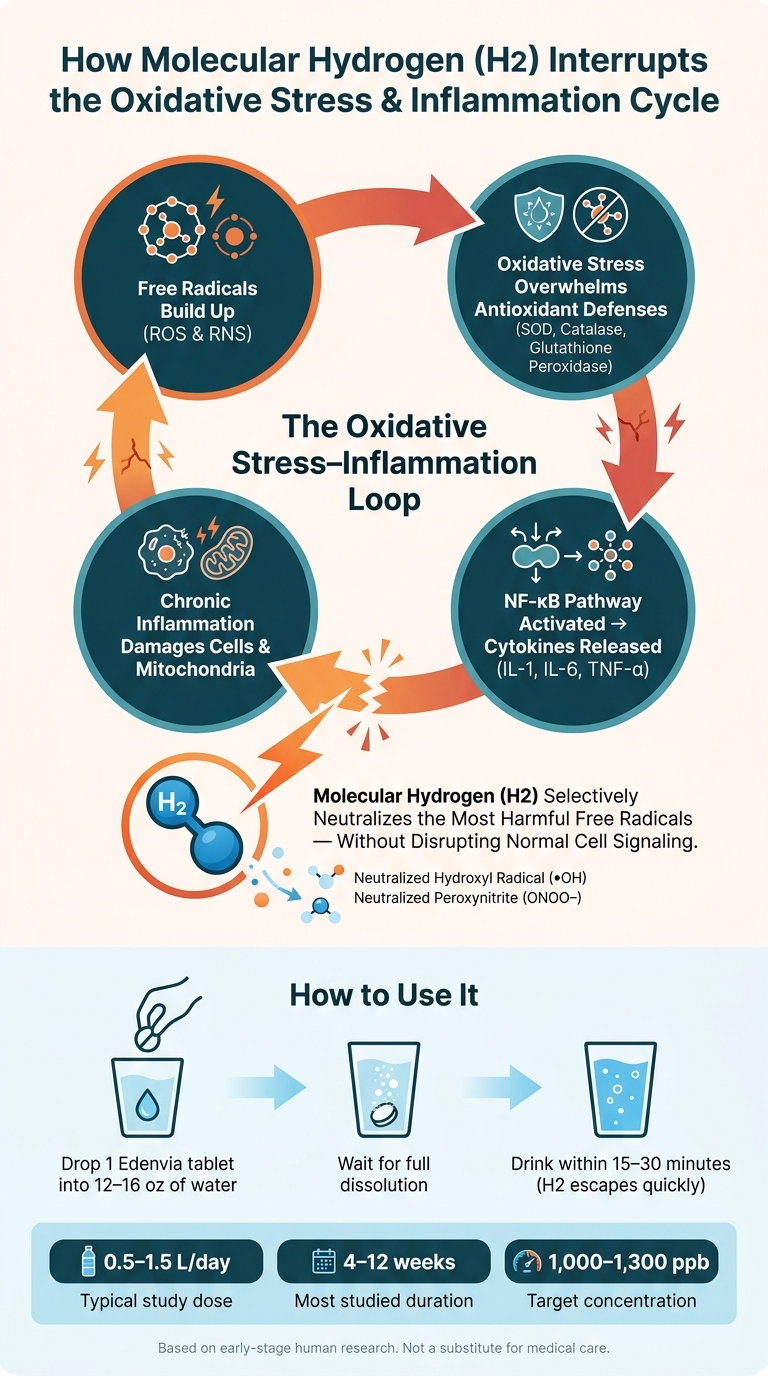
How Hydrogen Water Works: The Oxidative Stress & Inflammation Cycle
One place molecular hydrogen may help is the stress-inflammation loop. Molecular hydrogen (H2) is a molecule made of two hydrogen atoms. Because it’s so small, it can move through cell membranes and into cells with ease. When H2 is dissolved in regular water, you get hydrogen-rich water (HRW).
Part of the appeal comes from two things at once: how H2 behaves in the body and how simple it is to use day to day.
Selective Antioxidant Action and Inflammatory Signaling
H2 selectively targets the most damaging oxidants while leaving the reactive species used for normal cell signaling alone. That matters. It suggests H2 may help calm inflammatory signaling through the NF-κB pathway, which may lower pro-inflammatory markers like TNF-alpha, IL-6, and CRP without interfering with normal cell activity.
For joints, post-exercise recovery, and everyday comfort, that difference is worth noting. You want support without throwing normal cell function off balance. In one study of healthy adults, drinking 1.5 L per day for 4 weeks reduced the number of immune cells undergoing cell death.
How Hydrogen-Rich Water Is Made With Dissolvable Tablets
This is where the delivery format comes in. At home, dissolvable tablets can make hydrogen-rich water. These tablets usually use magnesium compounds that react with water and release H2 into the drink.
The process is simple:
- Drop a tablet into water
- Let it dissolve
- Drink it soon after
Try to drink it within one hour, since H2 escapes quickly.
Edenvia Molecular Hydrogen uses this tablet format to make hydrogen-rich water at home.
What the Research Says About Hydrogen Water
The big question is simple: do those lab-based effects show up in people?
So far, the research is promising, but not settled. More than 3,000 peer-reviewed studies have looked at molecular hydrogen, yet most human trials are still small. That means there’s a signal here, but not final proof.
Findings on Joint Health, Exercise Recovery, and Metabolic Stress
A small pilot study in rheumatoid arthritis found that daily hydrogen water lowered disease activity scores and oxidative stress markers over four weeks. Some people with early-stage disease also reached remission.
In a small randomized trial in NAFLD, tablet-made hydrogen-rich water reduced BMI and showed favorable metabolic trends compared with placebo. Meta-analyses also point to small but statistically significant drops in total cholesterol and LDL-C in adults who were overweight or obese.
Research on mitochondrial dysfunction suggests that hydrogen-rich water may lower serum lactate over 8 to 12 weeks.
Why does that matter? Because these are the kinds of outcomes people tend to care about day to day: less joint discomfort, less metabolic strain, and better recovery when oxidative stress and inflammation are part of the picture.
What the Evidence Does and Does Not Show Yet
Here’s the catch: most human studies are small, short, and use different doses and delivery methods. That makes the results harder to compare side by side.
Even so, the pattern keeps pointing in a similar direction. Researchers often see changes in oxidative stress and inflammatory markers. What they do not have yet is proof that hydrogen water treats any specific disease.
That leaves a practical next step: whether safe, consistent daily use makes sense in the first place.
How to Use Hydrogen Water Safely and Consistently
Oxidative stress doesn’t show up all at once. It builds little by little. That’s why hydrogen water tends to work best when you use it every day, not just now and then. The longest studied window is 4 to 12 weeks, with one simple goal: lower oxidative load on a steady basis, not in random bursts.
For day-to-day use, timing and freshness matter most. Drink it in the morning or around exercise, and use it soon after making it. Molecular hydrogen fades fast, so the water should be consumed within 15 to 30 minutes of preparation. Most products target 1,000 to 1,300 ppb, and some studies have used up to 1.6 ppm. Many study protocols used 0.5 to 1.5 liters per day, often split into two servings.
Using Edenvia Molecular Hydrogen at Home

At home, the simplest setup is a tablet mixed into one serving of water. Drop one Edenvia Molecular Hydrogen tablet into 12–16 oz of water, wait until it fully dissolves, then drink it without waiting too long. Follow the product label so your hydrogen intake stays steady.
Storage matters too. Keep the tablets in their original moisture-proof packaging until you’re ready to use them. They need to stay dry, since moisture can start the reaction too early and reduce potency. Stick with the label directions, since too much magnesium may lead to mild GI upset.
Benefits, Limits, and Safety Considerations
The safety data is reassuring. Hydrogen gas has been listed by the FDA as Generally Recognized as Safe (GRAS) for use in beverages since 2014, at volumes up to 2.14%. Any extra hydrogen is exhaled within 60 to 90 minutes. So far, human trials have not reported serious adverse effects.
That said, hydrogen water should sit next to medical care, not take its place. If you have a chronic condition, use prescription drugs, or are pregnant, talk with your healthcare provider before adding it to your routine.
Key Takeaways on Hydrogen Water for Cellular and Joint Support
Oxidative stress and inflammation can trap the body in a rough loop, each one pushing the other along. That’s where molecular hydrogen seems most useful. Research suggests H2 may help interrupt that loop by selectively targeting the free radicals that do the most harm, while leaving normal cell signaling alone. That idea shows up in human research, even if the data is still in its early stages.
The research covers a lot of ground, but it’s still taking shape. In one study, adults ages 30 and up saw a significant increase in antioxidant capacity after 4 weeks. Other studies point to help with exercise stress, recovery, and joint comfort over time. That said, the current picture is promising, not final.
The biggest issue is consistency. Human trials are still small, and they don’t all use the same dose or study length. So far, there isn’t a set protocol. Most studies have looked at daily use over several weeks.
For adults who want support for movement, joint comfort, and day-to-day resilience, hydrogen-rich water makes the most sense as a steady part of a wellness routine you already follow. Edenvia Molecular Hydrogen tablets keep it simple at home: dissolve, drink fresh, and use daily.
FAQs
How soon can I expect results?
Hydrogen from hydrogen-rich water reaches peak blood levels fast, usually within 5 to 15 minutes.
If you're using it after a workout, it's best to drink it within 30 minutes of exercise.
You might notice short-term effects pretty fast. But for broader changes in recovery, cellular health, and overall wellness, daily use for 30 days is the usual recommendation.
Can I take hydrogen water every day?
Yes. Hydrogen water is considered safe for daily use and has FDA Generally Recognized as Safe status.
Most experts suggest 0.5 to 1.5 liters per day, which is about 17 to 51 ounces. If you’re just starting out, begin with 4 to 9 ounces a day, then slowly work your way up over 1 to 2 weeks.
Who should talk to a doctor before using it?
Talk to your doctor before using hydrogen-rich water if you’re pregnant or breastfeeding, under 18, or dealing with kidney disease or diabetes.
If you have diabetes, medical supervision matters even more. Better insulin sensitivity may mean your medications need to be adjusted. And if you have questions about a certain health condition, it’s smart to get medical advice first.