

Top Studies on Hydrogen Water and Immune Health
Here’s the short answer: the best human research on hydrogen-rich water shows early links to lower inflammatory signaling, less immune-cell death, and better antioxidant status in some adults - but it does not prove immune treatment or disease prevention.
If you want the plain-English takeaway, this is it:
- A 2020 randomized, double-blind, placebo-controlled trial in 38 healthy adults found lower expression of parts of the TLR–NF-κB inflammation pathway after 4 weeks of hydrogen-rich water.
- In that same trial, the hydrogen-water group had less PBMC apoptosis and fewer CD14+ monocytes, which points to lower immune activation.
- Antioxidant status improved in adults age 30+ in that study, but not in younger adults.
- Small disease-focused studies, such as one in rheumatoid arthritis patients, also point in the same direction: less oxidative stress, with some symptom improvement.
- Animal and review papers help explain how this may work, mainly through lower oxidative stress and lower inflammatory signaling.
- But the limits matter: human studies are small, short, and use different methods, so the evidence is still early.
So if you’re asking, “Does hydrogen water help immune health?” my answer is: it may affect some immune-related markers, but the case is still preliminary.
| Study type | What it found | What to keep in mind |
|---|---|---|
| Human trial in healthy adults | Lower inflammatory gene expression, less PBMC apoptosis, antioxidant change in adults 30+ | Small sample, only 4 weeks |
| Small clinical studies in illness | Lower oxidative stress, some symptom shifts | Often open-label and small |
| Reviews | H₂ may lower harmful ROS while leaving normal signaling alone | Reviews depend on underlying study quality |
| Animal studies | Lower IL-1β, IL-6, TNF-α; effects on NF-κB, AP-1, NLRP3 | Animal models are not the same as daily human immune health |
In other words: the strongest theme is lower oxidative stress, and the immune findings appear to branch off from that. That makes hydrogen-rich water worth studying, but not settled science.
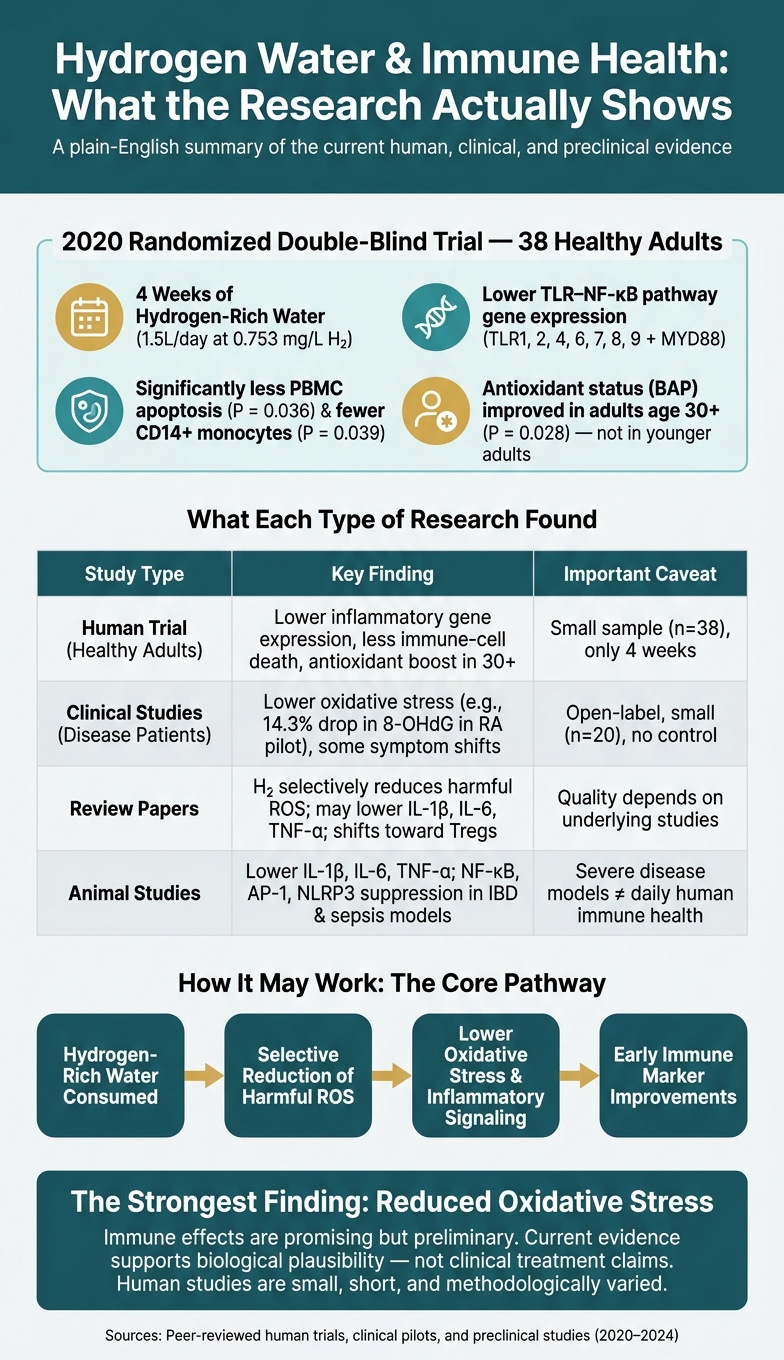
Hydrogen Water & Immune Health: What the Research Actually Shows
Hydrogen Water: Scam or Modern Miracle?
sbb-itb-6860cc4
Human studies on hydrogen water and immune markers
These studies looked at specific immune markers like gene expression, immune-cell survival, and antioxidant status. That makes them more useful if you want to understand what hydrogen-rich water is actually doing in the body. The clearest human data come from one randomized trial that checked all three: gene expression, immune-cell survival, and antioxidant status.
Randomized trial in healthy adults
A 2020 randomized, double-blind, placebo-controlled trial in 38 healthy adults found that 4 weeks of hydrogen-rich water lowered expression of TLR-NF-κB pathway genes and several pro-inflammatory markers.
In the study, participants drank 1.5 liters per day of hydrogen-rich water with a concentration of 0.753 mg/L H₂ for 4 weeks. A control group drank plain water instead. The results showed lower expression of several toll-like receptors - TLR1, TLR2, TLR4, TLR6, TLR7, TLR8, and TLR9 - as well as the mediator MYD88, which are key parts of the TLR-NF-κB inflammatory signaling pathway. Researchers also found lower expression of pro-inflammatory markers such as IL1B, IL8, IL6R, and TNFRSF10B.
BAP increased in participants age 30 and older (P = 0.028), but not in younger adults. The researchers suggest that adults under 30 may have higher baseline resilience, which could make the effect harder to detect.
Immune-cell and apoptosis findings from human blood samples
The same trial also looked at cell-level outcomes. The hydrogen water group had a significantly lower percentage of peripheral blood mononuclear cell (PBMC) apoptosis than the plain-water control group (P = 0.036), which means less immune-cell death. There was also a drop in circulating CD14+ cells, mainly monocytes (P = 0.039), which help start inflammatory responses and are closely linked to TLR-NF-κB signaling.
Researchers used RNA sequencing to analyze gene expression, but that subgroup included only 6 people, with 3 per group, so the results need caution. Even so, the data moved in the same direction: less apoptosis, lower inflammatory signaling, and higher BAP in adults 30 and older.
Taken together, these findings show a measurable anti-inflammatory signal, but the trials are small. Broader reviews and preclinical work help test whether the same pattern shows up across other immune settings.
What broader research suggests about immune regulation
The human trial data from the previous section gives us a good starting point. But it doesn't show the whole story.
To fill in the gaps, it helps to look at review papers and preclinical work. That research can show why those human results may happen and whether the same patterns show up in other settings.
Review findings on cytokines, T cells, and oxidative damage
These review findings help explain the lower inflammatory signaling seen in human blood tests. Across review papers, molecular hydrogen is described as selective, going after the most harmful ROS while leaving normal cell signaling more intact. In plain English, the idea is simple: reduce oxidative damage without shutting down the signals the body still needs.
That matters because oxidative stress and inflammation tend to feed each other. Reviews suggest that H₂ may lower pro-inflammatory cytokines such as IL-1β, IL-6, and TNF-α. They also note possible shifts in immune balance, including more Tregs and fewer exhausted CD8+ T cells.
Preclinical studies then test whether those immune effects show up in disease models.
Preclinical studies on inflammation and immune response
Animal studies add another piece of the puzzle. In a 2024 rat model of inflammatory bowel disease (IBD), researchers found that electrolyzed hydrogen water lowered IL-1β, IL-6, and TNF-α by regulating the NF-κB and activator protein-1 signaling pathways.
In a separate mouse model of sepsis, hydrogen-rich saline induced autophagy in macrophages and suppressed the NLRP3 inflammasome, which is a major driver of severe inflammation.
That said, animal data has limits. These studies looked at severe inflammatory conditions like sepsis, colitis, and intestinal ischemia-reperfusion injury. Those are not the same as day-to-day immune health, and results from those models do not map neatly onto humans.
So the takeaway here is modest: these models support biological plausibility, but they do not replace large human trials.
The next step is to see whether these same mechanisms hold up in specific inflammatory diseases.
Clinical contexts and evidence limits
Studies in rheumatoid arthritis, autoimmune conditions, and inflammatory illness
Some studies look at hydrogen water in diseases where oxidative stress tends to run higher. The main idea is simple: if hydrogen water has an anti-inflammatory effect, it should be easier to spot in these settings.
In a 20-person open-label pilot at Haradoi Hospital in Japan, 4 weeks of hydrogen water (530 mL/day at 4–5 ppm) lowered the mean Disease Activity Score (DAS28) from 3.83 to 3.02 and reduced urinary 8-OHdG, a biomarker for oxidative DNA damage, by an average of 14.3%. The authors linked the improvement to reduced oxidative stress.
A few other small clinical studies lean in the same direction, even though they look at different diseases. In a small NAFLD trial, hydrogen-rich water lowered BMI and showed nonsignificant downward trends in inflammatory markers.
That said, these are early signals, not proof of treatment effect. They help map out where future research should go, but they do not establish hydrogen water as a treatment for any specific condition.
Key limitations of the current evidence
The current evidence has clear limits. Most human studies are small, short, and use different delivery methods, so it’s hard to line them up side by side. Right now, the case is stronger for biological plausibility than for clinical certainty.
There’s another detail worth noting. Some effects seem to depend on age or health status. In healthy adults, hydrogen water significantly increased antioxidant markers in participants older than 30, but not in younger individuals. That kind of threshold effect hints that the intervention may work better when oxidative stress is already elevated.
That context matters when you look at the full body of research. The conclusion ties these human, review, and preclinical findings together.
Conclusion: What these studies collectively show
Taken together, these studies suggest one main pattern: across human and preclinical research, hydrogen-rich water most often reduces oxidative stress, with early hints of immune modulation. That antioxidant effect is the clearest thread tying the immune findings together.
In healthy adults, studies have reported lower PBMC apoptosis, fewer circulating CD14+ monocytes, and reduced NF-κB signaling. That said, the immune effects are promising but still unproven.
The research supports a plausible antioxidant-to-anti-inflammatory link, but not a clinical claim. It does not show that hydrogen water treats or prevents immune disease. The studies are short, sample sizes are small, and the protocols vary too much to support broad claims.
For readers who want a home-use option, Edenvia Molecular Hydrogen tablets dissolve in water to make hydrogen-rich water. The science supports interest, not certainty.
FAQs
How soon might hydrogen water affect immune markers?
It depends on the study. Some shifts in immune and body markers showed up as early as 24 hours after first use. Other effects took 4 weeks to several months of steady use.
Researchers have also reported early gains in peripheral vascular endothelial function. Other effects, tied to certain inflammatory markers and cell-level responses, appeared over longer periods.
Why did adults over 30 respond differently in the study?
In this randomized, double-blind study, adults age 30 and older showed a clear increase in serum biological antioxidant potential (BAP) after drinking hydrogen-rich water. By contrast, participants under 30 did not show a statistically meaningful effect.
The researchers also found that both hydrogen-rich water and plain water increased BAP overall. But the antioxidant gain that reached statistical significance appeared only in the older group.
Does hydrogen water support immunity or just lower oxidative stress?
Hydrogen water may do more than lower oxidative stress. Research suggests molecular hydrogen can also help regulate immune function by boosting antioxidant capacity, easing inflammatory responses, and affecting immune cell activity, including phagocytosis.
Taken together, these effects suggest hydrogen water supports immune regulation along with oxidative stress management.