

Hydrogen Water for Cognitive Decline: What Studies Show
Hydrogen-rich water (HRW) may help address cognitive decline by reducing oxidative stress, inflammation, and supporting brain cell health. Research highlights its ability to target harmful free radicals, improve mitochondrial function, and potentially slow neurodegenerative processes like Alzheimer's disease. While early findings are promising, most studies are small, short-term, and vary in dosage methods. Here's what you need to know:
- How it works: HRW neutralizes harmful reactive oxygen species (ROS) and boosts the body's antioxidant defenses.
- Animal studies: Show improved memory, reduced inflammation, and neuron protection in Alzheimer’s and vascular dementia models.
- Human trials: Mixed results; some benefits noted in APOE4 carriers and early dementia patients. Longer telomeres and better brain metabolism were observed in older adults.
- Safety: HRW is considered safe and classified as GRAS by the FDA.
Though HRW shows potential, more robust, long-term trials are needed to confirm its effects on cognitive health. Products like hydrogen tablets offer a convenient way to try it, but consult your doctor before use.
How Hydrogen-Rich Water May Affect the Brain
How Molecular Hydrogen Reduces Oxidative Stress in the Brain
Molecular hydrogen (H2) works by targeting harmful free radicals like hydroxyl radicals (·OH) and peroxynitrite (ONOO−), while leaving beneficial reactive oxygen species (ROS) intact for normal cellular signaling. Beyond this, H2 activates NRF2, a key regulator that boosts the production of protective enzymes such as superoxide dismutase (SOD), catalase (CAT), and glutathione (GSH). This dual action - neutralizing harmful radicals and enhancing the brain's antioxidant defenses - leads to reduced malondialdehyde (MDA) levels, a marker of oxidative stress. By addressing oxidative damage, H2 helps establish conditions that may reduce neuroinflammation.
Anti-Inflammatory and Neuroprotective Effects
Reducing inflammation is essential for protecting the brain from cognitive decline. H2 helps by suppressing NF-κB, a protein complex that triggers inflammation, and lowering levels of pro-inflammatory cytokines like TNF-α, IL-1β, and IL-6, which are linked to neurodegenerative processes. At the same time, it increases IL-10, an anti-inflammatory cytokine that promotes a more protective brain environment.
A study published in Frontiers in Aging Neuroscience (January 2025) highlights these effects. Researchers at Wenzhou University administered hydrogen-rich water (1,000 ppb) to zebrafish with Alzheimer’s-like pathology caused by aluminum chloride. After seven days, the treatment significantly reduced Aβ deposits (p < 0.0001), lowered IL-6 and TNF-α, and even restored gut microbiota balance by reducing harmful bacteria like Staphylococcus aureus.
Effects on Mitochondrial and Cellular Function
H2's benefits extend to mitochondrial health, which is critical for energy-hungry neurons. By reducing oxidative stress and inflammation, H2 helps stabilize the mitochondrial electron transport chain, minimizing ROS production within mitochondria.
"H2 can readily diffuse into mitochondria, where it attenuates excessive mitochondrial ROS generation and thereby contributes to the preservation of mitochondrial membrane potential and mitochondrial respiratory function." - Chaodeng Mo, Researcher, Wonju College of Medicine
In a March 2026 study published in MDPI Antioxidants, researchers at Wonju College of Medicine (Yonsei University) treated 5xFAD transgenic mice - an Alzheimer’s model - with 2% H2 inhalation for one hour daily over four weeks. The results showed increased hippocampal ATP levels, a lower BAX/BCL-2 ratio (indicating reduced cell death), and maintained NEUN expression, a marker for healthy neurons.
Additionally, a 2021 pilot trial with 40 older adults (average age 76) revealed that drinking 0.5 liters of hydrogen-rich water daily for six months increased N-acetylaspartate (NAA) and choline levels in the left frontal gray matter. The study also reported a 4% increase in mean telomere length in the hydrogen group, compared to a decline in the control group.
These cellular and mitochondrial improvements provide a foundation for the positive outcomes observed in both animal and human research.
sbb-itb-6860cc4
What Animal Studies Show
Aging and Cognitive Decline in Animal Models
Animal research has consistently supported HRW's antioxidant and anti-inflammatory properties. For instance, a February 2025 study published in Behavioural Brain Research examined SAMP8 mice, a model known for early age-related decline. These mice were given hydrogen-rich jelly (40 mg/L) for 26 to 28 weeks. The results? Improved spatial memory performance in the Y-maze test compared to untreated mice. Researchers linked these improvements to reduced neural apoptosis in the medial prefrontal cortex and hippocampal dentate gyrus.
Similarly, earlier research from Hebei Medical University, published in January 2019 in Behavioural Brain Research, confirmed these benefits in a rat model of vascular dementia. Cognitive impairment was induced using carotid occlusion, and HRW treatment significantly improved spatial memory in the Morris Water Maze. The study pointed to mechanisms like autophagy regulation via FoxO1 and reduced hippocampal neuronal apoptosis as key factors.
"Molecular hydrogen exerts beneficial effects on cognitive impairment induced by chronic cerebral hypoperfusion." - Peiyuan Lv, Hebei Medical University
These findings open the door to further exploration of HRW's potential in addressing ischemic and vascular-related conditions.
Brain Ischemia and Vascular Injury Models
With vascular dementia accounting for 15–20% of dementia cases, studying ischemic brain injuries is critical. A January 2025 study from Korea University College of Medicine, led by Jong-Il Choi and published in MDPI Antioxidants, used a bilateral common carotid artery stenosis (BCCAS) mouse model to simulate vascular dementia. Mice treated with molecular hydrogen (maintained above 1,000 ppb) for 12 weeks showed improvements in memory and reductions in anxiety-like behavior during Novel Object Recognition Tests. The treatment also restored BCL2 expression and balanced T regulatory cell homeostasis, reducing neuroinflammation.
HRW's benefits extend beyond dementia models. In stroke-prone rats, molecular hydrogen helped protect the blood-brain barrier and improved neurological function. Similarly, in neonatal pig models of asphyxia, hydrogen inhalation preserved cerebrovascular reactivity and mitigated delayed neurovascular dysfunction.
"H2 supplementation may promote neuronal resilience, modulate T cell differentiation, and support cognitive recovery in vascular dementia." - Jong-Il Choi, Korea University
Other Neurodegeneration Models
Animal studies on neurodegeneration highlight the diverse ways HRW supports brain health. Below is a summary of findings across various models:
| Animal Model | Condition | Key Outcome | Primary Mechanism |
|---|---|---|---|
| Zebrafish (AlCl₃-induced) | Alzheimer's-like pathology | Reduced Aβ deposition (p < 0.0001) and improved cognition; gut microbiota restored by lowering Staphylococcus aureus and Streptococcus | Gut-brain axis modulation; anti-inflammation |
| 5xFAD Transgenic Mice | Genetic Alzheimer's model | Reduced hippocampal Aβ42 and increased ATP levels | Redox homeostasis; mitochondrial support |
| SAMP8 Mice | Age-related decline | Improved spatial memory | Anti-apoptosis; anti-inflammation |
| SD Rats (2VO) | Vascular dementia | Inhibited hippocampal neuron loss and shrinkage | Regulation of autophagy via FoxO1 |
| C57BL/6 Mice (BCCAS) | Vascular dementia | Reversed memory impairment and restored T regulatory cell balance | ROS scavenging; immune modulation |
Notably, zebrafish research from Wenzhou University (January 2025) suggests that hydrogen's neuroprotective effects go beyond its antioxidant properties. The study points to the gut-brain axis as another pathway through which HRW can help mitigate cognitive decline.
Hydrogen Water Improves Brain Function in Minutes!
Human Studies on Hydrogen Water and Cognitive Health
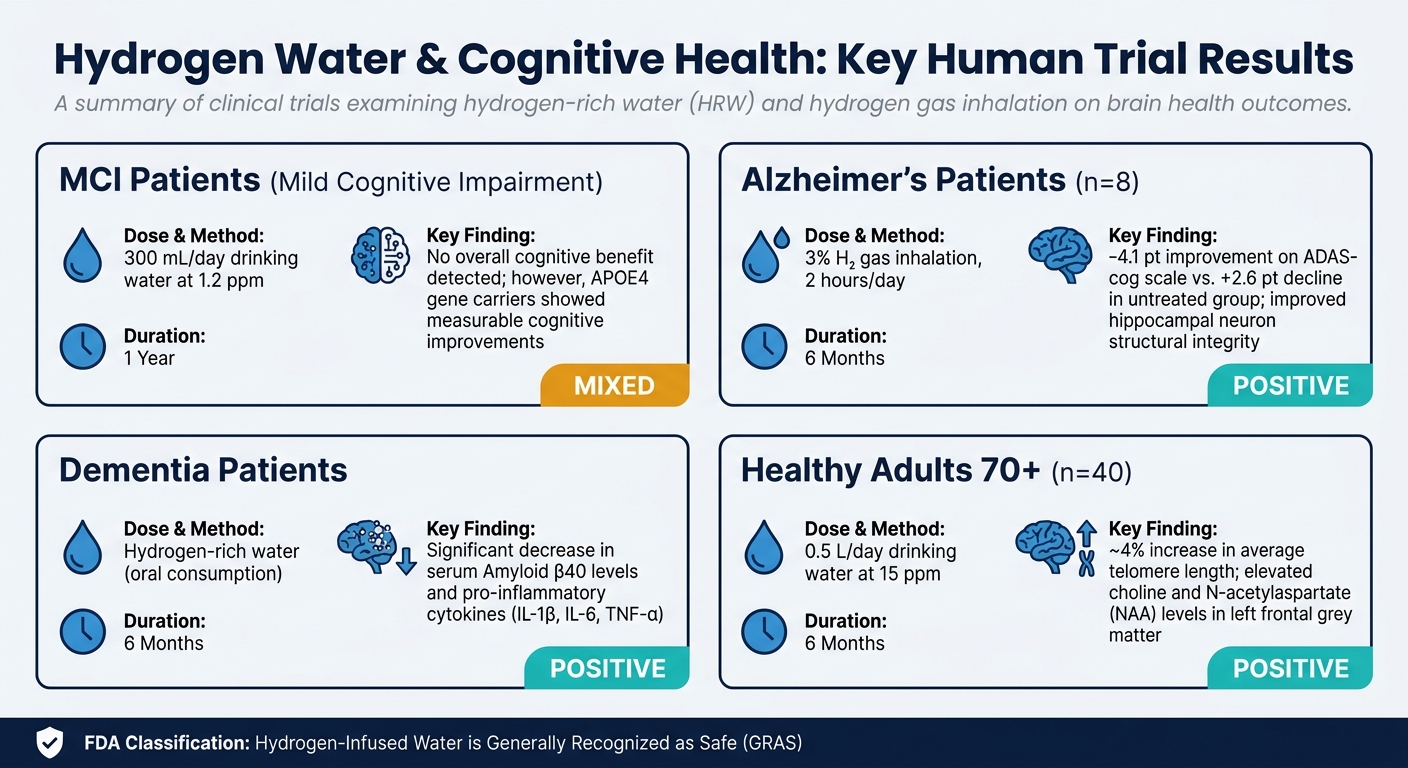
Hydrogen Water & Cognitive Health: Key Human Trial Results
Human trials have explored the potential of hydrogen-rich water (HRW) in cognitive health, delivering mixed but intriguing results.
Mild Cognitive Impairment and Early Decline
In a year-long study, individuals with mild cognitive impairment (MCI) consumed 300 mL (about 10 fl oz) of hydrogen-rich water daily, with a concentration of 1.2 ppm. While the overall group showed no significant improvement in cognitive scores, a closer look at the data revealed something interesting: participants carrying the APOE4 gene variant, a genetic marker associated with Alzheimer's risk, demonstrated cognitive improvements.
"In the trial of people with mild cognitive impairment, APOE4 carriers were the only subgroup to show benefits on cognitive tests in response to hydrogen-rich water consumption." - Alzheimer's Drug Discovery Foundation
These findings suggest that genetic factors might influence how individuals respond to HRW, reflecting the intricate nature of neurodegenerative conditions.
For those in more advanced stages of cognitive decline, other studies have examined HRW's effects on Alzheimer's and dementia patients.
Alzheimer's Disease and Dementia Trials
An open-label pilot study conducted at Nishijima Hospital tested hydrogen gas inhalation in eight Alzheimer's patients. Over six months, participants inhaled 3% hydrogen gas for one hour twice daily. The study, published in Pharmaceuticals in March 2023, used Diffusion Tensor Imaging to assess changes in the brain. Results showed significant improvements in the structural integrity of hippocampal neurons. Cognitive performance, measured by the ADAS-cog scale, improved by an average of −4.1 points in the treated group, compared to a +2.6-point decline in untreated patients.
"This study suggests that H2 treatment not only relieves temporary symptoms, but also has disease-modifying effects, despite its limitations." - Hirohisa Ono, Department of Neurosurgery and Neurology, Nishijima Hospital
Another clinical study, led by Johny Bajgai at Yonsei University in 2019, focused on dementia patients who drank hydrogen-rich water for six months. The findings revealed a significant reduction in serum Amyloid β 40 levels and pro-inflammatory cytokines such as IL-1β, IL-6, and TNF-α.
Safety and General Brain Health Findings
Hydrogen-rich water and hydrogen gas inhalation have been shown to be safe in human trials. The FDA has classified hydrogen-infused water as Generally Recognized as Safe (GRAS).
Beyond cognitive testing, some studies have explored broader indicators of brain health. A randomized controlled pilot trial led by Dragana Zanini at the University of Novi Sad, published in Experimental Gerontology in November 2021, included 40 adults aged 70 and older. Participants drank 0.5 liters (about 17 fl oz) of hydrogen-rich water daily at a concentration of 15 ppm for six months. Results showed a 4% increase in average telomere length and improved brain metabolism markers, with higher levels of choline and N-acetylaspartate (NAA) in the left frontal grey matter.
"HRW was superior to control water to increase brain choline and NAA levels in the left frontal grey matter... HRW was safe and could be put forward as a promising anti-aging agent." - Dragana Zanini, University of Novi Sad
Summary of Key Findings
| Study Population | Dose & Method | Duration | Key Finding |
|---|---|---|---|
| MCI patients | 300 mL/day (1.2 ppm) water | 1 year | No overall benefit; cognitive gains in APOE4 carriers only |
| Alzheimer's patients (n=8) | 3% H₂ gas inhalation, 2h/day | 6 months | −4.1 pt ADAS-cog improvement; improved hippocampal neuron integrity |
| Dementia patients | Hydrogen-rich water (unspecified concentration) | 6 months | Decrease in serum Aβ 40 and inflammatory cytokines |
| Healthy adults aged 70+ | 0.5 L/day (15 ppm) water | 6 months | ~4% increase in telomere length; improved brain metabolism markers |
For optimal results, hydrogen-rich water should be consumed within one hour of preparation to maintain its potency.
Research Limits and What Comes Next
Limitations of Current Research
While current studies offer hope, they come with notable limitations. For instance, small sample sizes make it difficult to apply findings broadly. The Alzheimer's trial at Nishijima Hospital included just eight patients, and a pilot study at the University of Novi Sad had only 40 participants.
Another hurdle is the lack of consistency in dosing. Hydrogen concentrations used in studies vary widely, from 0.8 ppm to 15 ppm, and delivery methods differ, including drinking water, gas inhalation, or saline infusions. This variability makes it hard to compare results. As the Alzheimer's Drug Discovery Foundation explains:
"The inconsistent results may relate to the different sources and doses of hydrogen used in these studies." - Alzheimer's Drug Discovery Foundation
Additionally, study designs often fall short of rigorous standards. Many trials rely on open-label or non-randomized methods, which can introduce bias. The field has yet to see widespread adoption of double-blind, placebo-controlled trials, which are considered the gold standard in clinical research.
How Hydrogen Water Is Used in Practice
Given the challenges in research, it’s worth examining how hydrogen water is used in practice. In studies, hydrogen is typically administered in two ways: gas inhalation (at concentrations of 2–3%, staying below the 4% flammability threshold) or by drinking hydrogen-rich water with concentrations ranging from 1 to 15 ppm. Since hydrogen has a short half-life, it must be consumed soon after preparation.
For everyday use outside clinical settings, products like effervescent tablets provide a practical solution. Brands such as Edenvia Molecular Hydrogen offer a portable way to create hydrogen-rich water without specialized tools. However, it’s important to note that hydrogen water is a supplement, not a replacement for medical treatments. Always consult a physician for health concerns.
These practical considerations highlight the need for further research to refine and standardize hydrogen delivery methods.
Key Areas for Future Research
To move the field forward, larger and longer-term trials are necessary. Most current studies last only one to six months, which isn’t enough to determine whether hydrogen can truly alter the progression of neurodegenerative diseases. Fanxianzi Meng from the Shandong Provincial Key Medical and Health Laboratory of Hydrogen Biomedical Research emphasizes this need:
"In the future, more in-depth studies and large-scale clinical trials are needed." - Fanxianzi Meng
Another critical avenue for research is exploring genetic subgroups. Preliminary findings suggest that hydrogen water may benefit APOE4 carriers, a group at higher risk, while showing less impact on the general population with mild cognitive impairment (MCI). Future studies should focus on these high-risk groups instead of treating all participants as a single category.
Finally, defining the optimal dose and delivery method remains a priority. Without this information, it’s difficult to translate promising lab results into practical applications. Addressing these gaps is key to understanding hydrogen-rich water’s potential role in combating cognitive decline.
Conclusion and Key Takeaways
Summary of Current Evidence
Research into hydrogen-rich water and its effects on cognitive health is still in its early stages, but initial findings from both animal and human studies are encouraging. Molecular hydrogen seems to support brain health by addressing oxidative stress, reducing neuroinflammation, and aiding mitochondrial function.
Although human trials have been limited by small sample sizes, they’ve shown positive results, including better cognitive scores, improved brain metabolism, and even longer telomeres - particularly in individuals with the APOE4 genotype.
As Nishimaki et al. stated:
"H2-water may have a potential for suppressing dementia in an oxidative stress model and in the APOE4 carriers with MCI."
While the evidence isn’t yet conclusive - due to short study durations, inconsistent dosing, and limited sample sizes - there haven’t been any significant safety concerns. Hydrogen-infused water is classified as GRAS (Generally Recognized as Safe) by the FDA. These findings suggest that hydrogen-rich water could be a promising long-term option for supporting brain health.
Adding Hydrogen-Rich Water to Your Wellness Routine
Based on current research, incorporating hydrogen-rich water into your daily routine could provide cumulative benefits for brain health over time. Consistency is key - studies suggest that noticeable effects often appear after 6 to 12 months of regular use, making it a long-term commitment rather than a quick fix.
Products like Edenvia Molecular Hydrogen tablets offer a simple and portable way to prepare hydrogen-rich water at home without requiring specialized equipment. Since hydrogen dissipates quickly, it’s best to drink the water within an hour of preparation to retain its potency.
If you have the APOE4 genotype - a genetic marker linked to higher dementia risk - you may see the most significant benefits. However, anyone looking to support cognitive health can consider adding hydrogen-rich water to a wellness plan that includes a balanced diet, regular exercise, and routine medical checkups.
FAQs
What’s the best daily dose of hydrogen-rich water for brain health?
There isn’t a clinically established daily dose of hydrogen-rich water specifically for brain health or preventing cognitive decline. Research has explored daily amounts between 300 mL and 1,000 mL, but findings in humans have been mixed. One challenge is that hydrogen gas escapes rapidly once the water is exposed to air, making delivery methods an area of ongoing study. Edenvia Molecular Hydrogen tablets provide an easy way to incorporate hydrogen-rich water into your daily life.
How long do I need to drink it before seeing any cognitive benefits?
Research on how long it takes to see cognitive benefits from hydrogen-rich water remains unclear. Animal studies hint at potential improvements anywhere from 30 days to 7 months. However, human trials have produced mixed outcomes - some even report no noticeable changes after a year. Since there’s no clinically proven timeline, the effects likely differ from person to person. Edenvia Molecular Hydrogen tablets offer an easy way to make hydrogen-rich water, helping you work toward your wellness goals.
Who should talk to a doctor before trying hydrogen-rich water?
Before introducing any new supplement into your routine, like hydrogen-rich water, it's important to talk to your doctor. While hydrogen is typically regarded as safe and clinical studies haven't reported negative side effects, your physician can evaluate how it fits with your health profile, medications, or existing conditions. For those looking into wellness solutions, Edenvia Molecular Hydrogen provides tablets that dissolve in water to create hydrogen-rich drinks. These are designed to deliver antioxidant properties, helping to combat oxidative stress and promote healthier cells.