

Hydrogen Water for Energy: What Studies Show
If you want the short answer: hydrogen water does not show a clear energy boost in human studies. What it may do is help a bit with recovery after hard exercise, with some studies showing lower fatigue, less soreness, lower lactate, and smaller drops in power.
Here’s the plain-English takeaway:
- Best-supported use: post-workout recovery support
- Less support: better endurance, VO₂max, or all-day energy
- What studies often find: lower perceived fatigue, less soreness, and lower muscle-damage markers
- What studies do not show well: steady gains in aerobic performance
- What to keep in mind: most studies are small, short, and mixed
In other words: if you expect hydrogen water to work like caffeine, the research does not support that. But if your goal is to feel a little less worn down after intense training, there may be a small effect.
| What people want | What studies show |
|---|---|
| More daily energy | Little support |
| Better endurance | Mixed results |
| Less fatigue during hard exercise | Some support |
| Less soreness after training | Some support |
| Better next-day recovery | Some support |
My read: the data leans toward modest recovery help, not a direct “energy” lift.
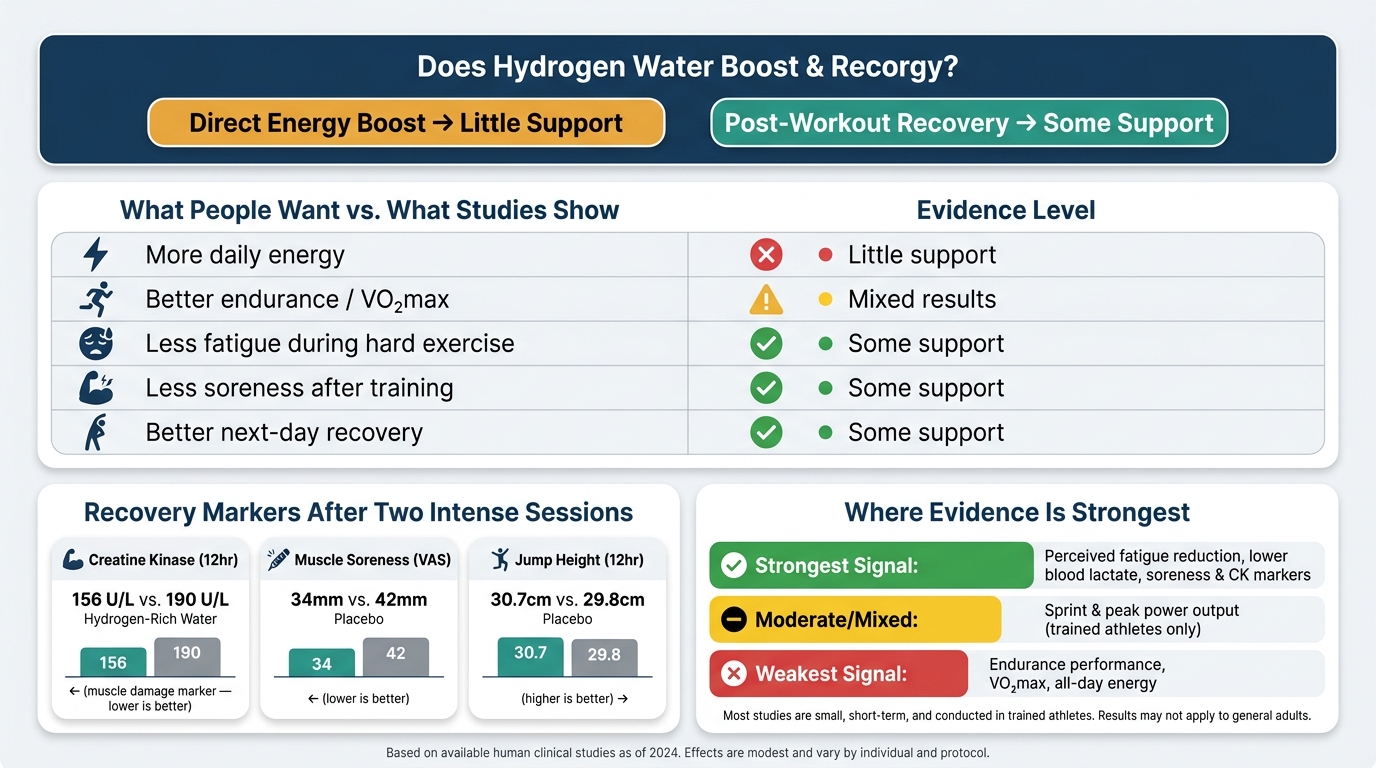
Hydrogen Water & Exercise: What Studies Actually Show
How Hydrogen-Rich Water May Affect Energy and Recovery
Oxidative Stress and Inflammation After Exercise
Hard training increases reactive oxygen species (ROS). When the body’s defense systems can’t keep up, oxidative stress goes up. Intense exercise can also increase inflammatory cytokines like TNF-α and IL-6, which may play a part in muscle damage and slower recovery.
Hydrogen works differently from broad antioxidants. Instead of clearing out ROS across the board, H₂ appears to target highly reactive species like hydroxyl radicals and peroxynitrite while leaving useful ROS signaling alone. That matters because some ROS help drive training adaptations.
A few exercise studies point in that direction. In physically active adults, three days of hard exercise led to less of a drop in total antioxidant capacity with hydrogen-rich water. In a two-month trial in juvenile female soccer players, researchers found lower MDA and inflammatory markers, along with higher SOD and total antioxidant capacity.
Those shifts suggest less oxidative drain after training. In plain English, the body may be taking a smaller hit from hard sessions, which lines up with reports of less fatigue afterward.
If that’s the case, the next step is simple: does it lead to less strain during exercise itself?
Perceived Effort, Lactate, and Exercise Fatigue
Controlled exercise studies have linked pre-exercise hydrogen-rich water with lower ratings of perceived exertion (RPE) and better breathing efficiency at the same workload.
One pilot study in healthy subjects found that hydrogen-rich water prevented the rise in blood lactate, compared with plain water, during heavy exercise. The drop in force output during maximal knee extensions was also smaller in the hydrogen group.
Put together, these findings suggest hydrogen-rich water may slightly reduce exercise strain. That said, the effects look small, and results haven’t been fully consistent across studies.
The part most people care about is more practical: do those lab changes show up as less soreness and better recovery the next day?
Muscle Damage, Soreness, and Next-Day Readiness
A study of recreationally active adults looked at what happened after two intense sessions in one day. Compared with placebo, the hydrogen group had lower CK and soreness, plus higher jump height 12 hours later:
| Outcome | Hydrogen-Rich Water | Placebo |
|---|---|---|
| Creatine kinase at 12 hours (U/L) | 156 ± 63 | 190 ± 64 |
| Muscle soreness (mm, visual analog scale) | 34 ± 12 | 42 ± 12 |
| Jump height (cm) | 30.7 ± 5.5 | 29.8 ± 5.8 |
All three differences were statistically significant (p < 0.05). Lower creatine kinase points to less muscle damage. Lower soreness suggests better comfort. Higher jump height 12 hours later suggests better functional recovery.
That’s the main link between hydrogen water and post-workout energy: not a jolt of energy like caffeine, but less wear and tear after hard training.
sbb-itb-6860cc4
Hydrogen Water for Bodybuilders: Benefits & Science Explained
What Human Studies Show
When researchers test hydrogen-rich water in people, the results tend to be modest, and they change based on the type of exercise.
Endurance and Time-to-Exhaustion Findings
Endurance results are mixed. If the goal is more energy for longer efforts, the answer so far is: sometimes, but not often. One crossover trial found a small gain in time to exhaustion with 500 mL taken 30 minutes before exercise. But larger trials in trained runners found no effect on time to exhaustion, VO₂max, or maximal heart rate compared with placebo.
A 2024 review summed up the bigger picture well: two studies found better aerobic performance, while eight publications found no such effect. In plain English, dose, timing, fitness level, and the kind of test used all seem to matter.
Sprint, Power, and Muscular Endurance Findings
The picture looks a bit better for short, hard efforts. Sprint and power results are still inconsistent, but they lean more positive than the endurance data. This is about short-burst output and repeat effort performance, not broad fitness gains.
A 7-day cycling trial improved peak and mean power in trained cyclists, but untrained participants did not respond. In a 2-week supplementation study, hydrogen-rich water helped athletes hold on to peak power output during repeated 10-second sprints across 30 minutes, while the placebo group showed clear drops in the later sprints. A review also reported a 1.9% improvement in 30-meter sprint time with hydrogen-rich water compared with control.
Recovery, Soreness, and Perceived Fatigue Findings
Recovery is where the signal looks strongest. In trials focused on recovery, hydrogen-rich water has most often been linked with lower soreness, lower CK, and better next-day function.
Subjective fatigue also shows a fairly repeatable pattern. In a randomized, double-blind trial in healthy adults, drinking hydrogen water just before exercise improved endurance and reduced perceived fatigue, with better maximal oxygen consumption and lower Borg fatigue scores in the hydrogen group. A systematic review and meta-analysis found that molecular hydrogen is a possible aid for easing subjective fatigue caused by high-intensity exercise, even when aerobic capacity itself does not change much. That may help explain why some athletes say they feel less tired during repeated hard efforts.
Taken together, the clearest signals show up in perceived fatigue, some sprint or power outcomes, and recovery markers. Endurance and VO₂max findings are still inconsistent.
Who Was Studied, How It Was Used, and What Remains Unclear
The results so far have been modest and mixed, so the details matter. Who took part in the studies, and how they used the water, can change how much weight we should give the findings.
Study Groups, Timing, and Common Protocols
Most human studies have looked at trained athletes or recreationally active adults. Far fewer have tested middle-aged or older adults who are just starting resistance training. So the research is useful, but it doesn’t line up perfectly with adults who care more about day-to-day recovery and steady energy than athletic performance.
Study setups also varied a lot. Some used a single dose before exercise. Others used loading periods of 4 to 8 days or continued use for as long as 6 weeks. In many studies, tablets were dissolved in room-temperature or chilled water, and participants drank the mixture within 30 minutes of preparation.
Safety and Open Research Questions
Human trials have generally found hydrogen-rich water to be safe and well-tolerated. But there’s still a catch: the studies haven’t always measured the same outcomes, which makes side-by-side comparison tough. There’s also little long-term data.
The best dose and timing for routine use are still unclear.
Those gaps limit what the current research can support.
Bottom Line: What the Studies Support and What They Do Not
Taken together, these studies lean more toward recovery support than a direct energy boost.
The research on hydrogen-rich water looks promising, but it does not back broad, reliable energy boosting. A 2023 systematic review and meta-analysis found moderate evidence for lower subjective fatigue and lower blood lactate after high-intensity exercise, but no meaningful improvement in VO₂max or maximal aerobic speed.
That matters because the most repeated effects are modest and short-term. Across studies, HRW has been linked with reduced perceived fatigue, lower blood lactate, less soreness, and better time-to-exhaustion in some trained people. But the results aren’t the same for everyone. Effects vary by athlete and by protocol, and one uphill-running study found a small benefit only in slower runners.
So if you’re expecting a clear “energy” effect, the data doesn’t quite get you there. HRW seems more useful for recovery support than for delivering a true boost in energy.
For readers thinking about trying HRW, product form seems less important than timing around exercise. Edenvia Molecular Hydrogen tablets create hydrogen-rich water, which is the same delivery format used in human HRW studies. Based on current research, the use that lines up best with the evidence is around intense exercise and recovery, where the gains appear modest and inconsistent.
FAQs
When should I drink hydrogen water for recovery?
Drink 14–17 fl oz of freshly prepared hydrogen water within 30 minutes after your workout to help with recovery.
Timing matters here. Blood hydrogen levels usually peak 5–15 minutes after you drink it, then return to normal in about one hour. So if you want the most from it, take it close to your workout.
If your training session is harder or lasts longer, your total daily intake can go up to 42–68 fl oz. Split that amount across before, during, and after exercise.
How long does it take to notice any effects?
Many people start to feel a difference in energy, brain fog, and mobility within 7 to 10 days of daily use. For some, the shift shows up sooner. For others, it takes a bit more time and builds little by little over a few weeks.
Changes tied to longer-term health, like better arterial function or less inflammation, often take 2 to 8 weeks to show up in a more clear way. If you want the best shot at seeing results, stick with a steady daily routine for at least 30 days.
Can hydrogen water help if I’m not an athlete?
Yes. Hydrogen water can still help even if you’re not an athlete.
Beyond workout recovery, Edenvia molecular hydrogen tablets may help with systemic oxidative stress, which is often linked to joint stiffness, discomfort, and brain fog.
By helping neutralize harmful free radicals at the cellular level, they support a balanced inflammatory response and overall wellness. In plain English: your body may feel more resilient, mobile, and comfortable day to day.