

Hydrogen Water and DNA Repair: What Studies Show
Short answer: hydrogen water may lower some markers of oxidative DNA damage, but human studies do not show that it directly improves DNA repair.
If you want the plain-English version, here it is:
- What it may do: lower markers like 8-OHdG in some studies
- What it has not shown: direct improvement in DNA repair in people
- What human trials look like: small, mixed, and often limited to biomarker changes
- What animal and lab work shows: less DNA damage under harsh stress, like radiation or ischemia
- Best way to view it: a wellness habit, not a DNA repair treatment
A few numbers help set the tone fast:
- In one 4-week trial, people drank 1.5 liters per day, but hydrogen water did not beat plain water for lowering serum 8-OHdG
- In a small rheumatoid arthritis study, urinary 8-OHdG fell by about 14.3%
- In a metabolic syndrome study, SOD went up 39% and TBARS fell 43%, while the DNA marker shift was not strong enough to confirm an effect
Here’s the main point I’d keep in mind: the research leans more toward less damage than better repair. That’s an important difference. Most studies measure signs of oxidative stress, not DNA repair enzymes, repair timing, or direct repair activity.
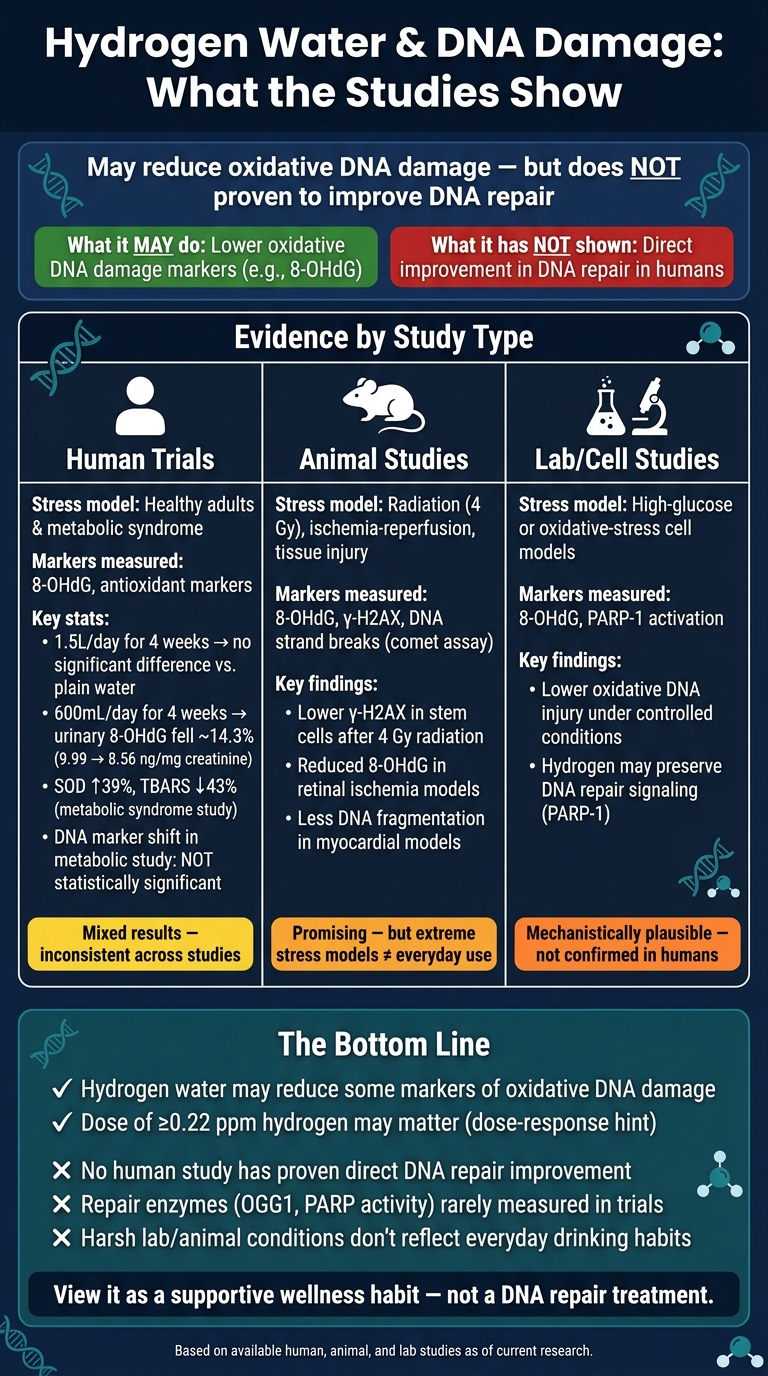
Hydrogen Water & DNA Damage: What Studies Actually Show
Tyler LeBaron: Hydrogen Water, Mitochondrial Health, Selective Antioxidants, & Longevity | TUH #265
sbb-itb-6860cc4
Quick comparison
| Study type | What researchers measured | What the results suggest |
|---|---|---|
| Human studies | 8-OHdG and other oxidative stress markers | Mixed results; some marker drops, no direct proof of better DNA repair |
| Animal studies | 8-OHdG, γ-H2AX, comet assay, tissue stress markers | Less DNA injury under acute stress conditions |
| Lab studies | Oxidative damage signals and repair-related proteins | Hydrogen may reduce injury in controlled settings |
So if you’re reading claims about hydrogen water and DNA, I’d keep it simple: it may help cut oxidative DNA damage in some cases, but claims about DNA repair go past what the studies show.
How oxidative stress damages DNA and where hydrogen fits in
Your body makes reactive oxygen species, or ROS, all the time. That group includes hydroxyl radicals. In small amounts, some ROS help with normal cell signaling. Trouble starts when ROS production gets ahead of the body's antioxidant defenses. That's called oxidative stress, and DNA is one of the main things it hits. Those DNA lesions are the ones most often examined in hydrogen-water research.
Hydroxyl radicals, 8-OHdG, and DNA strand breaks
Among these ROS, hydroxyl radicals are the main concern for DNA. Unlike superoxide and hydrogen peroxide, they don't have a dedicated enzyme defense. They form right where the reaction happens, then damage nearby DNA.
Hydrogen-water studies usually look at two markers of injury: 8-OHdG and DNA strand breaks. 8-OHdG is excreted in urine after repair, which makes it a practical and widely used marker of oxidative DNA damage. Strand breaks are measured with the comet assay. This test shows DNA fragments moving out of a cell's nucleus under an electric field; longer "tails" mean more breaks. That's why these two markers show up again and again in this research.
The key question is simple: does molecular hydrogen lower the damage load before repair starts?
How molecular hydrogen acts as a selective antioxidant
This is where hydrogen may come in. H₂ is the smallest molecule there is, so it can move through cell membranes fast and reach places like the nucleus and mitochondria that larger antioxidant molecules may not access as easily.
Hydrogen may act as a selective antioxidant, with a bias toward the most reactive and damaging species. That may matter because hydrogen could cut down the worst ROS without shutting down normal cell signaling.
If hydrogen lowers hydroxyl-radical attack, fewer 8-OHdG lesions and strand breaks should build up. The next section looks at whether human biomarker studies support that idea.
What human studies show about hydrogen-rich water and DNA damage
Human trials are small, and the findings don't all point in the same direction. Still, a few studies do report shifts in markers tied to oxidative DNA damage. The clearest signals come from research that measured 8-OHdG before and after people used hydrogen-rich water on a regular basis.
Urinary and blood markers of oxidative DNA injury
A number of trials have looked at 8-OHdG before and after hydrogen-rich water intake. That matters because 8-OHdG is one of the most common markers used to track oxidative damage to DNA.
In one randomized, double-blind, placebo-controlled trial in healthy adults, participants drank 1.5 liters per day of hydrogen-rich water for 4 weeks. Serum 8-OHdG dropped in both the hydrogen group and the plain water group, and the difference between groups was not statistically significant. In plain English: the marker went down, but not in a way that lets us pin the change on hydrogen itself. Studies in people with specific health issues tend to show a stronger signal.
That pattern shows up in an open-label pilot study in rheumatoid arthritis. Participants drank 600 mL per day of high-concentration hydrogen water for 4 weeks, and urinary 8-OHdG fell by about 14.3% - from 9.99 to 8.56 ng/mg creatinine (p < 0.01). After a 4-week washout period, levels still stayed below baseline. That's the kind of result that gets attention, even if the study size keeps us from reading too much into it.
A similar theme appears in an 8-week metabolic syndrome study. SOD rose by 39%, TBARS fell by 43%, and 8-OHdG generation rates moved down from 4.2 to 2.5 ng/kg/hour. But that last change did not reach statistical significance. So the pattern looked good on paper, but the DNA marker result wasn't strong enough to count as a firm effect.
One dose-response study adds another piece to the puzzle. Water with at least 0.22 ppm hydrogen lowered serum 8-OHdG more than tap water, which hints at a dose-related effect.
What these studies can and cannot prove
These studies suggest lower markers of oxidative DNA damage. They do not show direct proof that DNA repair itself improved.
That's a key distinction. Most trials stop at biomarker changes. They rarely measure DNA repair enzymes such as OGG1 or PARP activity, track repair speed over time, or look at detailed genomic integrity endpoints. They also usually don't include the biopsy-based work needed to show better repair at the molecular level.
So, for now, the human evidence says hydrogen-rich water may shift oxidative DNA damage markers in some settings. What it does not tell us is whether the body is fixing DNA damage more effectively. Animal and lab studies help test whether these biomarker shifts reflect actual repair.
What animal and lab studies add to the picture
Animal and cell studies help answer a basic question: do those biomarker changes point to actual DNA protection?
That’s where preclinical work comes in. Researchers can test tissues and stem cells under tightly controlled stress, then look directly at what’s happening inside the body. This makes it easier to see how hydrogen may help protect DNA.
Radiation, stem cell, and tissue protection findings
In mice exposed to 4 Gy total-body irradiation, hydrogen-rich water lowered γ-H2AX in c-kit+ hematopoietic stem cells and reduced 8-oxoG-positive cells. In plain terms, that points to less oxidative guanine damage.
A similar pattern shows up in other injury models. In retinal ischemia-reperfusion models, hydrogen-rich saline reduced 8-OHdG staining and preserved PARP-1, which suggests DNA repair signaling was less disrupted.
In myocardial ischemia-reperfusion models, hydrogen-rich water reduced DNA fragmentation measured by the comet assay and increased myocardial SOD and GSH as supporting markers. Across these models, hydrogen lowered DNA damage markers and limited downstream cell stress.
Limits of preclinical evidence
These findings help fill in the mechanism, but they don’t mirror day-to-day exposure. The stress conditions used here - 4 Gy of ionizing radiation, retinal ischemia, and myocardial reperfusion injury - and the tightly controlled ways hydrogen was delivered are very different from routine drinking use.
There’s also the species gap. Rodents and humans do not respond in exactly the same way. So these studies support mechanistic plausibility, not confirmed effects in healthy adults using everyday intake levels. That’s why human trials still carry the most weight for normal use.
Bottom line: What the evidence means for everyday use
Taken together, the studies point to lower oxidative DNA damage, not proven DNA repair enhancement. Put simply, the current evidence suggests hydrogen-rich water may help reduce oxidative stress and some markers of DNA injury, but it has not been shown to improve DNA repair directly.
How to read the research without overstating it
Most human studies lean on biomarker changes. That matters, because a shift in a marker is not the same thing as proving a direct effect on DNA repair.
One randomized trial in healthy adults makes that pretty clear. In that study, plain water led to a 52% decrease from baseline in serum 8-OHdG, compared with 35% in the hydrogen water group, with no statistically significant difference between groups. That kind of result is a good reality check.
Animal and lab studies do show that hydrogen can limit oxidative damage in stressed cells and tissues. But there's a catch: those studies often use harsh conditions like radiation, ischemia-reperfusion, or high-glucose exposure. Those setups don't match normal day-to-day life.
For everyday use, it makes more sense to view hydrogen-rich water as a supportive wellness habit, not a DNA repair treatment. It belongs in the same lane as a balanced diet, regular exercise, enough sleep, and avoiding tobacco.
Key takeaways from the studies
Here is the evidence by study type.
| Study type | Stress model | Main DNA-related marker | Overall takeaway |
|---|---|---|---|
| Human trials | Healthy adults and metabolic syndrome | 8-OHdG, antioxidant markers | Modest drops in oxidative DNA damage markers; effects are not consistent across every study |
| Animal studies | Radiation, ischemia-reperfusion, and tissue injury models | 8-OHdG, γ-H2AX, DNA strand breaks | Lowers acute oxidative damage in models that do not reflect everyday exposure |
| Lab studies | High-glucose or oxidative-stress cell models | 8-OHdG and PARP-1 activation | Shows lower oxidative DNA injury under tightly controlled conditions |
Across all three study types, the same pattern shows up: less damage looks more likely than faster repair. Larger and longer human trials that focus on DNA repair endpoints - not just biomarkers - are still needed before stronger claims can be made.
FAQs
Does hydrogen water actually repair DNA?
Research suggests hydrogen water may help protect DNA by lowering oxidative damage and helping cells stay in better shape. Molecular hydrogen is extremely small, which means it may move deep into cells, including the nucleus.
Some studies also connect hydrogen-rich water with signs of healthier cellular aging. In one pilot study, participants saw a 4% increase in mean telomere length and improved DNA methylation after six months.
Why do researchers use 8-OHdG in these studies?
Researchers use 8-hydroxy-2'-deoxyguanosine (8-OHdG) as a standard biomarker of oxidative DNA damage. It shows up when reactive oxygen species (ROS) attack DNA inside cells.
That makes 8-OHdG a useful way to measure oxidative stress in a clear, direct way. When researchers track its levels, they can see how much DNA damage is happening and judge how well an intervention - such as hydrogen-rich water - may help lower that damage and support cellular repair.
Can healthy adults expect the same benefits seen in animal studies?
Not exactly. Animal studies can help show how molecular hydrogen works, but they can't tell you how every healthy adult will respond.
Human studies show hydrogen-rich water is safe, well tolerated, and may help support markers tied to cellular aging, metabolic health, and physical performance. With steady use, Edenvia Molecular Hydrogen tablets can support the body’s natural antioxidant defenses for daily wellness and recovery.