

Hydrogen Water and Chronic Inflammation: A Closer Look
If you want the short answer: hydrogen-rich water may help with oxidative stress linked to chronic inflammation, but it is not a fix on its own. The best use looks simple: keep your basics in place - food, sleep, walking, stress control - and use hydrogen water as an add-on.
Here’s what I’d take from the article right away:
- Chronic inflammation is low-grade inflammation that can last for months or years.
- It is linked with fatigue, joint pain, poor sleep, and low energy.
- A big part of the issue is oxidative stress, where reactive oxygen species build up faster than the body can handle.
- Molecular hydrogen (H2) may help by acting on the most reactive oxidants while leaving normal cell signaling alone.
- Early studies are promising, but the research is still small and short-term.
- In one small rheumatoid arthritis study, urinary 8-OHdG fell 14.3%, and disease scores dropped from 3.83 to 3.02 over 12 weeks.
- In a 38-person trial, hydrogen-rich water was linked to lower NF-κB-related inflammatory signaling and less immune-cell apoptosis.
- Most daily anti-inflammation tools still matter more: diet, exercise, sleep, and stress control.
- A common intake range in the article was about 34 to 50 fl oz (1.0–1.5 L) per day.
The main point: hydrogen water looks like a low-effort hydration add-on for people who want extra support for oxidative stress. It does not replace medical care, and it should not push out the basics that do most of the work.
If I had to put the whole article into one line, it would be this: start with core habits, then use hydrogen-rich water only as a simple extra step.
HYDROGEN WATER: THE FUTURE OF HEALTH?
sbb-itb-6860cc4
The Problem: Why Managing Inflammation Naturally Is Difficult
Most people dealing with chronic inflammation already know the basics: eat better, move more, sleep well, and keep stress in check. The hard part isn't knowing what to do. It's doing it day after day. That's why simple support that fits into daily life matters so much.
Common Natural Approaches and Where They Fall Short
A Mediterranean-style diet, regular exercise, good sleep, stress management, omega-3s, and curcumin are some of the most talked-about natural ways to support a healthy inflammatory response. There's evidence behind each one. But they all ask something from you every single day.
Diet takes planning, shopping, and sticking with it. Exercise can help a lot over time, but the first few weeks can be rough. As Frontiers in Nutrition noted:
"Individuals who are new to regular exercise often struggle to maintain their exercise regimens because of the early onset of fatigue and inadequate recovery."
That early fatigue and slower recovery is one of the main reasons people stop before the habit has time to settle in.
Supplements like curcumin and omega-3s are popular for a reason, but they have limits too. Curcumin has poor absorption. Omega-3 quality can change a lot from one product to another. And with both, people often wait weeks or even months before noticing anything.
There's also a bigger problem here. Chronic inflammation involves more than one inflammatory pathway, including NLRP3 activity and mitochondrial stress, so one tactic on its own probably won't cover the whole picture. As Kuo-Cheng Lu et al. at Taipei Tzu Chi Hospital put it:
"Treating the intricate clinical manifestations of chronic inflammation remains challenging, and no effective treatments are currently available."
That gets to the heart of the issue: single-approach plans often sound good on paper, but they don't fully deal with what chronic inflammation involves in practice.
Comparing Inflammation Management Strategies Side by Side
The table below gives a simple side-by-side look at how common natural strategies compare in day-to-day use.
| Strategy | Evidence Strength | Time to Notice Effects | Daily Effort | Common Limitations |
|---|---|---|---|---|
| Diet (Mediterranean) | High | Months | High | Meal planning, adherence, variable food quality |
| Regular Exercise | High | Weeks to Months | High | Early fatigue, recovery barriers |
| Sleep | High | Days to Weeks | Moderate | Modern lifestyle constraints |
| Stress Management | Moderate to High | Variable | High | Requires high consistency |
| Curcumin | Moderate | Weeks | Low | Poor absorption, inconsistent dosing |
| Omega-3s | High | Months | Low | Variable product quality and purity |
None of these strategies fixes the whole problem by itself. They can help, sometimes a lot, but each comes with tradeoffs: uneven results, steady effort, and a wait that can feel longer than people expect. That's the gap making hydrogen-rich water stand out as a low-friction daily support.
A Possible Solution: What Hydrogen-Rich Water May Offer
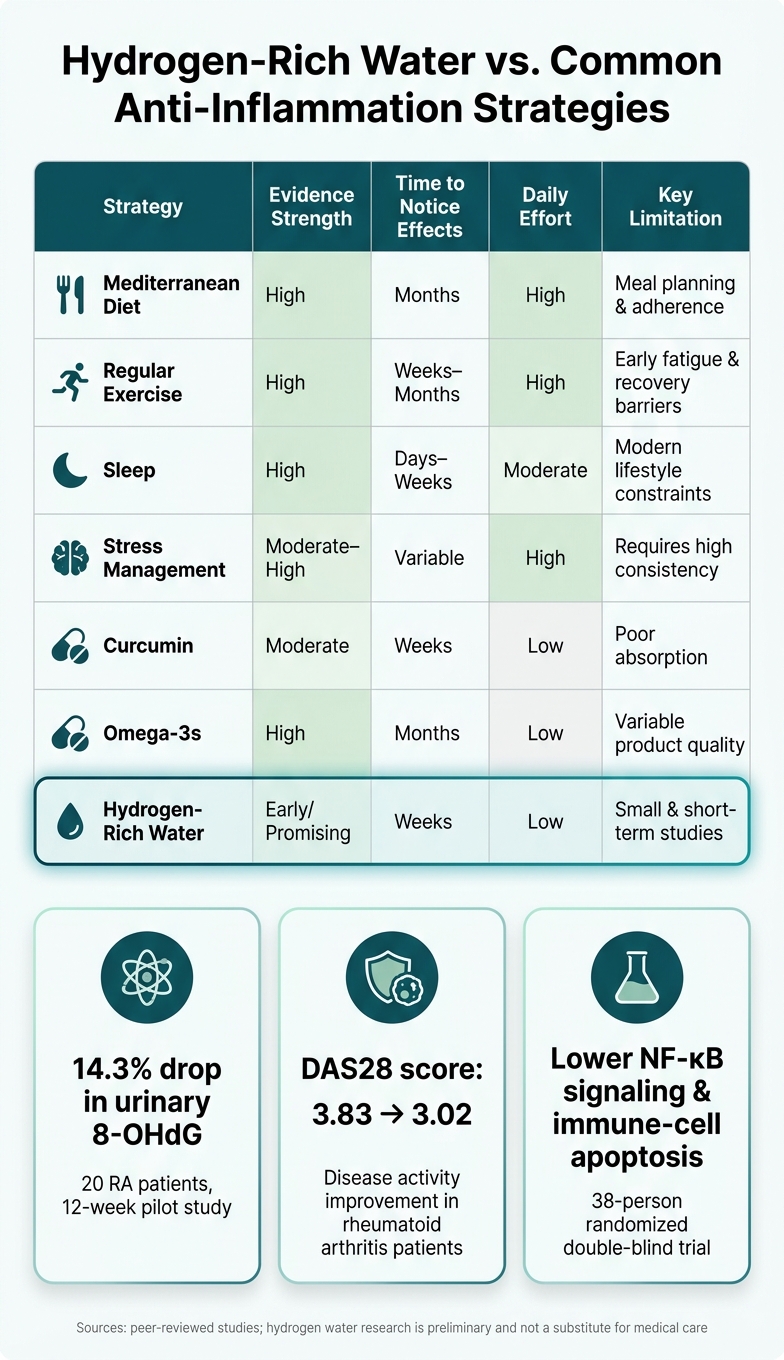
Natural Inflammation Management Strategies Compared: Evidence, Effort & Results
That gap helps explain why hydrogen-rich water has picked up interest as a simple form of daily support. It delivers molecular hydrogen, which may help the body deal with oxidative stress without asking much from your routine.
How Molecular Hydrogen Works in the Body
Research suggests H2 may act on the most reactive oxidants, especially hydroxyl radicals and peroxynitrite, while leaving normal signaling ROS alone. That matters because not all ROS are bad. Some help the body send normal signals, so the goal isn't to wipe everything out.
H2 also stands apart from broad antioxidants because it can reach the mitochondria directly. That's a big deal since mitochondria are one of the main places where ROS are produced during chronic inflammation. On top of that, studies point to possible effects on key inflammatory pathways. These include downregulation of NF-κB signaling and upregulation of Nrf-2, which helps support the body's own antioxidant defenses.
Preclinical work also suggests H2 may inhibit the NLRP3 inflammasome, a protein complex linked to the release of pro-inflammatory cytokines such as IL-1β and IL-18. Put simply, researchers aren't just looking at H2 as a basic free-radical scavenger. They're also studying how it may affect the signaling systems behind inflammation.
What Studies on Hydrogen Water Have Found So Far
Human research on hydrogen-rich water (HRW) and chronic inflammation is still in the early stages, but the results so far are encouraging.
In a small pilot study of 20 people with rheumatoid arthritis, daily hydrogen-rich water was linked to lower oxidative stress and better disease scores. Urinary 8-OHdG dropped by an average of 14.3%, and DAS28 scores fell from 3.83 to 3.02. All five patients with early-stage, ACPA-negative RA reached clinical remission by the end of the 12-week protocol.
A randomized, double-blind trial of 38 healthy adults found that hydrogen-rich water reduced inflammatory signaling and markers of cell damage. RNA sequencing showed downregulation of gene networks tied to TLR-NF-κB signaling. The HRW group also had lower immune-cell apoptosis than the plain water group.
Researchers are looking at HRW as an adjunctive approach, not a stand-alone treatment. That's an important point. The current view isn't that hydrogen water replaces medical care or the basics like sleep, diet, exercise, and stress management. It may fit alongside them.
"Molecular hydrogen (H2) was demonstrated to be a selective scavenger for the hydroxyl radical... H2 in the water could complement conventional therapy by reducing the oxidative stress in RA."
A Snapshot of the Evidence on Hydrogen-Rich Water
| Study Population | Delivery Form | Duration | Main Outcomes | Main Limitations |
|---|---|---|---|---|
| 20 patients with rheumatoid arthritis | 530 mL/day (4–5 ppm H2) | 4 weeks on, 4 weeks off, 4 weeks on | 14.3% reduction in 8-OHdG; DAS28 fell from 3.83 to 3.02; remission in early-stage RA cases | Small sample size; open-label pilot study; no placebo group |
| 38 healthy adults ages 20–59 | 1.5 L/day (0.75 mg/L H2) | 4 weeks | Lower immune-cell apoptosis; downregulated NF-κB signaling; increased overall antioxidant capacity in participants 30 and older | Short-term duration; single-country sample |
| Rats with LPS-induced chronic inflammation | Ad libitum HRW (saturated) | 7 months | Protected the gut barrier; activated Nrf-2; reduced TNF-α and IL-6; increased tight-junction proteins | Animal model; may not fully translate to humans |
| 25-article systematic review | Various HRW forms | Various | Encouraging results for exercise, liver function, and oxidative stress | Preliminary findings; calls for larger, more rigorous trials |
Across these studies, the pattern is fairly clear: HRW appears to lower markers of oxidative stress and may affect inflammatory signaling. At the same time, the research has limits. Sample sizes are often small, many trials are short, and long-term human data are still limited.
The next issue is practical. If hydrogen-rich water has a place, where does it fit in a day-to-day anti-inflammatory routine without pushing aside the habits that matter most?
Putting Hydrogen Water Into a Daily Routine
The research is still early, so the practical question is simple: how does hydrogen-rich water fit into a routine that people can stick with?
What a Balanced Anti-Inflammatory Routine Looks Like
Hydrogen-rich water makes the most sense when it’s part of a steady daily routine. That routine should still center on the basics: protein, fiber, walking, and steady sleep. In that setup, hydrogen-rich water is an extra hydration tool, not a substitute.
A practical target is about 34 to 50 fl oz (1.0–1.5 L) per day. Most people will find it easier to split that into two servings, one in the morning and one later in the day.
Morning can be a good time for it, especially before food or other drinks. Another solid option is after exercise, since molecular hydrogen reaches mitochondria quickly. It also helps to drink it soon after preparation, ideally within 30 minutes.
Where Edenvia Molecular Hydrogen Fits In

For readers who want a tablet-based option, Edenvia Molecular Hydrogen fits neatly here. Each tablet dissolves in a glass of water to make hydrogen-rich water designed to support joint comfort by targeting oxidative stress.
Daily Support Options Compared
Here’s the simplest side-by-side view:
| Support Option | Daily Effort | Main Role | Convenience | Long-Term Fit |
|---|---|---|---|---|
| Diet, sleep, walking | High | Base layer; addresses root causes of systemic inflammation | Low - requires time and planning | Must-have; the base everything else builds on |
| Common Supplements (fish oil, turmeric) | Low | Targeted; modulates specific inflammatory pathways | High - pill format | Moderate; works best with steady use |
| Hydrogen-rich water tablets | Low | Selective antioxidant; targets mitochondrial oxidative stress | High - dissolves in water | Easy add-on to daily hydration habits |
So hydrogen water fits best as a support tool, not the main driver of the plan.
Conclusion: What to Take Away About Hydrogen Water and Chronic Inflammation
Taken together, the current evidence suggests that hydrogen-rich water may be a practical add-on for chronic inflammation support. There isn’t one fix for chronic inflammation. It tends to respond best to steady habits, daily consistency, and a few well-chosen tools. In that mix, hydrogen-rich water stands out as one option worth a look.
Key Points to Remember
Early studies suggest that hydrogen-rich water may help reduce inflammatory signaling and markers linked to oxidative stress, but the research is still early. Molecular hydrogen is selective: it targets highly reactive hydroxyl radicals while leaving normal ROS signaling intact. That reaction produces water, and studies have reported good tolerability.
For people who want extra oxidative-stress support without overhauling their daily habits, hydrogen-rich water looks like a low-friction option. The big day-to-day issue is simple: convenience. For readers who want an at-home format, Edenvia Molecular Hydrogen tablets dissolve in water to make hydrogen-rich water.
Start with the basics first. Hydrogen-rich water makes the most sense as a daily add-on, not a shortcut.
FAQs
Who may benefit most from hydrogen-rich water?
Hydrogen-rich water may be especially helpful for people trying to manage oxidative stress and chronic inflammation. That can include people with metabolic syndrome, rheumatoid arthritis, or inflammatory bowel disease.
It may also help athletes and people who are just getting back into exercise. In those cases, it may help ease muscle fatigue, lower blood lactate levels, and support recovery.
Edenvia Molecular Hydrogen tablets offer a simple way to make hydrogen-rich water for joint comfort, mobility, and overall wellness.
How long does it usually take to notice effects?
With Edenvia Molecular Hydrogen, blood hydrogen levels usually peak within 5 to 15 minutes after you drink it.
That means it works fast in the body, at least in terms of blood hydrogen levels.
For longer-term effects tied to chronic inflammation, studies tend to show measurable changes after 4 weeks of steady daily use.
Is hydrogen water safe to use every day?
Yes. Hydrogen water is generally considered safe for daily use. The FDA classifies molecular hydrogen gas as Generally Recognized as Safe (GRAS) for use in beverages.
Research points to a strong safety profile. In studies, only a small group of people reported mild, short-term bloating or gas. For most healthy adults, 0.5 to 1.5 liters per day is a common range.
Some people should check with a doctor before using it, including:
- People who are pregnant
- Children
- People with kidney disease
- People with diabetes