

Hydrogen Water and Cartilage Protection: Key Insights
Short answer: I’d treat hydrogen-rich water as a joint support tool, not as a proven way to protect cartilage. The research is strongest in lab and animal studies, where hydrogen seems to lower oxidative stress, calm inflammation, and help cartilage cells stay alive. In people, the data so far is much thinner and mostly looks at symptoms like pain and stiffness.
Here’s the simple takeaway:
- Lab studies suggest hydrogen may help protect aggrecan and type II collagen
- Animal studies show less cartilage damage and lower levels of enzymes like MMP-13 and ADAMTS-5
- Human studies are small and short, often just 4 days to 1 month
- A small rheumatoid arthritis study used about 17 fl oz (500–530 mL) per day at 4–5 ppm for 4 weeks
- No human trial has yet shown cartilage preservation directly with scans or long-term joint measurements
If you’re wondering whether it can help your knees, hips, or other joints, my read is simple: it may help with the joint environment, but it has not been shown to stop cartilage loss in humans.
| Evidence type | What it shows | What it does not show |
|---|---|---|
| Cell studies | Less oxidative stress, less cell death, lower matrix breakdown | What happens in a whole human joint |
| Animal studies | Lower cartilage damage scores, lower inflammatory markers | Long-term results in aging adults |
| Human studies | Some symptom improvement | Proof of cartilage repair or preservation |
So if I were summarizing the article in one line, it would be this: hydrogen water looks promising for joint support, but the cartilage claim is still unproven in people.
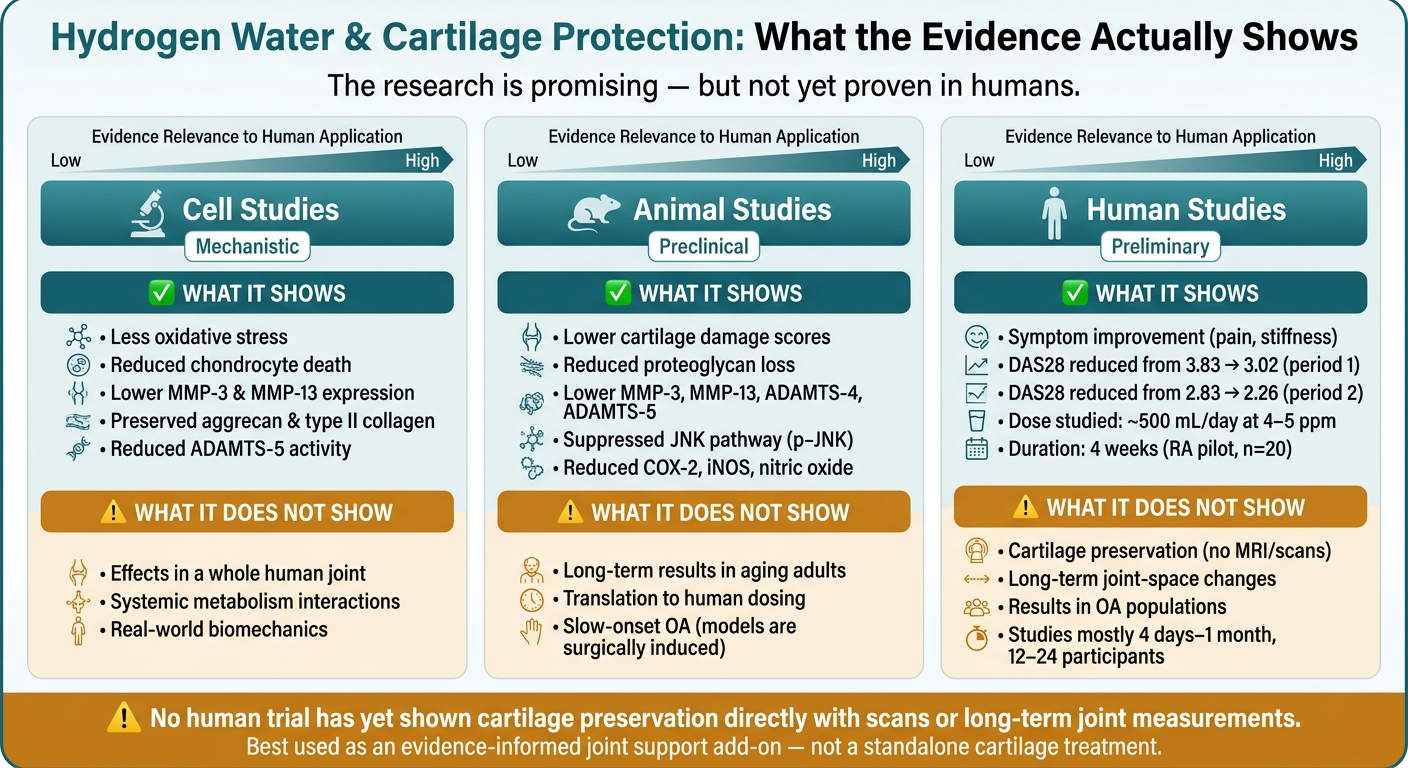
Hydrogen Water & Cartilage Protection: Evidence by Study Type
Hydrogen's Health Benefits for ARTHRITIS - episode 69
For those looking to support their health with this technology, molecular hydrogen tablets offer a convenient way to create hydrogen-rich water at home.
sbb-itb-6860cc4
How Molecular Hydrogen May Help Protect Cartilage
At the cellular level, molecular hydrogen seems to support cartilage in three linked ways: selective antioxidant action, anti-inflammatory effects, and anti-apoptotic actions on chondrocytes. Put simply, these pathways affect oxidative stress, inflammation, and the survival of cartilage cells.
How Hydrogen Acts as a Selective Antioxidant
Molecular hydrogen is selective. It mainly targets hydroxyl radicals (•OH) and peroxynitrite (ONOO⁻), while leaving signaling molecules like superoxide, hydrogen peroxide, and nitric oxide alone.
That detail matters. Some reactive molecules help cells communicate, so wiping all of them out can create new problems. Hydrogen appears to take a narrower approach.
In chondrocyte studies, exposure to peroxynitrite disrupted key cartilage proteins. When hydrogen was added, it restored aggrecan and type II collagen levels and reduced MMP3 and MMP13, two enzymes that break down the cartilage matrix. In plain English, that means hydrogen may help cartilage hold on to its structure during oxidative stress. Less oxidative stress can also dial down later inflammatory signaling.
How Hydrogen May Reduce Inflammatory Signaling in Joints
Hydrogen may also calm the stress signals that turn on cartilage-damaging enzymes. Preclinical studies suggest H₂ can modulate JNK, NF-κB, and related stress-activated pathways, which is linked with lower expression of enzymes such as MMP-13 and ADAMTS-5.
These enzymes are often higher in osteoarthritic joints. And they do direct damage by breaking down collagen and aggrecan, the proteins that give cartilage its strength and cushioning. In rat osteoarthritis models, hydrogen-rich water lowered MMP3, MMP13, ADAMTS4, and ADAMTS5. It also reduced COX-2, iNOS, and nitric oxide levels. The result is a joint setting that is less tilted toward tissue breakdown.
How Hydrogen May Protect Chondrocytes From Cell Death
Protecting cartilage cells matters because they do not come back easily. Cartilage has a poor ability to replace lost chondrocytes, so keeping the cells that remain alive is a big deal.
Research points to a clear anti-apoptotic effect. In human chondrocytes exposed to oxidative stress with tert-butyl hydroperoxide, H₂ reduced cleaved caspase-3, cytochrome c, and Bax. It also lowered ADAMTS-5 and MMP-13 expression.
This effect likely stems from lower mitochondrial oxidative damage, which may help stop chondrocytes from dying. Research also suggests that H₂ may support the body’s own antioxidant defenses through Nrf2-related pathways.
What Preclinical Studies Show About Cartilage Integrity
Most of the support for cartilage protection comes from cell and animal research, not human trials. That matters, because these proposed effects show up most clearly in preclinical work.
Cell Studies on Chondrocyte Survival and Matrix Damage
In one lab setup, researchers used a nitric oxide donor called SNAP to stress chondrocytes. That led to higher protein nitration and more cell death. When molecular hydrogen was added, nitrated protein levels dropped and chondrocyte survival improved. In plain English: hydrogen seemed to help cartilage cells hold up better under stress.
That lines up with hydrogen's selective antioxidant profile. It appears to act on highly reactive species such as hydroxyl radicals and peroxynitrite, without broadly shutting down normal cell signaling.
A 2026 systematic review found a similar pattern across OA-related preclinical models: hydrogen reduced oxidative stress, lowered inflammatory cytokines, and improved cartilage cell viability. Seeing that same pattern across different lab setups helps the biological case, even though it still doesn't show the same thing will happen in people.
Animal Studies on Osteoarthritis and Joint Degeneration
Animal studies help answer the next step: do those cell-level effects show up as less cartilage damage?
In rat OA models, animals given hydrogen-rich water had better preservation of type II collagen and aggrecan. They also showed lower expression of MMP-3, MMP-13, ADAMTS-4, and ADAMTS-5 than untreated controls. On top of that, cartilage damage scores were lower, proteoglycan loss was reduced, and markers of chondrocyte apoptosis fell.
A 2021 mouse study used the destabilization of the medial meniscus, or DMM, surgical OA model. Researchers found that hydrogen suppressed phosphorylation of JNK, written as p-JNK, in chondrocytes. Then they added a JNK activator called anisomycin, which reversed hydrogen's protective effect. That ties the cartilage effects to JNK pathway inhibition.
There is a big catch here. Rodent OA is usually induced fast through surgery or chemical agents. That's very different from the slow, years-long cartilage wear seen in aging adults. Animal studies also tend to run for only weeks to a few months, and the hydrogen dose or delivery method may not match what a person gets from drinking hydrogen-rich water every day. So while these findings are promising, they do not prove cartilage preservation in humans.
The next question is whether early human data line up with these lab findings.
What Human Studies Can and Cannot Tell Us Yet
Human studies mostly look at symptoms, not cartilage structure. So the main question right now is pretty simple: does it help people feel and move better? Not: does it protect cartilage in a proven way?
Early Findings on Pain, Mobility, and Joint Function
A small pilot study in 20 rheumatoid arthritis patients found that drinking about 500–530 mL/day of high-concentration hydrogen water (4–5 ppm) for 4 weeks reduced DAS28 from 3.83 to 3.02 in the first drinking period and from 2.83 to 2.26 in the second, with both changes reaching statistical significance (p < 0.01).
That points to symptom relief. People may have had less pain, better mobility, or better joint function. But there’s an important catch: it still doesn’t show cartilage protection.
Current Research Limits for Cartilage Preservation
The gap is pretty clear. No current human trial directly confirms that hydrogen-rich water preserves cartilage. Most studies are short, often lasting 4 days to 1 month, and usually include only about 12 to 24 participants. Long-term trials that measure things like cartilage thickness or joint-space change are still missing.
| Study Type | Evidence Level | Main Outcomes Measured | Key Limitations |
|---|---|---|---|
| Cell studies | Mechanistic; high internal validity | Chondrocyte survival, oxidative stress markers, cytokine production, matrix degradation | Controlled lab conditions; no whole-joint biomechanics or systemic metabolism |
| Animal studies | Strong preclinical support | Histologic cartilage grading, joint degeneration scores, inflammatory markers | Induced disease models; dosing differs from human use; translation uncertain |
| Early human studies | Preliminary; symptom-focused | Pain scales, WOMAC, SF-36, functional tests, muscle damage markers | Short duration, small samples, no MRI/cartilage biomarkers, often combined with exercise |
So the human evidence points to symptom relief, not proven cartilage preservation. In plain English, that means practical use should center on support - not on expecting cartilage repair.
Practical Takeaways for Adults Considering Hydrogen-Rich Water
How Hydrogen Water Fits Into a Joint Wellness Routine
If you want to try hydrogen-rich water, the main thing to know is simple: treat it as support, not as a stand-alone fix.
Research links hydrogen-rich water with lower oxidative stress and inflammation. But it doesn't replace exercise, weight control, or medical care.
For cartilage-focused use, consistency matters more than perfect timing. The aim is steady exposure, not a one-off drink here and there. Most studies used daily intake over 4 to 8 weeks.
In those studies, a common daily amount was about 17 fl oz (500 mL). It also helps to drink it soon after mixing, before the hydrogen fades out of the water. So in practice, freshness and daily use matter more than the exact hour you drink it.
Where Edenvia Molecular Hydrogen Fits the Research Context
This is where Edenvia Molecular Hydrogen comes in. Edenvia Molecular Hydrogen uses tablets that turn a glass of water into hydrogen-rich water, which lines up with the oral format used in human studies.
Each tablet dissolves in about 2 to 3 minutes, and drinking the water within 30 minutes helps keep the hydrogen concentration from dropping too much.
Conclusion: Key Points on Hydrogen Water and Cartilage Protection
Put together, the research points to a plausible support role for hydrogen-rich water. At the same time, human trials that look directly at cartilage-preservation outcomes are still missing, and most of the clinical data come from rheumatoid arthritis and general inflammation settings, not osteoarthritis.
So the best way to view it is as a small, evidence-informed add-on.
FAQs
Can hydrogen water actually prevent cartilage loss?
Research suggests hydrogen-rich water may help protect cartilage by reducing oxidative stress and chronic inflammation, two major drivers of joint wear and tear.
Molecular hydrogen works as a selective antioxidant. That means it can help neutralize harmful free radicals without disrupting normal cell signaling. It may also help lower pro-inflammatory cytokines and support the body’s natural recovery processes.
As part of a daily wellness routine, Edenvia Molecular Hydrogen tablets may help support joint comfort, mobility, and overall cellular health.
How long do I need to drink it to notice joint benefits?
Most users start to notice less joint pain, less stiffness, and smoother day-to-day movement within 7 to 10 days of taking it every day.
Bigger changes - like easier mobility and less inflammation - usually show up within 2 to 4 weeks. Results can vary from person to person, but it’s best to use it daily for at least 30 days.
Is hydrogen water more helpful for osteoarthritis or rheumatoid arthritis?
The available information doesn’t clearly show whether hydrogen water helps more with osteoarthritis or rheumatoid arthritis.
What it may do is support overall joint comfort and mobility by helping reduce oxidative stress, inflammation, and joint discomfort. But based on the findings provided, there’s no direct comparison between the two conditions.