

Hydrogen Water in 12-Week Weight Loss Studies
Here’s the short answer: hydrogen-rich water may shift cravings, cholesterol, blood sugar, and waist size a little within 8 to 24 weeks, but it does not show clear stand-alone weight loss at 12 weeks.
If I strip the research down to what matters most, this is what I get:
- Weight loss is mixed. In one 8-week trial, men lost 2.0 kg, but the full group did not show a clear drop.
- Cravings may drop earlier than body weight. One trial found cravings fell by 7.4 points with HRW vs. 1.3 points with placebo.
- Waist change may depend on exercise. In a 12-week study, a more active subgroup saw a 1.87 cm drop, while the control group went up 0.96 cm.
- Cholesterol changes are small. A 2026 meta-analysis found total cholesterol down 6.71 mg/dL and LDL down 3.21 mg/dL.
- Longer use may show more on glucose markers. A 24-week study reported drops in blood glucose and HbA1c.
- Safety looked okay in the trials covered. No severe adverse effects were reported in the 8- to 24-week studies mentioned.
So if you’re asking, “Can hydrogen water help me lose weight in 12 weeks?” my answer is simple: maybe a little on support markers, not much on the scale.
What I’d take from this article is even simpler:
- Best-fit use: a support tool, not a fat-loss fix
- Best early signals: cravings, GLP-1, cholesterol, glucose-related markers
- Weakest claim: direct, clear weight loss from HRW alone
- Best context: people with metabolic risk who also stay active and keep diet steady
That’s the lens I’d use for the rest of the article: look at outcomes one by one, not just the headline claim about weight loss.
Why I Changed My Mind About Hydrogen Water (with Tyler LeBaron)
sbb-itb-6860cc4
How 12-Week Hydrogen Water Studies Are Set Up
Most HRW studies use a randomized, double-blind, placebo-controlled design. That’s the standard setup in this area of research. In plain English, neither the participants nor the researchers know who gets HRW and who gets the placebo until the study is over.
Participants, Dosing, and Measured Outcomes
These trials usually include adults with overweight or obesity. Many also have metabolic syndrome, type 2 diabetes, or fatty liver disease. To keep the results clean, participants are often asked to keep their diet and physical activity the same and avoid starting new supplements or weight-loss drugs.
Daily intake usually falls between 0.5 and 2.0 liters of HRW. In many studies, that amount is split into three servings taken in the morning, afternoon, and before dinner. Hydrogen levels range from 0.5 ppm to 7.5 ppm, which works out to about 3 to 15 mg of molecular hydrogen per day.
Researchers also tend to measure the same core set of outcomes across these trials:
| Outcome Category | Specific Markers |
|---|---|
| Body Composition | Weight, BMI, waist circumference, body fat |
| Appetite | Food cravings, GLP-1, ghrelin |
| Metabolic Health | Fasting glucose, HbA1c, insulin |
| Lipid Profile | Total cholesterol, LDL, HDL, triglycerides |
| Inflammation and Oxidative Stress | CRP, TNF-alpha, IL-6, 8-OHdG |
Why 8-Week and 24-Week Findings Still Apply
The 8-week and 24-week studies help show what a 12-week protocol may be able to detect. The shorter 8-week trial found higher GLP-1 and lower LDL. The longer 24-week trial found lower HbA1c, blood glucose, BMI, and waist-to-hip ratio. Put together, those findings help set expectations for what researchers might see over 12 weeks.
What Studies Report on Weight, Body Fat, Appetite, and Metabolic Health
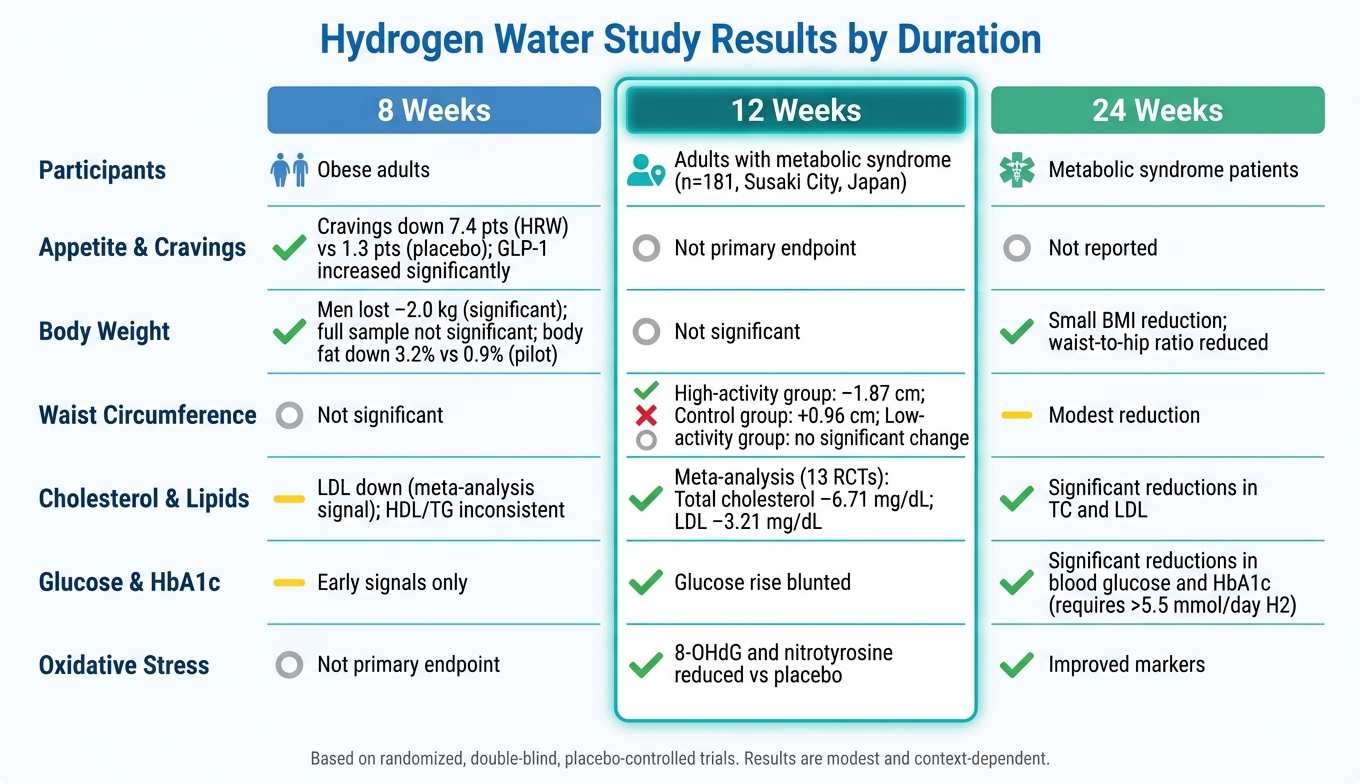
Hydrogen Water Study Results: 8, 12 & 24 Weeks Compared
Results don't move in a straight line. In these studies, metabolic markers tend to shift more often than body weight. Appetite and blood lipid changes also show up earlier and more often than changes on the scale.
Appetite, Cravings, and Body Composition Changes Around 12 Weeks
Appetite changes look like one of the clearest early signs in HRW research. In the 2025 HYDRAPPET trial, obese participants drank 1.0 liter of HRW per day, providing 15 mg of H2, for 8 weeks. Food cravings dropped by 7.4 points in the HRW group, compared with 1.3 points in the placebo group, and plasma GLP-1 levels increased significantly. Put simply, craving shifts may show up before weight shifts.
The scale showed a more mixed picture. In that same trial, weight loss reached statistical significance only in men, who lost −2.0 kg, while the full sample did not reach statistical significance. A short pilot study found something similar: body fat fell by 3.2% with HRW versus 0.9% with placebo, even though weight loss was not significant.
By 12 weeks, waist results seemed to depend in part on how active people were. In a 3-month trial in Susaki City, Japan, which included 181 participants with metabolic syndrome, HRW users with high activity levels reduced waist circumference by 1.87 cm, while the control group's waist circumference increased by 0.96 cm. People with low physical activity did not show significant waist changes.
Inflammation, Oxidative Stress, and Cardiometabolic Markers
A 2026 meta-analysis of 13 randomized controlled trials found that HRW significantly lowered total cholesterol by 6.71 mg/dL and LDL cholesterol by 3.21 mg/dL in overweight or obese adults. Researchers generally describe those lipid shifts as statistically significant but modest in clinical terms. Triglyceride findings were inconsistent, and HDL-C changes were small.
Glucose control also improved, especially in longer trials. A 24-week study using high-concentration HRW (>5.5 mmol/day) reported significant reductions in blood glucose and HbA1c in patients with metabolic syndrome. Oxidative stress markers, including 8-OHdG and nitrotyrosine, were lower in HRW groups than in placebo groups. That doesn't mean direct fat loss on its own, but it may help explain why HRW is being studied as a support tool for weight management.
Study Comparison Table: 8-, 12-, and 24-Week Findings
The pattern becomes easier to see when the studies are grouped by length.
| Study Duration | Participant Type | Primary Endpoints | Main Findings | Key Limitations |
|---|---|---|---|---|
| 8 Weeks | Obese adults | Cravings, GLP-1, weight, body fat | Cravings down 7.4 points; GLP-1 up; men lost 2.0 kg; the full sample did not; body fat down 3.2% in a separate pilot | Small samples; short window; weight results inconsistent |
| 12 Weeks | Metabolic syndrome | Waist circumference, glucose, oxidative stress | Waist down 1.87 cm in the high-activity group; glucose rise was blunted; 8-OHdG and nitrotyrosine reduced | Benefits tied to exercise level; not replicated in low-activity participants |
| 24 Weeks | Metabolic syndrome | HbA1c, glucose, BMI, lipids | Significant reductions in TC, LDL, glucose, and HbA1c; small BMI and waist-to-hip reductions | Requires high H2 concentration (>5.5 mmol/day); body composition changes remained modest |
Those time-based patterns lead straight into the next practical issue: how to set up a 12-week plan.
How to Use Hydrogen-Rich Water in a 12-Week Wellness Plan
Those study patterns lead to a practical question: how do you actually use HRW over 12 weeks?
The research points in a pretty clear direction. HRW seems to work best as a lifestyle add-on. It makes more sense to treat HRW as an experimental option for adults with metabolic risk, not as a stand-alone weight-loss fix. In plain English, use HRW with diet and exercise habits, not in place of them.
From there, it comes down to the routine.
What Clinical Protocols Typically Look Like
Most study protocols use about 1 liter per day, split into three servings: morning, early afternoon, and before dinner. Researchers usually keep diet and physical activity steady because HRW is meant to sit alongside existing habits, not replace them.
There’s also a clear pattern around movement. In the 3-month Susaki City trial, the subgroup with high physical activity saw a 1.87 cm drop in waist circumference, while the filtered-water control group saw a 0.96 cm increase. That suggests better activity levels may help improve results.
In weight-related research, daily H2 intake usually falls between 5 mg and 15 mg. Many of these studies use tablet-based delivery, which is a common setup in this area of research.
Where Edenvia Molecular Hydrogen Fits
If you're following a daily HRW routine, the product format matters. Edenvia Molecular Hydrogen uses the same tablet-dissolution method used in clinical research, so it lines up well with the split-dose pattern seen in studies.
As you go, track things like cravings and metabolic markers. Just keep your expectations in check: weight changes are often modest.
Bottom Line: What the Research Actually Supports
Across the 8-, 12-, and 24-week studies above, the pattern is pretty consistent. Hydrogen-rich water shows promise, but the 12-week data is still early and a bit mixed.
The clearest signals show up in appetite and metabolic markers, not on the scale. In plain English: the strongest findings point to less craving and small improvements in lipid markers, rather than obvious weight loss.
HRW has also been well tolerated in 8- to 24-week trials, with no severe adverse effects reported.
Key Points to Remember
Read the evidence by outcome, not by headline weight change.
| Outcome | What the Research Shows |
|---|---|
| Appetite/Cravings | Significant craving reduction and GLP-1 increase |
| Cholesterol/Glucose | Small improvements in cholesterol; some promise for glucose |
| Safety | Well tolerated across 8- to 24-week trials; no severe effects reported |
A 12-week window is long enough to spot early shifts in cravings and blood markers. It isn't long enough to expect dramatic fat loss from HRW alone.
A better way to view it: metabolic support tool. It may fit best as one part of a broader plan that includes movement and steady habits.
FAQs
How much hydrogen water should I drink daily?
In 12-week studies on metabolic health and weight management, daily intake usually falls between 1.0 and 1.5 liters.
People often divide that into smaller servings of 333 to 500 milliliters across the day, such as before breakfast, lunch, and dinner. Edenvia molecular hydrogen tablets make it easy to prepare hydrogen-rich water as part of your daily routine.
Who may benefit most from a 12-week HRW plan?
Adults with metabolic syndrome, type 2 diabetes, or overweight or obesity tied to cardiometabolic issues may see the most from a 12-week hydrogen-rich water (HRW) plan.
Clinical evidence suggests HRW may work as a supportive, non-drug add-on for managing lipid levels, blood glucose, and inflammation. Edenvia Molecular Hydrogen tablets offer a simple way to make hydrogen-rich water for overall wellness support.
When should I expect to notice results?
Most studies on hydrogen-rich water track results over 8 to 24 weeks.
Some people may notice early shifts in markers like cholesterol, glucose metabolism, and sleep quality within about 8 weeks.
Changes in body composition, such as BMI and waist-to-hip ratio, are more often reported over 12 to 24 weeks.