

Hydrogen Therapy for Seasonal Immune Challenges: Study Insights
If you want the short answer: hydrogen therapy shows early promise for rhinitis symptoms, but the best human data so far is for inhalation and nasal irrigation, not hydrogen-rich water.
From what I found in the article, the main takeaway is simple:
- Human studies reported lower nasal symptom scores
- Some trials also found lower IgE, eosinophils, and ECP
- Most studies were small and short
- Animal and lab work suggest anti-inflammatory and antioxidant effects
- The evidence is strongest for allergic rhinitis, not broad “seasonal immune support”
Here’s the practical view:
- If you’re looking at targeted nasal symptom relief, the study signal points most to hydrogen inhalation and hydrogen-rich saline nasal rinse
- If you’re looking at hydrogen-rich water, the article ties it more to general oxidative stress support, not direct allergy treatment
- If you want long-term answers, they’re not here yet. The research base is still limited
Key numbers from the article:
- 500 million people worldwide may be affected by allergic rhinitis
- One double-blind rhinitis trial included 120 patients
- One asthma animal study used 3% hydrogen inhalation
- A 2024 meta-analysis reviewed 12 rodent studies
Hydrogen-rich saline irrigation on chronic rhinitis - Video abstract [ID 365611]
sbb-itb-6860cc4
Quick comparison
| Method | What studies looked at | What the article suggests |
|---|---|---|
| Hydrogen inhalation | Nasal symptom scores, IgE, eosinophils, nasal flora | Best fit for studied rhinitis symptom relief |
| Hydrogen-rich saline nasal irrigation | TNSS and ECP in chronic rhinitis | Best fit for local nasal support |
| Hydrogen-rich water | Systemic oxidative stress and inflammatory markers | More for general support than direct seasonal allergy care |
Bottom line: I’d read this as early rhinitis-focused research, not proof that hydrogen is a standard treatment for seasonal allergies. The signal is there, but the long-term picture is still unclear.
How Molecular Hydrogen May Affect Immune and Inflammatory Pathways
Researchers have looked at whether hydrogen can interrupt the oxidative stress cycle described above. The idea is pretty simple: molecular hydrogen may affect immune and inflammatory signaling through selective antioxidant and anti-inflammatory actions.
Selective Antioxidant and Anti-Inflammatory Activity
H2 stands out because it doesn’t seem to wipe out every reactive oxygen species. Instead, it appears to go after the most damaging ones - the hydroxyl radical (•OH) and peroxynitrite (ONOO⁻) - while leaving the ROS your body still uses intact.
Researchers have described molecular hydrogen as a selective free-radical scavenger. It may also help switch on the body’s own antioxidant systems, including superoxide dismutase (SOD), catalase (CAT), and glutathione peroxidase (GPx), through activation of the Nrf2 pathway. On top of that, studies suggest H2 can suppress the NF-κB and NLRP3 inflammasome pathways, which are major drivers of allergic and respiratory inflammation.
Those pathway changes matter because they line up with shifts in inflammatory signaling seen in allergic conditions. In allergic and respiratory models, H2 has been linked with lower levels of pro-inflammatory markers such as IL-1β, IL-4, IL-5, IL-13, and TNF-α, along with higher anti-inflammatory signals like IL-10 and IFN-γ. A 2024 meta-analysis of 12 rodent studies found that high-concentration hydrogen significantly reduced TNF-α, IL-1β, IL-4, and IL-8, but showed no significant effect on IL-6 in the pooled data.
What Mechanism Studies Can and Cannot Prove
This is where it helps to stay grounded. Mechanism studies can show that something may work at a biological level, but they do not prove symptom relief.
Lab and animal research can show plausibility, not proven clinical benefit. Right now, most of the evidence is still observational or preclinical, so symptom relief in people has not yet been established. Most of these mechanistic studies were done in mouse or guinea pig models, often over short 7- to 14-day study periods. The next section looks at whether these mechanisms show up in human symptom studies.
Study Findings: Allergic Rhinitis, Nasal Symptoms, and Respiratory Immune Stress
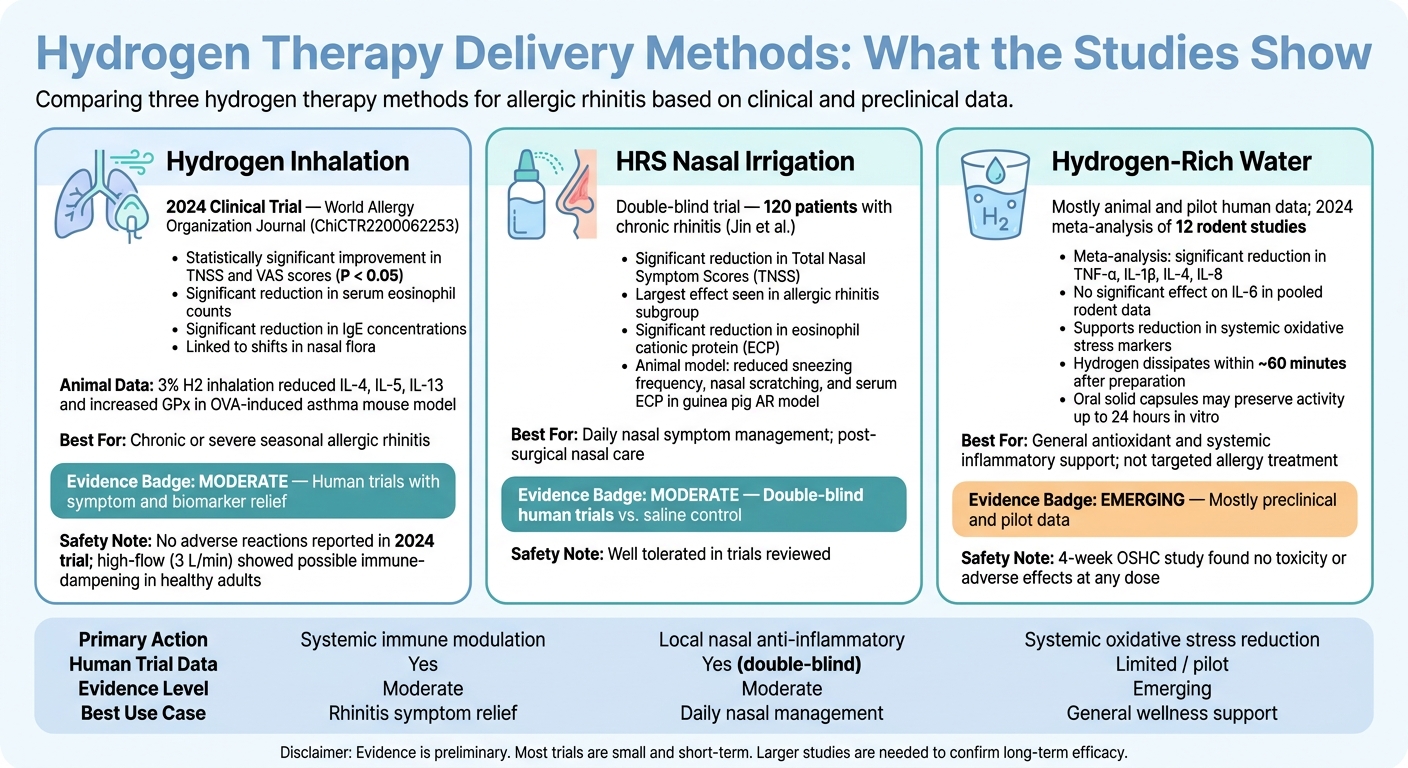
Hydrogen Therapy Delivery Methods for Allergic Rhinitis: Evidence Comparison
Human Studies on Allergic Rhinitis and Nasal Symptom Relief
Researchers have moved past theory and started testing whether these effects show up in day-to-day symptom relief. So far, human studies have looked at two main approaches: inhaled hydrogen gas and hydrogen-rich saline (HRS) nasal irrigation.
A 2024 clinical trial published in the World Allergy Organization Journal (Registration No. ChiCTR2200062253) reported that hydrogen inhalation led to statistically significant gains in Total Nasal Symptom Scores (TNSS) and Visual Analog Scale (VAS) scores in patients with allergic rhinitis (AR). Serum eosinophil counts and immunoglobulin E (IgE) concentrations also fell significantly (P < 0.05). The study also connected symptom relief with shifts in nasal flora.
Another human study, a double-blind trial involving 120 patients with chronic rhinitis, found that HRS nasal irrigation lowered TNSS, with the biggest effect seen in allergic rhinitis. HRS also lowered eosinophil cationic protein (ECP), which is a key marker of allergic inflammation.
Respiratory Findings Relevant to Seasonal Allergy
Human data are still limited in some areas, so animal models help fill in the picture. They can show whether the same anti-inflammatory pattern appears in the airways.
In an OVA-induced asthma mouse model, 3% hydrogen inhalation reduced inflammatory cell infiltration, lowered IL-4, IL-5, and IL-13, and increased GPx activity. In a separate animal study, hydrogen-rich saline reduced sneezing frequency and nasal scratching, while also lowering serum ECP levels in guinea pig models of AR.
Evidence by Delivery Method and Study Type
| Delivery Method | Main Study Focus | Main Use | Strength of Evidence |
|---|---|---|---|
| H2 Inhalation | Systemic immune modulation, nasal flora balance, AR symptom scores | Chronic or severe seasonal AR | Moderate - human trials showing symptom and biomarker relief |
| Nasal Irrigation (HRS) | Local anti-inflammatory action, ECP reduction, physical clearance | Daily symptom management; post-surgical nasal care | Moderate - double-blind human trials vs. saline |
| Hydrogen-Rich Water | General antioxidant support, systemic oxidative stress reduction | General wellness and mild seasonal support | Emerging - mostly animal and pilot human data |
Across both inhalation and nasal irrigation, human trials have shown statistically significant results. At the same time, researchers keep making the same point: larger studies are still needed to check long-term efficacy with more confidence. The next section covers how these delivery methods were used and what is known about safety.
Safety, Delivery Methods, and Practical Context for Readers
How Hydrogen Has Been Used in Studies
After the symptom findings, the next step is looking at how hydrogen was given in studies and what that means in day-to-day use. Researchers have tested inhalation, nasal irrigation, HRW, and oral capsules. The main differences come down to access, delivery speed, and how long the hydrogen stays available.
HRS nasal irrigation goes straight to the nasal mucosa and was tested in a 120-patient chronic rhinitis trial by Jin et al.. HRW is simpler for daily use, which is a big part of its appeal, but there’s a catch: hydrogen can dissipate within about 60 minutes after preparation. Oral solid hydrogen capsules are meant for sustained release and may preserve hydrogen-related activity for up to 24 hours in vitro.
What Is Known About Safety and Remaining Gaps
Short-term trials have reported few side effects, but the evidence base is still small. Across the studies reviewed, hydrogen therapy has generally been well tolerated. The 2024 World Allergy Organization Journal trial reported no adverse reactions during or after hydrogen inhalation in allergic rhinitis patients. A separate 4-week OSHC study found no toxicity or adverse effects at any dose level.
There is one detail worth noting. High-flow hydrogen inhalation at 3 L/min showed a possible immune-dampening effect in healthy middle-aged participants. That doesn’t settle the issue, but it does show why dose and setting matter. Most human trials so far are short, include small sample sizes, and need longer follow-up before anyone can make firm claims.
Where Hydrogen-Rich Water Products Fit Into the Discussion
Hydrogen-rich water is the easiest at-home format to get, including tablet-based products such as Edenvia Molecular Hydrogen. That said, the clinical trials tied most closely to seasonal immune symptoms used inhalation or nasal irrigation, not HRW. The broader HRW research does support a role in lowering systemic inflammatory markers such as IL-6 and TNF-α.
So HRW products make more sense as general antioxidant support than as a targeted seasonal allergy treatment.
Conclusion: What the Evidence Supports So Far
Taken together, the current studies point most clearly to rhinitis. Human trials have reported better TNSS and VAS scores with hydrogen-rich saline nasal irrigation and hydrogen inhalation, along with drops in serum IgE and eosinophil counts. Those are clinically relevant outcomes in allergic and chronic rhinitis. The early data is promising, but it’s still preliminary.
The big question isn’t whether there’s a signal. It’s how long it lasts and whether other researchers can get the same results again and again. As Ling Jin et al. note, these studies are still small and short term. It’s also still unclear how much long-term benefit hydrogen may offer, how it works in people, and which delivery method makes the most sense. Animal studies help answer part of that, but they can’t stand in for larger human trials.
Key Points to Remember
Hydrogen therapy shows its clearest early signal in rhinitis symptom relief, not broad seasonal immune support. That difference matters. The strongest findings are linked to specific rhinitis outcomes under controlled study conditions. At this stage, hydrogen therapy is best viewed as an early-stage option with encouraging rhinitis data, not a settled clinical standard.
FAQs
Is hydrogen therapy proven for seasonal allergies?
Not yet. Early research suggests hydrogen therapy may help with the biology behind allergic conditions through antioxidant and anti-inflammatory effects. Some studies have also reported benefits in airway inflammation, asthma models, and allergic rhinitis.
That said, it has not been clinically proven for seasonal allergies in the same way as standard treatments. Larger randomized controlled trials are still needed to confirm how well it works and what dosing makes sense.
Which form of hydrogen seems most effective for rhinitis?
Research suggests hydrogen inhalation has shown the clearest clinical benefit in people with allergic rhinitis. In clinical settings, it improved nasal symptom scores and inflammatory markers.
Hydrogen-rich saline has also reduced allergic rhinitis inflammation in animal studies. But when it comes to rhinitis in humans, the clinical evidence is still limited.
Is hydrogen-rich water enough for allergy relief?
Research suggests hydrogen-rich water is a recognized way to deliver molecular hydrogen. That may help support antioxidant and anti-inflammatory responses.
Put simply, it may help with systemic inflammation support. At the same time, it’s best viewed as part of overall wellness support during seasonal immune challenges.
Edenvia Molecular Hydrogen tablets offer a simple way to make hydrogen-rich water.