

Hydrogen Tablets vs. Traditional Antioxidants
If I had to sum it up in one line: hydrogen tablets and antioxidant nutrients do different things, and neither replaces the other.
If you want the short answer, here it is:
- Hydrogen tablets make hydrogen-rich water and seem to act in a more selective way during oxidative stress.
- Antioxidant nutrients like vitamin C, vitamin E, selenium, beta-carotene, and polyphenols give broader nutrition support, mainly through food.
- The research is not equal. Hydrogen has small human studies and short trials. Antioxidant nutrients have many more years of research, but high-dose pills often do not match the results seen with food-based eating patterns.
- Safety is different too. Hydrogen has looked well tolerated in short-term studies, while some high-dose antioxidant supplements have been linked with risks in some groups.
- For joint comfort, recovery, and mobility, food still matters most. Hydrogen may be an add-on, not a stand-in for diet.
Put another way: if you already eat well and still deal with stiffness, slow recovery, or joint discomfort, hydrogen tablets may be worth looking into. But if your diet is weak, no tablet fixes that.
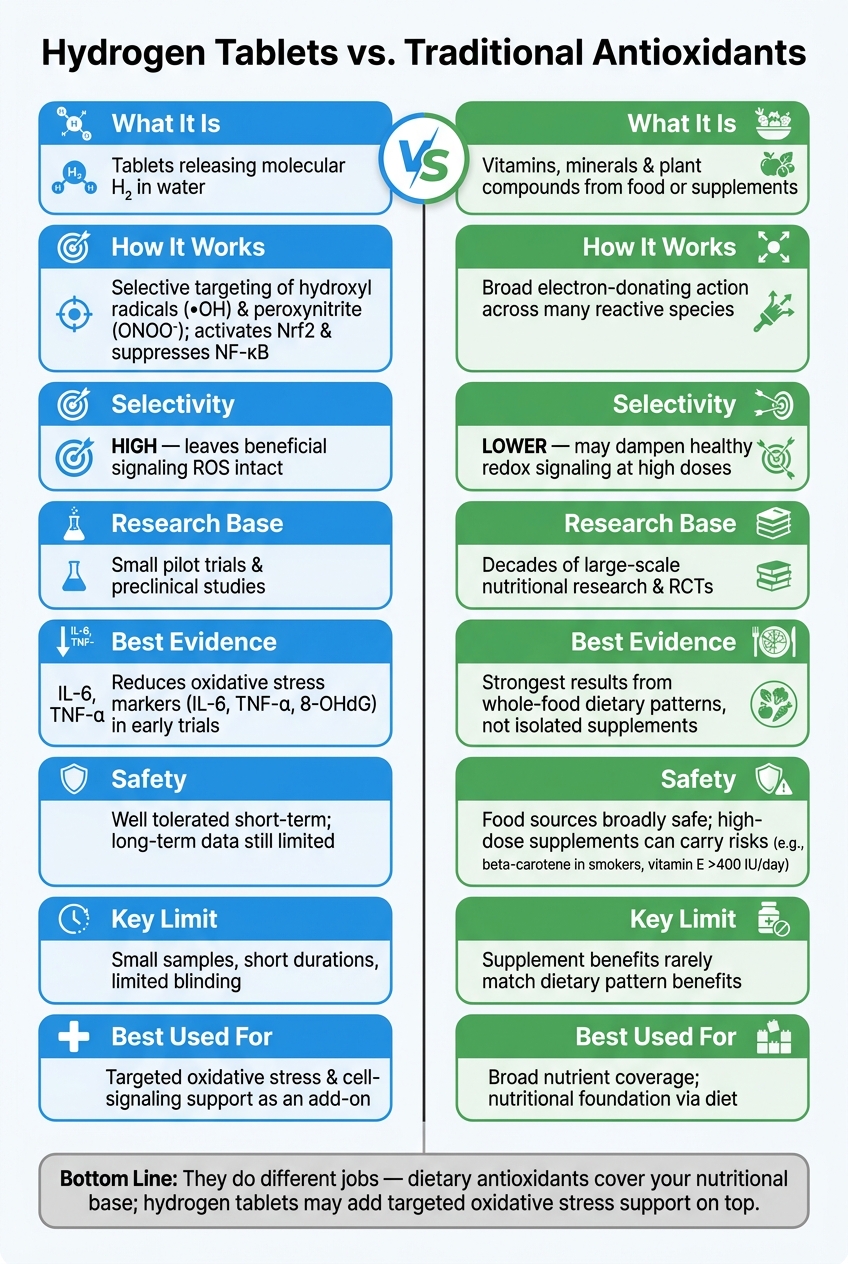
Hydrogen Tablets vs. Traditional Antioxidants: Side-by-Side Comparison
Why Hydrogen Beats Traditional Antioxidants for Health | Mercola Cellular Wisdom
sbb-itb-6860cc4
Quick Comparison
| Criteria | Hydrogen Tablets | Antioxidant Nutrients |
|---|---|---|
| What they are | Tablets that release molecular hydrogen (H₂) in water | Vitamins, minerals, and plant compounds from foods or supplements |
| Main examples | H₂ tablets | Vitamin C, vitamin E, selenium, beta-carotene, polyphenols |
| How they work | More selective action on certain reactive species; may affect Nrf2 and NF-κB | Broader electron-donating action across many reactive species |
| Main research pattern | Small human trials, pilot studies, preclinical work | Many decades of nutrition research and large trials |
| Best-supported use | Oxidative stress and inflammation markers in early studies | Lower inflammation and better health patterns when eaten in foods |
| Main limit | Small samples, short study length | High-dose supplements often give mixed or poor results |
| Safety note | Short-term use looks well tolerated; long-term data are still limited | Food sources are usually low risk; stacked supplement doses can be a problem |
My take: if you’re comparing them head-to-head, the main question is not “Which one is better?” It’s “What job do I want it to do?” That’s the frame I’d use for the rest of this article.
How Hydrogen Tablets and Traditional Antioxidants Work
The main difference comes down to selectivity. How each option reacts with free radicals shapes what it changes - and what it leaves untouched.
Hydrogen Tablets: Selective Antioxidant and Cell-Signaling Effects
Molecular hydrogen (H₂) is a very small, nonpolar gas that moves fast through cell membranes and tissues. That small size helps it reach places like the mitochondria and the brain with little delay. In plain terms, it can get where it needs to go fast, which affects oxidative stress without shutting down healthy redox signaling.
Its biggest edge is selectivity. H₂ mainly targets hydroxyl radicals (•OH) and peroxynitrite (ONOO⁻), two of the most damaging reactive species in the body. At the same time, it mostly leaves hydrogen peroxide and superoxide alone. That matters because cells use those molecules for signaling. If you wipe those out too broadly, cell communication and adaptation can take a hit.
H₂ doesn’t stop there. It also acts at the signaling level. Research shows it can activate Nrf2, which supports the expression of antioxidant enzymes like superoxide dismutase (SOD), catalase, and heme oxygenase-1 (HO-1). It may also help suppress NF-κB, a key driver of inflammatory signaling. So you’re looking at a two-part effect: less damage from the worst radicals, plus more support for the body’s own defense systems.
Traditional Antioxidants: How They Neutralize Free Radicals
Traditional antioxidants work in a more direct way. They neutralize radicals by donating electrons. Vitamin C does this in watery areas like blood plasma. Vitamin E works inside fatty cell membranes, where it helps stop lipid peroxidation. Vitamin C can also regenerate oxidized vitamin E.
Where these antioxidants act depends a lot on solubility. Water-soluble compounds stay mostly in aqueous spaces, while fat-soluble ones build up in membranes and other lipid-rich areas. That shapes their range in the body.
The tradeoff is that traditional antioxidants tend to react with a broader mix of reactive species, including some that play a normal role in cell signaling. At high supplemental doses, that broad activity can sometimes blunt the adaptive responses the body depends on.
Here’s the side-by-side view:
Mechanism Comparison Table
| Feature | Hydrogen Tablets (H₂) | Traditional Antioxidants |
|---|---|---|
| Selectivity | Highly selective; targets •OH and ONOO⁻ | Broadly reactive with multiple ROS/RNS |
| Primary species targeted | Hydroxyl radicals, peroxynitrite | Superoxide, hydrogen peroxide, lipid radicals, others |
| Effect on Nrf2 | Can activate Nrf2/ARE and support antioxidant enzyme expression | Can activate Nrf2 indirectly or directly, depending on the compound. |
| Effect on NF-κB | May help suppress NF-κB activation and inflammatory signaling | May reduce NF-κB activity, but usually through broader ROS suppression |
| Blood-brain barrier | Crosses readily due to its small size | Limited; many compounds depend on specific transporters |
| Impact on redox signaling | Preserves physiological ROS/RNS signaling | May dampen signaling species at high supplemental doses |
Benefits, Evidence, and Safety
Mechanism matters. But when you're deciding what belongs in a daily routine, evidence and safety matter more.
What Research Suggests About Molecular Hydrogen Tablets
Most human research on molecular hydrogen comes from small trials in RA and metabolic syndrome. Across those studies, H₂ has consistently lowered markers of oxidative stress and inflammation, including IL-6, TNF-α, and 8-OHdG. Some of that work also showed early signs of symptom relief in joint conditions. A 45-study systematic review found antioxidant, anti-inflammatory, and cytoprotective effects across joint, muscle, and tendon conditions.
Still, there are clear limits here. Most trials are small, short, and don't use strict blinding. The brain-health data are also uneven. One small Parkinson's trial reported a positive result, but a larger trial found no benefit. So the picture isn't simple.
On the safety side, tolerability has generally been good in the trials that have been reported. The catch is that long-term safety data are still limited.
Traditional antioxidants have a much larger body of research behind them. But a bigger evidence base doesn't automatically mean they're more targeted.
What Research Suggests About Traditional Antioxidants
When it comes to inflammation and mobility, the strongest results come from dietary patterns, not isolated pills.
Traditional antioxidants tend to perform better in food-based eating patterns than in supplement form. Diets rich in fruits, vegetables, nuts, and grains are linked to lower inflammation and better cardiovascular outcomes. By contrast, high-dose single-nutrient supplements have produced mixed results.
That's a big deal. A food-first pattern works more like an orchestra. A single supplement acts more like one instrument trying to carry the whole song.
High-dose antioxidant supplements are also less dependable and can create problems in some groups. Trials of beta-carotene found a higher lung cancer risk in smokers, and some vitamin E meta-analyses reported a small increase in all-cause mortality. A large evidence review found that in generally well-nourished adults, antioxidant supplements do not improve mortality, disease risk, or quality of life.
For joint health and mobility, antioxidant-rich dietary patterns are linked to lower systemic inflammation and better functional mobility in aging populations. But isolated high-dose supplements rarely reproduce those same effects on their own.
Evidence and Safety Comparison Table
| Category | Molecular Hydrogen (H₂) | Traditional Antioxidants |
|---|---|---|
| Oxidative stress | Reduces 8-OHdG and related markers in pilot trials | Strong dietary evidence; supplement data mixed |
| Inflammation | Lowers IL-6, TNF-α, CRP in small trials | Food patterns reduce inflammation; high-dose supplements inconsistent |
| Metabolic support | Promising in small human trials and preclinical models | Antioxidant-rich diets linked to lower cardiometabolic risk |
| Joint/mobility | Pilot RA data show symptom and biomarker improvements | Whole-food patterns may support mobility through lower inflammation |
| Brain health | Mixed human RCT results; intriguing preclinical data | Polyphenol-rich diets associated with brain health; supplement evidence inconsistent |
| Safety profile | Well tolerated short-term; long-term data limited | Food sources broadly safe; high-dose supplements can carry risks |
| Key limit | Small samples, short durations, limited blinding | Supplement benefits rarely match dietary pattern benefits |
| Evidence base | Preclinical and early-phase human trials | Decades of nutritional science and large RCTs |
Daily Use: Practical Differences
Practical use matters just as much as mechanism.
How Hydrogen Tablets Are Typically Used
Hydrogen tablets are pretty simple to use, but the timing matters. You dissolve one tablet in 12 to 16 oz of cool or room-temperature water, wait 2 to 3 minutes, and drink it right away. Hot water is a no-go.
The routine is straightforward: dissolve the tablet in water, then drink it promptly. Depending on a person's health goals, some people take tablets one to three times per day, spaced out across the day. Storage matters too. Keep tablets in a cool, dry place and away from humidity.
That quick mix-and-drink step is the main day-to-day difference between hydrogen tablets and antioxidant-rich foods or standard supplements.
How Traditional Antioxidants Fit Into Diet and Supplements
Traditional antioxidants are easier to spread across the day because food already brings them into regular meals. Fruits, vegetables, nuts, oils, and grains supply most of them.
Supplements can help fill gaps, but there's a catch: it's easy to stack doses without meaning to. Many multivitamins already include vitamin C and vitamin E. Add separate antioxidant products on top, and total intake can climb past safe limits, such as the 2,000 mg/day upper limit for vitamin C or vitamin E intakes above 400 IU/day, which have been questioned in some analyses.
Supplement doses can vary a lot, so check labels and track your total intake across products. Read Supplement Facts labels and keep an eye on the full daily total.
Everyday Use Comparison Table
| Feature | Hydrogen Tablets | Traditional Antioxidants |
|---|---|---|
| Preparation | Dissolve 1 tablet in 12–16 oz water; wait 2–3 min | Swallow capsule with water, or prepare antioxidant-rich meals |
| Speed of use | ~2–5 minutes total | Under 1 minute (capsules); variable for food |
| Typical routine | One to three times daily, often spaced across the day | With meals; food sources integrated throughout the day |
| Hydration link | Direct - each dose requires 12–16 oz of water | Indirect; capsules need only a sip |
| Storage | Cool, dry place; sensitive to moisture | Room temperature for most; refrigeration for some foods |
| Main precautions | Avoid hot water; drink promptly after effervescence | Watch for dose stacking; check labels across all supplements |
| Wellness fit | Targeted oxidative stress and cell-signaling support | Broad nutrient coverage; strongest through dietary patterns |
Conclusion: How Hydrogen Tablets Differ From Traditional Antioxidants
In plain English, traditional antioxidants offer broad support against free radicals, while molecular hydrogen works in a more selective way, going after some of the most damaging radicals. On top of that, H₂ appears to affect pathways tied to inflammation and cellular energy. Because it’s so small, it can move into tissues fast. That’s why it’s often described as targeted support, not a replacement for nutrients from food.
Put simply: they do different jobs. Dietary antioxidants help cover your nutritional base, while hydrogen tablets may add extra support for oxidative stress.
Key Takeaways for Readers Focused on Inflammation and Mobility
For people dealing with inflammation or mobility issues, the takeaway is pretty straightforward.
Hydrogen tablets may make the most sense if you already eat well but still struggle with stubborn stiffness, slow recovery, or joint and recovery concerns. Research on musculoskeletal complaints points to possible gains in pain, function, and inflammatory markers. That said, many of these studies are small, and larger trials are still needed.
Dietary antioxidants still matter every day. Foods like fruits, vegetables, nuts, and whole grains give you vitamins, minerals, and phytonutrients that hydrogen tablets simply don’t provide. Over time, eating more of these foods is linked with lower inflammation and better mobility.
Both tend to have a favorable safety profile, but there’s an important difference. High-dose antioxidant supplements can come with toxicity risks or drug interactions, while hydrogen is generally well tolerated and leaves the body fast. If you have a chronic inflammatory condition, a complex medical history, or take several medications, talk with a healthcare professional before adding either one.
Consistency matters more than timing. Don’t judge the effect after a single dose. Look at how you feel after a few weeks of steady use.
FAQs
Can hydrogen tablets replace antioxidants from food?
No. Molecular hydrogen tablets are a targeted, selective antioxidant. They don't replace the broad mix of nutrients you get from food.
Standard antioxidants like vitamins C and E still play an important role in the diet. Molecular hydrogen works in a different way. It helps neutralize the most harmful free radicals without interfering with helpful reactive oxygen species.
Edenvia Molecular Hydrogen tablets are best used alongside a healthy diet, not instead of one.
Who might benefit most from hydrogen tablets?
Hydrogen tablets may help people who want to keep oxidative stress in check and support a healthy inflammatory response.
They may also be a good fit for people dealing with joint stiffness, muscle fatigue, or chronic discomfort. That includes athletes, active adults, and anyone focused on wellness, recovery, and long-term vitality.
How long should I use hydrogen tablets before judging results?
Results depend on your wellness goals.
Some people notice shifts in energy and mental clarity within 7 to 10 days. Broader wellness effects may show up in 1 to 2 weeks, or they may build more slowly over several weeks.
Some health markers can take 6 to 8 weeks to change. If you want a better read on how they’re working for you, use them consistently for at least 30 days.