

Do Hydrogen Tablets Reduce Post-Workout Inflammation?
Short answer: maybe. From what I see in the article, hydrogen tablets may help with post-workout recovery more than performance. The best human results point to less soreness, lower creatine kinase (CK), and a drop in IL-6 after hard exercise, but the research is still limited and results are mixed.
If you want the plain-English version, here it is:
- What they are: Tablets you drop into water to make hydrogen-rich water (HRW)
- What they may do: Help cut down extra oxidative stress after training
- What they seem to help most: Soreness, fatigue, and recovery
- What they do not clearly improve: Aerobic endurance and some performance markers
- How to use them: Drink soon after mixing, since hydrogen gas fades fast
- Best way to think about them: A small recovery tool, not a fix for poor sleep, food, or hydration
A few numbers stand out. In one swimmer study, CK was 156 U/L vs. 190 U/L with placebo, and soreness was 34 mm vs. 42 mm at 12 hours. In another trial, post-exercise IL-6 fell in the hydrogen group while it went up in controls. Meta-analysis data also showed a 0.30 effect size for lower-body power and -0.37 for lactate, but not for VO2 max.
Here’s the main takeaway: if you want less soreness and a smoother recovery day, hydrogen tablets may be worth a look. If you want a clear performance boost, the case is weaker. I’d treat them as a support option, with the most value coming from steady use and good timing.
What Post-Workout Inflammation Is and When It Becomes a Problem
That’s the basic idea behind post-workout recovery: you want enough inflammation to help repair, but not so much that your body gets stuck spinning its wheels. After hard training, inflammation and oxidative stress help kick off the repair process. Trouble starts when that response hangs around too long or climbs too high.
How Exercise Triggers Oxidative Stress and Muscle Soreness
Hard or eccentric exercise can cause tiny amounts of muscle damage. In response, your body releases pro-inflammatory cytokines like IL-6 and TNF-α. Those compounds can make nerves more sensitive to pain and add to stiffness and tenderness.
Exercise also boosts ROS. In small amounts, that’s part of the process. But when ROS levels get too high, they can damage muscle cells. Blood markers such as CK and LDH also go up when muscle damage is greater. If you’ve ever felt fine after a workout and then gotten sore the next day, that’s DOMS at work: delayed-onset muscle soreness usually peaks 24 to 72 hours after intense or eccentric exercise.
Why Some Inflammation Helps but Too Much Can Slow Recovery
Not all ROS are bad. Small amounts help signal adaptation, including mitochondrial biogenesis and the upregulation of your body’s own antioxidant enzymes. So the goal isn’t to wipe out all ROS. In fact, too much antioxidant suppression can reduce those training adaptations.
The bigger issue comes from the most damaging radicals, such as hydroxyl radicals and peroxynitrite. These can keep inflammation going longer and slow repair. That tension between helpful stress and too much stress is a big reason molecular hydrogen has drawn interest in recovery routines.
How Hydrogen Tablets May Help Reduce Inflammation After Exercise
Once you understand how too much post-workout inflammation can drag out recovery, the next step is pretty simple: how might hydrogen tablets help? These tablets dissolve in water and release molecular hydrogen, which makes hydrogen-rich water, or HRW, easy to add to a post-training routine.
What Molecular Hydrogen Does Inside the Body
Molecular hydrogen may help curb excess oxidative stress brought on by hard exercise and may also affect inflammatory signaling after tough workouts. More specifically, it appears to go after the most damaging reactive oxygen species, including hydroxyl radicals (•OH) and peroxynitrite (ONOO⁻), while leaving the radicals tied to normal cell signaling alone.
That matters because not all oxidative activity is bad. Your body still needs some of those signals to adjust to training. So the goal isn’t to shut everything down. It’s to cut back on the harmful part without getting in the way of adaptation.
Molecular hydrogen may also affect inflammatory pathways such as NF-κB and help regulate cytokines like TNF-α and IL-6. That helps explain why both timing and steady use can matter when HRW is part of a recovery plan.
Why Hydrogen-Rich Water Is Used in Recovery Routines
The biggest day-to-day plus is convenience. You dissolve a tablet in water, drink it, and move on with your usual post-workout routine.
There’s one small but important timing detail: drink it within 5 to 10 minutes after it dissolves, since H2 gas escapes into the air pretty fast once it’s in solution. And timing alone isn’t the whole story. In studies that showed recovery-related effects, people usually used it for at least 8 days in a row.
Where Edenvia Molecular Hydrogen Fits In
This is the form most people are likely to use in practice. Edenvia Molecular Hydrogen tablets are made to dissolve in water and produce hydrogen-rich water for post-workout use.
Each tablet also provides about 80 mg of magnesium, which is around 19% of the Daily Value. Magnesium supports muscle function and plays a role in more than 300 enzymatic reactions in the body.
What Research Says About Hydrogen-Rich Water for Inflammation and Recovery
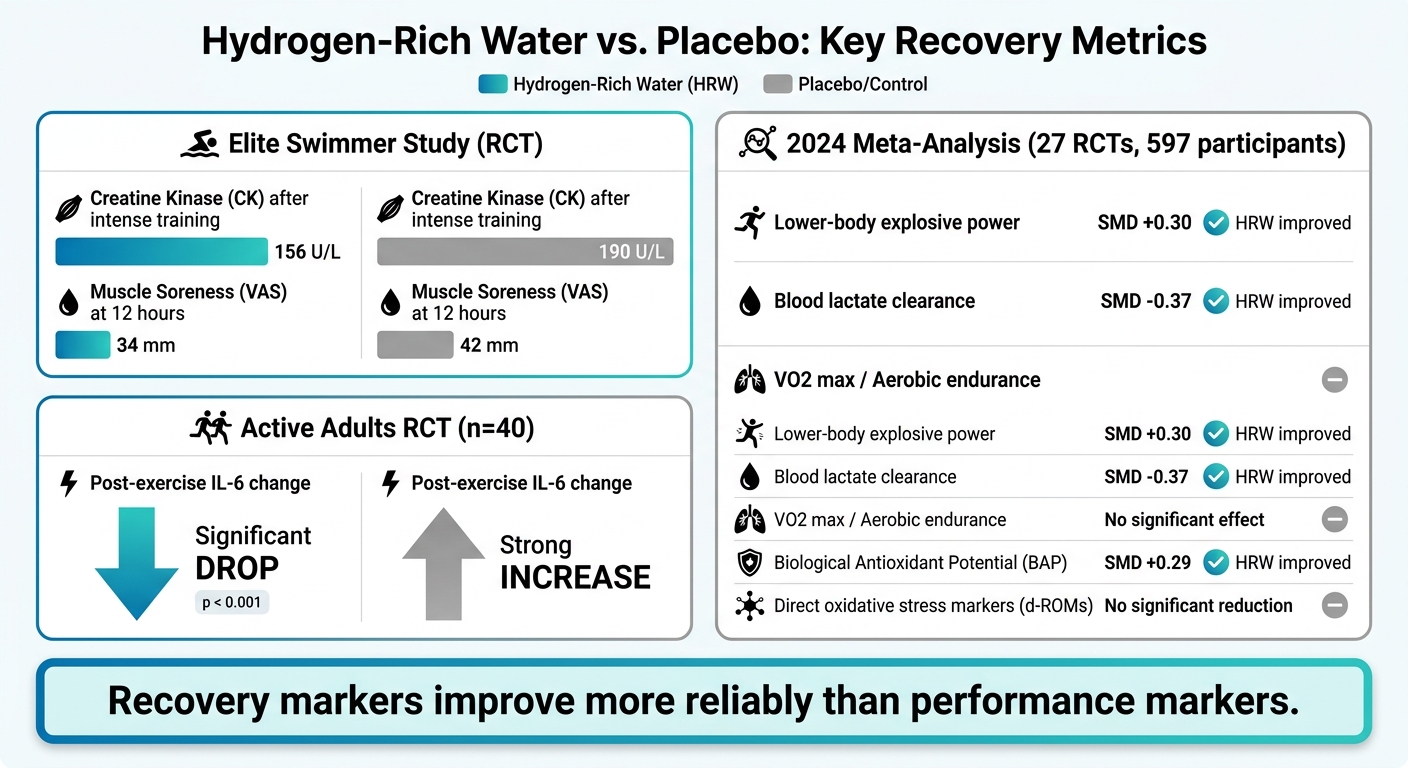
Hydrogen-Rich Water vs. Placebo: Key Recovery Metrics
The evidence looks promising, but it’s not cut-and-dried. Human studies are still limited, and results don’t line up across every marker. Even so, one pattern shows up again and again: recovery seems to improve more often than performance.
Findings From Human and Animal Studies
Recovery markers show the clearest signal. In a study of elite swimmers, the hydrogen-rich water group had creatine kinase (CK) levels of 156 U/L after intense training, compared with 190 U/L in the placebo group. Perceived muscle soreness was also lower - 34 mm vs. 42 mm on a visual analog scale at the 12-hour mark.
A separate RCT of 40 physically active adults found something similar. Those drinking hydrogen-enriched water showed a significant drop in post-exercise IL-6 (p < 0.001), while the control group showed a strong increase. Put simply, the strongest signals show up in soreness, muscle damage, and inflammatory markers.
Antioxidant findings are less clear. A 2024 meta-analysis found that H2 improved Biological Antioxidant Potential (BAP) with an SMD of 0.29, but it did not significantly reduce direct oxidative stress markers like d-ROMs. So H2 may help the body’s antioxidant capacity without directly lowering oxidative stress markers.
Performance data tells a similar story. A 2024 meta-analysis of 27 studies involving 597 participants found statistically significant gains in lower-body explosive power (SMD 0.30) and blood lactate clearance (SMD -0.37). Aerobic endurance did not improve.
Study Comparison Table: Delivery Method, Markers Measured, and Results
These studies point to the same pattern: recovery markers improve more reliably than performance markers.
| Study Type | Delivery Method | Exercise Type | Markers Measured | Results |
|---|---|---|---|---|
| RCT - Elite Swimmers | Hydrogen-Rich Water | Sprints & 400m swim | CK, Soreness (VAS) | Reduced CK (156 vs. 190 U/L); lower soreness at 12h |
| RCT - Active Adults | HRW | Maximal aerobic test | IL-6, MDA | Significant post-exercise IL-6 reduction; MDA results unclear |
| Meta-Analysis - 27 RCTs | Hydrogen-Rich Water | Various | BAP, d-ROMs, Explosive Power, Blood Lactate | Improved BAP and lactate clearance; no effect on d-ROMs or VO2max |
| RCT - Resistance Training | Hydrogen-Rich Water (8 days) | Resistance training | Endurance, fatigue recovery | Improved endurance and faster fatigue recovery |
| Systematic Review | Various | Various | Performance, recovery, inflammation | Mixed evidence; useful recovery signal; high study heterogeneity |
Recovery markers show the clearest signal. That makes timing and consistency the next practical question.
sbb-itb-6860cc4
How to Use Hydrogen Tablets in a Post-Workout Routine
Use hydrogen tablets around your workout to support recovery. In practice, two things matter most: timing and daily use.
Timing, Consistency, and Safety Considerations
Research points to two useful timing windows. The first is 15–30 minutes before exercise, which may help blunt oxidative stress during training. The second is within 10–30 minutes after exercise, when your body shifts into early recovery mode.
That said, the point isn't to wipe out normal training stress. You still want the kind of stress that helps your body improve. The aim is to reduce excess oxidative stress during recovery.
Consistency also matters. Some studies found better recovery markers after as little as 8 straight days of use. In other cases, certain markers took 2–4 weeks of regular use to shift. So if you try hydrogen tablets once or twice and expect a big change, you're probably jumping the gun.
For use, dissolve one tablet in 16 oz (500 mL) of still water and drink it within 5–10 minutes. That's a small but key detail. Hydrogen gas fades fast, so waiting too long can cut down what you're getting from the drink.
Once you have the routine down, safety is the next thing people usually ask about. Human studies show good tolerability, and sports trials have not reported any major adverse effects. If you have kidney issues that affect magnesium metabolism, talk with a doctor before using them.
Here is the simplest way to judge what hydrogen tablets may help with - and where expectations should stay in check.
Pros and Limitations Table: What to Expect
Hydrogen tablets work best as one part of a broader recovery plan. They don't replace sleep, protein intake, or proper hydration.
| Potential Benefits | Realistic Limitations |
|---|---|
| Selective antioxidant support: Targets harmful hydroxyl radicals without blunting useful training adaptations. | Mixed outcomes: Studies on aerobic endurance and maximal strength are often inconsistent or show no benefit. |
| Inflammation modulation: May lower markers of muscle damage like creatine kinase and malondialdehyde (MDA) after exercise. | Individual variation: Effects may differ based on training status, age, and baseline oxidative stress levels. |
| Strong safety profile: No significant adverse effects reported in human sports trials. | Consistency required: Daily use matters; some studies show recovery changes in as little as 8 days, while others take 2–4 weeks. |
| Convenient and portable: Easy to use anywhere with still water. | Volatility: H2 gas dissipates fast, so delayed use lowers effectiveness. |
Conclusion: Do Hydrogen Tablets Reduce Post-Workout Inflammation?
The short answer: possibly. Hydrogen tablets may help lower post-workout inflammation by limiting extra oxidative stress and helping the body settle into a calmer inflammatory response after training. That effect ties back to how molecular hydrogen interacts with exercise-related oxidative stress.
Their main upside is targeted antioxidant support without broadly shutting down the normal signals your body uses to adapt to training. For recovery, that selective action is the main reason these tablets are getting attention.
The research looks promising, but it isn't conclusive. Hydrogen water appears more consistent for recovery markers than for direct performance gains, and results for aerobic outcomes are still mixed.
If you want a simple way to try this in practice, Edenvia Molecular Hydrogen tablets dissolve in water to make hydrogen-rich water for post-workout use.
Use them as a support tool, not a stand-in for sleep, nutrition, hydration, and rest.
FAQs
How long do hydrogen tablets take to work?
Edenvia molecular hydrogen tablets usually dissolve in water in 90 seconds to 3 minutes.
Once the tablet has dissolved, drink the water right away or within 10 to 30 minutes. That timing matters because hydrogen gas escapes pretty fast from an open container.
After you drink it, hydrogen levels in the body tend to peak within 10 to 15 minutes and usually return to baseline within about one hour.
Some people may notice effects after a single use. But broader anti-inflammatory support is more often linked to steady use over 4 to 12 weeks.
Can hydrogen tablets affect muscle gains?
Hydrogen tablets may help cut post-workout soreness, fatigue, and oxidative stress, but they don’t directly build muscle. Based on current clinical evidence, hydrogen-rich water appears to have only a small effect on raw strength and muscle growth.
Where these tablets may help most is recovery. By helping manage inflammation and muscle damage without interfering with key cellular signaling, Edenvia Molecular Hydrogen tablets may help you bounce back better and train more consistently over time.
Who should avoid hydrogen tablets?
Hydrogen tablets are usually safe for healthy adults.
That said, there are a couple of cases where it makes sense to check with a doctor first. Some tablets contain magnesium, so people with kidney problems that affect how the body handles magnesium should get medical advice before using them.
The same goes for anyone taking medications that interact with magnesium.
In rare cases, too much magnesium may lead to mild stomach upset or loose stools.