

Hydrogen Tablets for Chronic Pain: Benefits
Chronic pain affects millions and often persists despite conventional treatments. Hydrogen tablets, when dissolved in water, may offer relief by targeting oxidative stress and inflammation, two major contributors to chronic pain.
Key takeaways:
- Oxidative stress fuels chronic pain: Reactive oxygen species (ROS) damage cells and promote inflammation, keeping pain signals active.
- Hydrogen’s unique action: Molecular hydrogen selectively neutralizes harmful ROS (like hydroxyl radicals) while sparing beneficial ones, reducing inflammation and oxidative damage.
- Research-backed results: Studies show hydrogen-rich water reduces pain sensitivity, inflammation markers, and improves mobility in conditions like fibromyalgia and osteoarthritis.
- Easy to use: Simply dissolve a tablet in water and drink; many users report improvements within 1–2 weeks.
Hydrogen tablets offer a simple, science-supported way to manage chronic pain by addressing its root causes rather than just masking symptoms.
Using Molecular Hydrogen an Analgesic?
sbb-itb-6860cc4
How Oxidative Stress Drives Chronic Pain
Chronic pain often originates from a chemical imbalance within cells. When reactive oxygen species (ROS) overwhelm the body's natural antioxidant defenses, oxidative stress occurs. This stress damages cells and inflames tissues, keeping pain signals active even after the initial injury has healed.
"Oxidative stress refers to the process in which... a disruption of the redox balance in the body results in the production of free radicals that exceed the body's antioxidant clearance capacity, leading to the accumulation of reactive oxygen species in cells and organs, thereby causing oxidative stress injury." - Frontiers in Molecular Neuroscience
Common Causes of Chronic Pain
Certain conditions are strongly linked to oxidative stress and inflammation. For example, osteoarthritis, which impacts over 250 million people globally, creates a low-oxygen environment in joints. This stresses mitochondria, increases ROS levels, and damages type II collagen, accelerating joint breakdown. Neuropathic pain, affecting an estimated 5–10% of the global population, involves oxidative damage to the myelin sheath, leading to abnormal nerve signaling. Fibromyalgia may also result from systemic oxidative stress paired with heightened inflammatory cytokines.
How ROS and Inflammation Affect Pain Pathways
Mitochondria are the primary producers of ROS, including the highly damaging hydroxyl radical (·OH). When ROS levels overwhelm mitochondrial capacity, they activate the NLRP3 inflammasome. This, in turn, drives the release of proinflammatory cytokines like IL-1β and IL-18, creating a feedback loop where oxidative stress amplifies pain.
The Journal of Nanobiotechnology highlights this cycle:
"Mitochondrial metabolic dysregulation further fuels ROS production, creating a vicious cycle. Elevated ROS levels contribute to low-grade inflammation in cartilage and synovium, leading to the secretion of extracellular matrix degrading enzymes that enhance cartilage degradation."
At the same time, the body's natural antioxidant defenses, such as superoxide dismutase (SOD) and catalase (CAT), become depleted under chronic oxidative stress. This leaves cells vulnerable. Biomarkers like malondialdehyde (MDA) and 8-OHDG rise, signaling increased lipid peroxidation and DNA damage. The result? Persistent pain, stiff joints, and reduced mobility - not due to the original injury, but because the oxidative and inflammatory environment remains unresolved. Up next, we'll explore how molecular hydrogen addresses these oxidative challenges.
How Molecular Hydrogen Works Against Pain
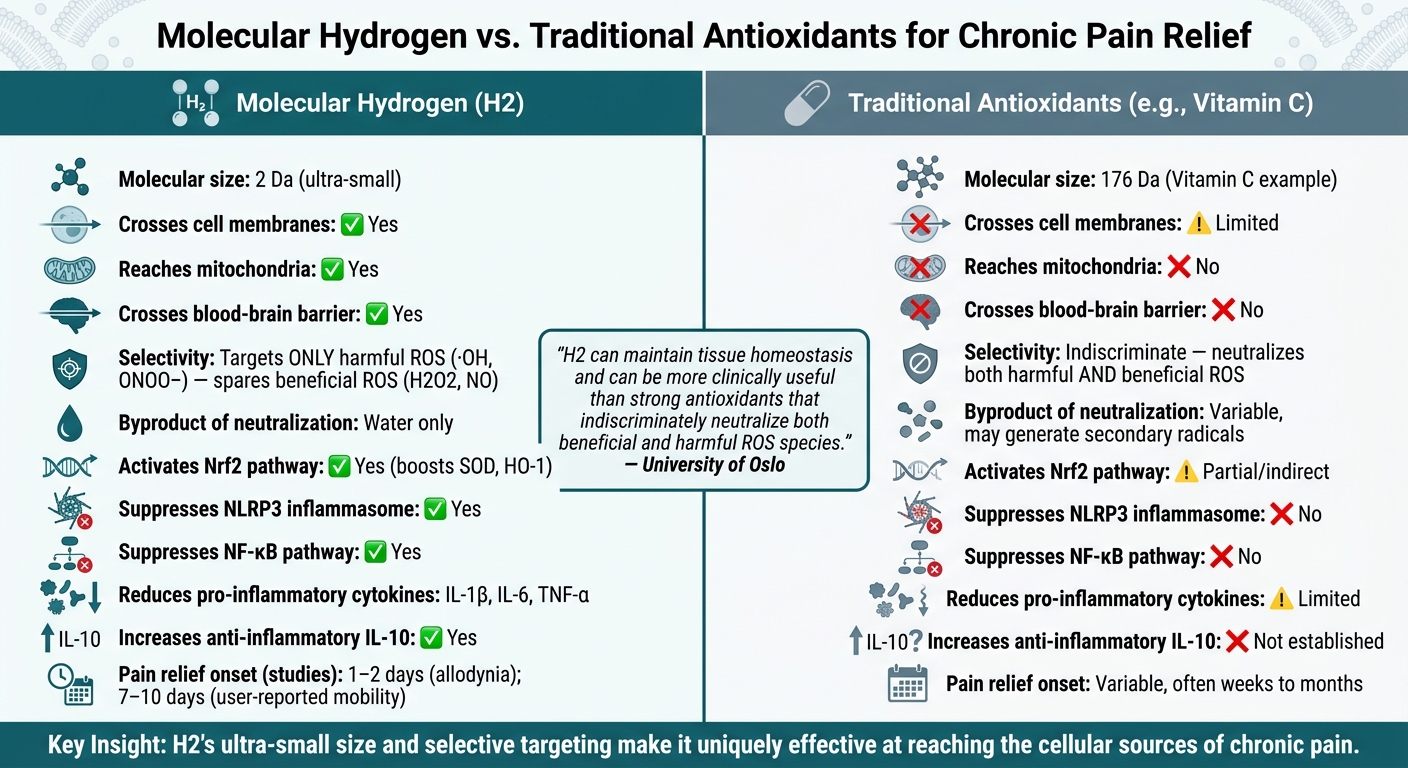
Molecular Hydrogen vs. Traditional Antioxidants for Chronic Pain Relief
Molecular hydrogen (H2) is a selective antioxidant that zeroes in on the most harmful reactive oxygen species (ROS), such as the hydroxyl radical (·OH) and peroxynitrite (ONOO−), while sparing beneficial ROS like hydrogen peroxide and nitric oxide. These "good" ROS play vital roles in immune defense and cellular communication. Unlike most antioxidants, which can't differentiate between harmful and helpful ROS, H2's precision makes it uniquely effective.
"Demonstrated to selectively counteract deleterious reactive oxygen species (ROS), such as the hydroxyl radical, H2 can maintain tissue homeostasis and can be more clinically useful than strong antioxidants that indiscriminately neutralize both beneficial and harmful ROS species." - Hennie Marie Johnsen, Department of Pharmacy, University of Oslo
The Mechanisms Behind Molecular Hydrogen
Weighing in at just 2 Da, molecular hydrogen is incredibly small. This allows it to cross cell membranes, reach mitochondria, and even pass through the blood-brain barrier - something antioxidants like Vitamin C (176 Da) can't do. Once inside, H2 acts on multiple levels:
- Activating the Nrf2 pathway: This boosts the body's production of antioxidant enzymes like superoxide dismutase (SOD) and heme oxygenase-1 (HO-1).
- Suppressing inflammatory pathways: It inhibits the NLRP3 inflammasome and NF-κB pathway, both of which contribute to chronic neuroinflammation.
- Reducing nerve hypersensitivity: H2 decreases p-ERK1/2 activity, a marker linked to heightened nerve sensitivity in chronic pain conditions.
A fascinating detail? When H2 neutralizes a hydroxyl radical, the only byproduct is water. These mechanisms highlight its potential for addressing pain at its source, rather than just covering up symptoms.
Research on Hydrogen for Pain Management
The science backs up these mechanisms with real-world results. For example, a March 2026 study published in the International Journal of Molecular Sciences explored the effects of daily hydrogen-rich water (HRW) injections (0.3 mM) on a fibromyalgia mouse model. The treatment reversed mechanical and thermal hypersensitivity, normalized oxidative markers in the spine (like 4-HNE), and reduced nerve sensitization driven by p-ERK1/2. Impressively, cold allodynia was eliminated within just one day.
Another study from October 2022, featured in Antioxidants and led by Professor Olga Pol at the Autonomous University of Barcelona, examined HRW in mice with inflammatory pain induced by CFA. Twice-daily treatments completely stopped mechanical allodynia and thermal hyperalgesia within two days. Additionally, the therapy reduced inflammatory markers (p-IKBα) and apoptotic proteins (BAX) in both the affected paws and the amygdala.
"These data revealed the analgesic, antidepressant, and anxiolytic actions of HRW. The protective, anti-inflammatory, and antioxidant qualities of this treatment during inflammatory pain were also demonstrated." - Olga Pol, Professor, Autonomous University of Barcelona
These studies are significant because they show H2 doesn't just dull pain - it tackles the oxidative stress and inflammation that perpetuate it. This approach could reshape how we think about managing chronic pain.
Benefits of Hydrogen Tablets for Chronic Pain
The research discussed earlier highlights a key point: molecular hydrogen doesn't just mask pain temporarily - it tackles the underlying causes.
Anti-Inflammatory and Antioxidant Effects
Molecular hydrogen works at the source of pain by targeting harmful free radicals while sparing beneficial ones. Moritz Rosch from the Max Planck Institute for Chemistry explains:
"The beneficial effects of molecular hydrogen involve activation of the cell's antioxidant system via the transcription factor Nrf2."
This activation of Nrf2 does more than just combat existing oxidative stress. It encourages the body to enhance its own antioxidant production over time. Additionally, H2 reduces pro-inflammatory cytokines like IL-1β, IL-6, and TNF-α, while increasing anti-inflammatory IL-10. This dual action not only calms inflammation but also supports the body's ability to recover and protect itself. These biochemical changes can lead to noticeable improvements in mobility and overall daily function.
Better Mobility and Daily Function
Chronic inflammation doesn’t just hurt - it limits movement and makes everyday tasks feel like a struggle. H2’s ability to penetrate tissues allows it to target inflammation at its core, promoting better mobility. Studies show that H2 reduces pain sensitivity without impacting motor skills, offering relief without the side effects like drowsiness or coordination issues often associated with pain medications. Many users report feeling more comfortable within 7–10 days. This improved mobility makes hydrogen tablets a practical and accessible option for ongoing pain management.
Safety and Ease of Use
Hydrogen has a long-standing record of safety, supported by its use in high concentrations for deep-sea diving and consistent results in human trials. Using the tablets is straightforward: drop one into a glass of room-temperature water, let it dissolve for about 3 minutes, and drink it within 30 minutes to retain the hydrogen. There’s no need for electricity, special equipment, or a prescription - just a simple, portable solution that fits easily into your routine.
Why Consider Edenvia Molecular Hydrogen Tablets

Edenvia Molecular Hydrogen tablets offer an easy way to tap into hydrogen's well-documented benefits for managing chronic pain. These tablets are designed to bring the antioxidant and anti-inflammatory properties of molecular hydrogen into your daily routine, targeting inflammation and oxidative stress for effective relief.
Targeting Inflammation and Oxidative Stress
Edenvia tablets work by infusing water with a high concentration of molecular hydrogen, which is quickly absorbed by your cells. Thanks to its small molecular size, hydrogen easily penetrates cell membranes, addressing oxidative stress at its core. This straightforward approach promotes overall cellular health while also supporting joint comfort and mobility - all without the need for additives.
Support for Joint Comfort and Mobility
More than 12,674 verified customers have reported noticeable improvements in joint comfort and mobility after using Edenvia tablets. These results highlight hydrogen's ability to translate its cellular benefits into real-world relief. Robert K., a verified customer, shared his experience:
"After adding hydrogen water to my routine, I started noticing less discomfort within a couple weeks. I'm moving easier and waking up without that constant stiffness."
Many users report feeling better within just 1 to 2 weeks of consistent use. For best results, it’s recommended to use the tablets once or twice daily for 30 days.
Third-Party Tested and Backed by a Guarantee
Edenvia prioritizes transparency and quality. Their tablets undergo third-party lab testing to ensure purity and are backed by a 30-day money-back guarantee. As the company states:
"We are committed to quality ingredients, rigorous standards, and honest labeling. You deserve to know exactly what you're putting in your body."
With an impressive average rating of 4.9 out of 5 stars from over 12,674 reviews, Edenvia Molecular Hydrogen tablets have built a strong reputation for delivering results you can trust.
Conclusion: Managing Chronic Pain Naturally with Hydrogen Tablets
Chronic pain often arises from a cycle of oxidative stress and inflammation, a pattern that most conventional treatments fail to break. Molecular hydrogen, however, offers a different approach. It works at the cellular level, targeting and neutralizing the most harmful free radicals while leaving the body’s natural processes intact. This precise action sets it apart from traditional antioxidant supplements and opens the door to noticeable relief.
Studies continue to back this method, showing that molecular hydrogen can reduce inflammation markers like C-reactive protein (CRP) and erythrocyte sedimentation rate (ESR). For those dealing with joint stiffness, reduced mobility, or ongoing discomfort, this can mean a real difference in day-to-day life.
Edenvia Molecular Hydrogen tablets provide a simple way to incorporate this science into your routine. Just dissolve one tablet in 16 oz of water, drink immediately, and repeat daily for 30 days. Many users report feeling improvements in joint flexibility and overall comfort within 1 to 2 weeks.
As one satisfied customer, Macy W., shared:
"Hydrogen water has been the first thing where I actually noticed improvement. Walking and going up stairs feels much easier now."
Stories like Macy’s highlight the everyday benefits of this scientifically supported option. With third-party testing and a 30-day money-back guarantee, these tablets offer a natural and reliable way to address chronic pain. Embrace the science of molecular hydrogen to regain comfort and improve mobility.
FAQs
Can I take hydrogen tablets with my pain meds?
Yes, you can use hydrogen tablets alongside pain medications. However, it’s always a good idea to check with your healthcare provider first to make sure they’re safe and won’t interfere with your specific treatment plan.
How do I know if my tablet made enough hydrogen in the water?
To ensure your hydrogen tablet has dissolved properly and produced enough hydrogen, aim for a concentration between 1.2 and 1.6 PPM immediately after it dissolves. You can measure this with a dissolved hydrogen meter for accuracy. Alternatively, watch for signs like the tablet dissolving within 2–3 minutes and the release of bubbles. For the best results, drink the water within 30 minutes, as hydrogen levels drop quickly over time.
Who should avoid hydrogen tablets for chronic pain?
Molecular hydrogen is considered safe for most people. However, if you're on medications for high blood pressure, diabetes, or chronic inflammation, it's a smart move to check with your healthcare provider first, as there could be potential interactions.
Some individuals might notice mild side effects like gas or bloating when using effervescent tablets. In rare cases, allergic reactions such as rashes or itching can occur. If you experience any of these, stop using the product immediately.
One key thing to remember: always dissolve the tablet completely in water before drinking it. Never swallow the tablet directly.