

How Hydrogen Reduces Oxidative Stress in Heart Health
Here’s the short answer: molecular hydrogen may help lower some of the most harmful forms of oxidative stress tied to heart and blood vessel strain, but it is not a proven heart treatment.
If I boil the article down, it says this:
- Oxidative stress can harm the heart by damaging blood vessels, lowering nitric oxide, and adding to inflammation.
- Hydrogen is being studied as a selective antioxidant, which means it may target harsher oxidants without shutting down normal cell signaling.
- The strongest research so far is in animal studies, especially for ischemia-reperfusion injury, heart remodeling, and metabolic risk support.
- Human data is still limited, though a few small studies reported changes in endothelial function, glucose control, lipids, and redox markers.
- For day-to-day use, hydrogen-rich water is the easiest form, while inhalation and saline are mostly used in medical or lab settings.
- Safety looks fairly good so far, but long-term data in people with heart disease is still thin.
Put another way: if you want a simple takeaway, hydrogen looks like a possible add-on for wellness support, not a fix for heart disease, high blood pressure, diabetes, or past cardiac events.
A few points stand out right away:
- 24 weeks: one study of hydrogen-rich water in adults with metabolic syndrome reported changes in body composition, resting heart rate, lipids, glucose, and redox markers.
- 22.2% and 25.4%: one small trial reported improved endothelial function after 24 hours and 2 weeks.
- 6 months: one cohort in adults with type 2 diabetes reported better HbA1c and lipid results with adjunct hydrogen inhalation.
That’s the core message of the article in plain English: hydrogen may help with oxidative stress linked to heart health, but the research is still early and should be viewed with caution.
Why I Changed My Mind About Hydrogen Water (with Tyler LeBaron)
sbb-itb-6860cc4
How Molecular Hydrogen Helps Restore Redox Balance
Building on redox balance, hydrogen stands out because it can get to the heart’s most stressed cells fast.
How Hydrogen Reaches Cells and Mitochondria
H₂ is a small, neutral gas, so it diffuses into cells and mitochondria quickly. Studies show that hydrogen appears in blood and tissues within minutes after administration. That speed matters. In stressed heart tissue, mitochondrial ROS drive a large share of the damage.
How Hydrogen Targets the Most Harmful Oxidants
Hydrogen selectively scavenges hydroxyl radicals and peroxynitrite while sparing signaling ROS. That’s an important distinction. You want to reduce the oxidants that damage tissue without shutting down the ROS signals cells still use to function.
In cardiovascular studies, hydrogen is linked with lower MDA and 8-OHdG, along with higher SOD. In plain terms, that points to less oxidative damage and better antioxidant defense. This selective action may help keep normal cell signaling in place while cutting oxidative injury.
How Hydrogen May Support Inflammation and Cell Survival Pathways
Hydrogen may also affect stress-response pathways tied to heart protection. In heart models, it has been shown to activate the Nrf2/HO-1 pathway, which increases HO-1 levels and reduces 8-OHdG. It also influences PI3K/Akt, a pathway linked to cell survival and recovery after ischemia-reperfusion injury.
On the inflammation side, hydrogen has been shown to lower TNF-α, IL-6, IL-1β, and myeloperoxidase (MPO). That matters most in ischemia-reperfusion injury, heart failure, and other states where cardiac stress is at its highest.
Where Hydrogen May Support Cardiovascular Health
The clearest signals show up in a few cardiovascular settings where oxidative stress helps drive injury, structural change, and long-term risk. The strongest signal is in acute ischemic injury, then in chronic remodeling, and then in vascular and metabolic risk support.
| Condition studied | Proposed mechanism | Key outcomes reported | Evidence type |
|---|---|---|---|
| Ischemia-reperfusion injury | Reduced oxidative damage and cell death during reperfusion | Lower oxidative markers; possible functional benefit | Mostly animal and preclinical |
| Heart failure and remodeling | Support for mitochondrial function, lower fibrosis, reduced hypertrophy | Less hypertrophy/fibrosis; preserved viability | Mostly animal and mechanistic |
| Vascular and metabolic risk factors | Endothelial support, lower inflammation, reduced LDL oxidation | Better vascular markers; modest metabolic changes | Limited human data; mostly preclinical |
Ischemia-Reperfusion Injury and Recovery After Reduced Blood Flow
When blood flow returns to the heart after a blockage, reperfusion can set off a burst of reactive oxygen species. That burst can add to tissue injury instead of simply fixing the problem.
In animal models, hydrogen inhalation reduced infarct size, arrhythmias, and cardiac dysfunction after blood flow returned. A small STEMI feasibility study found that inhaled hydrogen during coronary intervention was safe and hinted at better left-ventricular remodeling, but hard outcomes remain unproven.
That same oxidative load doesn’t only matter in acute events. If it sticks around, it can also push slower structural damage in heart failure.
Heart Failure, Remodeling, and Mitochondrial Strain
Chronic oxidative stress can slowly reshape the heart. Over time, it drives fibrosis, hypertrophy, and cardiomyocyte loss, which drag down ventricular function.
In preclinical heart failure models, hydrogen reduced cardiomyocyte apoptosis, limited cardiac hypertrophy, and improved cardiac performance. Repeated low-concentration hydrogen inhalation in early-stage chronic heart failure models improved microvascular perfusion (p < 0.05), reduced myocardial edema, and helped normalize metabolic and oxidative stress parameters. That points to a possible slowing of remodeling progression.
At this point, there are no completed human heart-failure trials. So support in this area comes from animal and cell models only.
Hydrogen is also being studied earlier in the risk pathway, where vascular and metabolic strain can add to long-term cardiac risk.
Metabolic and Vascular Risk Factors Tied to Heart Health
This is where limited human data starts to show up. In a real-world cohort of adults with type 2 diabetes, adjunct hydrogen inhalation over about six months improved glycemic control. More participants reached HbA1c < 7%, lipid profiles improved, insulin resistance fell, and the incidence of adverse events was lower.
So far, these findings mainly support hydrogen as a redox-focused adjunct. The next section looks at how people typically use it.
How Hydrogen Is Used and What Daily Use Looks Like
Once you know how hydrogen may support redox balance, the next step is simple: how does someone use it in daily life? The answer depends on the delivery method, and some options are far more practical than others.
| Form | Route | Used in research | Practicality for home use |
|---|---|---|---|
| Inhalation | Breathing hydrogen gas under controlled settings | Acute and clinical research settings | Low |
| Hydrogen-rich saline | Injection or infusion | Experimental and clinical research | Low |
| Hydrogen-rich water | Oral intake | Wellness and some human studies | High |
Inhalation protocols need hospital-grade equipment, regulated gas mixtures, and trained staff. Hydrogen-rich saline is prepared and given by injection or infusion in controlled medical or lab settings. So while both show up in research, they don't fit neatly into normal day-to-day use.
That leaves hydrogen-rich water as the option that moves most easily into daily routines.
Hydrogen-Rich Water as a Practical Daily Option
In studies, people often use 1 to 2 servings per day for 12 to 24 weeks. That matters because it gives a more realistic picture of what day-to-day use can look like, not just a one-off test.
A 24-week study of hydrogen-rich water in adults with metabolic syndrome found improvements in body composition, resting heart rate, blood lipids, glucose, and redox homeostasis markers when people consumed it steadily during the trial.
Where Edenvia Molecular Hydrogen Fits
For home use, the easiest format is hydrogen-rich water made by dissolving tablets in water. Edenvia Molecular Hydrogen offers tablets made for that purpose.
Here's what daily use looks like in plain terms:
- Drop one tablet into room-temperature or chilled water
- Wait about 2 to 3 minutes for it to dissolve
- Drink it within 30 minutes, before the hydrogen dissipates
So yes, the routine itself is pretty simple. The bigger question is still about the evidence, dosing, and safety limits.
Safety, Research Limits, and Key Takeaways
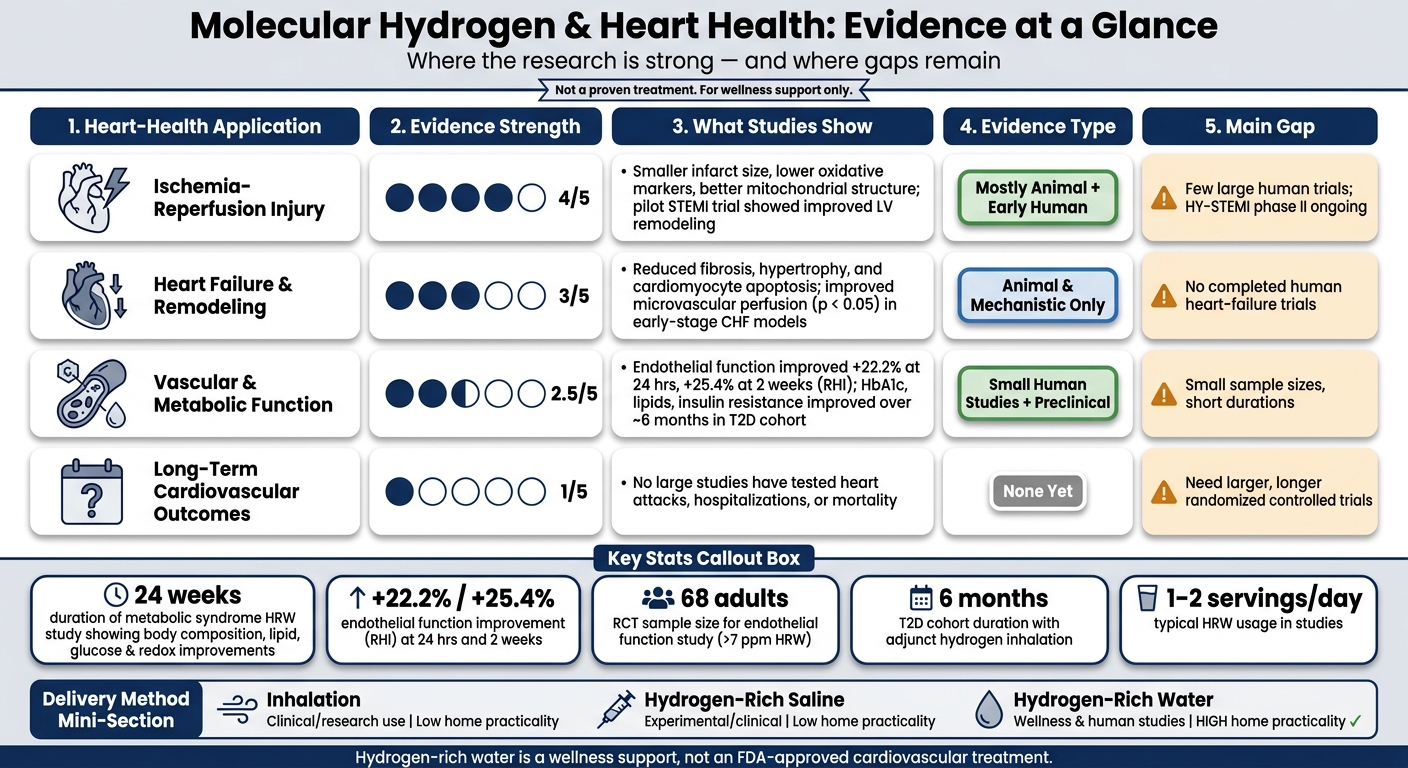
Hydrogen Therapy for Heart Health: Evidence Strength by Application
Using hydrogen day to day is the easy part. The tougher part is knowing how much confidence the research deserves.
Right now, the human data look promising, but they’re still limited. The clearest signals still come from preclinical work. And when it comes to long-term heart outcomes, the proof just isn’t there yet.
Here’s where the support looks strongest, and where the evidence is still thin:
| Heart-health application | Evidence strength | What the evidence shows | Main gap |
|---|---|---|---|
| Ischemia-reperfusion injury | Stronger preclinical support | Reduced oxidative injury in models | Few large human trials |
| Heart failure and remodeling | Moderate preclinical support | Lower fibrosis, hypertrophy, and mitochondrial strain in models | Human evidence remains limited |
| Vascular and metabolic function | Early mixed human and preclinical support | Possible benefits for endothelial and cardiometabolic markers | Small studies and short duration |
| Long-term cardiovascular outcomes | Limited | No large studies have tested heart attacks, hospitalizations, or mortality | Need larger, longer human studies |
What Current Research Supports
Recent studies point to three main areas. That matters because these studies test whether hydrogen’s redox effects may lead to actual cardiovascular protection.
For ischemia-reperfusion injury, animal models have shown a steady pattern: smaller infarct size, better mitochondrial structure, and lower oxidative stress markers. In a pilot trial, patients with ST-elevation myocardial infarction who underwent percutaneous coronary intervention were able to use inhaled hydrogen, and the treatment was linked to better heart-muscle preservation and left-ventricle remodeling. There’s also an ongoing phase II study, HY-STEMI, looking at 1.3% hydrogen in 26% oxygen versus 26% oxygen alone during emergency care and for 2 hours after reperfusion, with left ventricular function and remodeling as key outcomes.
For vascular and metabolic function, one randomized controlled trial followed 68 adults and found that daily use of highly concentrated hydrogen water (>7 ppm) improved endothelial function. Researchers measured this with the reactive hyperemia index, which increased 22.2% after 24 hours and 25.4% after two weeks. That’s a useful signal. Still, it came from a small, short study.
What to Keep in Mind Before Trying Hydrogen Support
Molecular hydrogen has generally been well tolerated in studies, and few serious adverse events have been linked to it. Even so, long-term safety data in people with complex cardiovascular conditions are still missing.
If you have coronary artery disease, heart failure, high blood pressure, diabetes, or a history of cardiac events - or if you take heart or diabetes medicines - talk with a cardiologist or another qualified healthcare professional before adding hydrogen support to your routine. Hydrogen should complement guideline-directed care, not replace it. Dosing, timing, and delivery method also aren’t standardized, which means a setup used in a controlled research protocol may not match everyday home use.
There’s also a practical U.S. point worth keeping in mind: hydrogen products sold for wellness are usually marketed as dietary supplements or wellness products, not FDA-approved cardiovascular drugs. So if a label sounds a little too bold, read it with that context in mind.
Hydrogen-rich water is a wellness support, not a proven cardiovascular treatment.
FAQs
Can hydrogen help protect the heart from oxidative stress?
Yes. Molecular hydrogen may help protect the heart by reducing oxidative stress at the cellular level. It appears to selectively target harmful free radicals, including hydroxyl radicals, which may help limit LDL cholesterol oxidation tied to plaque buildup in the arteries.
Because hydrogen is extremely small, it can move deep into arterial cells. That may help support healthy cholesterol levels and normal cardiovascular function.
Is hydrogen-rich water a proven heart treatment?
No. While molecular hydrogen has been looked at for safety and for its possible role in lowering oxidative stress, hydrogen-rich water is not a medically proven or FDA-approved treatment for heart disease.
It may help support cardiovascular wellness because it can act as a selective antioxidant. But it should not take the place of medical care.
If you're thinking about trying it, talk with a healthcare professional first, especially if you have a medical condition or take prescription medications.
Who should talk to a doctor before trying hydrogen?
Talk to a doctor before using molecular hydrogen if you are pregnant or breastfeeding, under 18, have a pre-existing condition such as kidney disease or diabetes, or take prescription medications.
This matters even more if you have diabetes. Hydrogen water may affect insulin sensitivity, which could mean your medication needs to be adjusted with a doctor’s supervision.