

Hydrogen's Mechanism Against Oxidative Stress
Here’s the main point: hydrogen (H₂) may help lower oxidative stress by reacting more with the most damaging oxidants - especially hydroxyl radicals and peroxynitrite - while leaving much of normal cell signaling alone.
That matters because your body still needs some reactive molecules to do basic cell jobs. So the idea behind hydrogen is simple: reduce damage without shutting down the signals cells use every day. In the studies covered here, researchers also link hydrogen to lower inflammation, better mitochondrial function, and shifts in markers like SOD, TBARS, 8-OHdG, IL-6, and TNF-α.
What I’d take from this article:
- Hydrogen is not framed like a broad antioxidant.
- It may act more on the most harmful oxidants than on signaling molecules like hydrogen peroxide.
- It may also affect cell pathways tied to stress and inflammation, such as Nrf2 and NF-κB.
- In small human trials, forms like hydrogen-rich water (HRW) were linked to marker changes such as:
- SOD up 39%
- TBARS down 43%
- lower 8-OHdG, TNF-α, and IL-6
- The human data is still limited, and study methods vary a lot.
If you want the plain-English version, it’s this: hydrogen may help your cells handle oxidative stress in a narrower way than many general antioxidants, but the strongest support still comes from lab and animal work, not large human trials.
This article walks through the cell mechanism, the human and animal research, and how hydrogen differs from broad antioxidant approaches.
How Molecular Hydrogen May Work at the Cellular Level
Selective Scavenging of Hydroxyl Radicals and Peroxynitrite
Hydrogen may leave signaling molecules like superoxide, hydrogen peroxide, and nitric oxide mostly alone while going after the oxidants that do the most damage, especially hydroxyl radicals and peroxynitrite. In plain English: it may help calm the worst oxidative damage without shutting off normal cell signaling.
A key study found that hydrogen selectively reduced hydroxyl radicals while leaving other physiologic reactive species largely unchanged. That matters because cells still need some reactive species to send signals and regulate normal function.
Part of this may come down to hydrogen's physical traits. It's small, neutral, and nonpolar, so it can move across membranes with ease. Its weak reducing power may also help it react with highly unstable radicals without broadly suppressing redox signaling.
That kind of selectivity helps explain why hydrogen may shape redox-sensitive signaling instead of simply blocking it.
Effects on Nrf2, NF-kB, and Other Redox-Sensitive Pathways
Hydrogen may do more than directly neutralize harmful oxidants. It may also nudge the cell's own defense and inflammation systems in a better direction.
Research points to the Nrf2-Keap1 system, where H₂ can increase production of endogenous antioxidant enzymes, including SOD, CAT, GPX, and HO-1. At the same time, it appears to suppress NF-κB signaling and lower pro-inflammatory cytokines such as TNF-α, IL-1β, and IL-6.
This matters because oxidative stress and inflammation often feed each other. Once that loop starts, cells can get stuck in a rough cycle. Hydrogen may help interrupt that cycle and lower oxidative burden over time.
Mitochondrial Protection, Energy Production, and Hormesis
Mitochondria are especially vulnerable to oxidative stress, and when they take a hit, energy production can slip. Hydrogen may help protect mitochondrial function by preserving respiratory chain activity, supporting ATP generation, and promoting removal of damaged mitochondria.
Researchers also describe a hormetic effect. That means H₂ may trigger a mild adaptive response that helps cells become more resilient when stress shows up later.
So the picture here isn't that hydrogen shuts reactive species off across the board. It appears to help the cell keep redox balance in a healthier range while still allowing normal signaling to do its job.
sbb-itb-6860cc4
How Hydrogen Inhalation Reduces Oxidative Stress: A Scientific Summary
What the Research Shows in Preclinical and Human Studies
The studies below look at a simple question: do the cell-level effects described above also show up in living tissue and in people?
Cell and Animal Studies on Oxidative Injury
Early evidence comes from lab and animal work.
A 2007 study at Nippon Medical School found that 35 minutes of 2% H₂ inhalation reduced brain injury in rats after focal cerebral ischemia-reperfusion injury. Oxidative markers such as 8-OHdG and 4-HNE dropped in treated animals compared with controls.
Other animal studies pushed this further. In a mouse model of acute pancreatitis, 12 hours of pre-treatment with 2% H₂ inhalation reduced early inflammation and oxidative stress by increasing Hsp60 expression and lowering TNF-α and IL-6. In a sepsis model, 3 hours of 2% H₂ inhalation activated Fundc1-linked mitophagy, which helped preserve ATP and protect liver tissue.
Human Studies on Oxidative Stress, Inflammation, and Mobility-Related Outcomes
Human trials are smaller, but the pattern looks similar. Across metabolic and joint-related conditions, researchers saw shifts in oxidative stress and inflammation markers in the same general direction.
In one study of 20 patients with metabolic syndrome, drinking 1.5 to 2.0 liters of hydrogen-rich water per day for 8 weeks increased SOD activity by 39% and reduced TBARS by 43%. A separate 6-month trial with 60 subjects reported reductions in LDL cholesterol, fasting blood glucose, TNF-α, and IL-6.
Joint-related findings point the same way. In a study of 20 patients with rheumatoid arthritis, drinking 0.5 liters of hydrogen-rich water daily for 4 weeks led to lower urinary 8-OHdG and better DAS28 scores. In another trial, H₂-generating tablets at 2 g/day reduced inflammation markers and self-reported pain.
Study Summary Table: Models, Delivery Methods, Biomarkers, and Main Findings
The table below pulls the main models, delivery methods, and biomarker changes into one place.
| Condition / Model | H₂ Delivery Method | Biomarkers Measured | Direction of Change | Proposed Mechanism |
|---|---|---|---|---|
| Cerebral ischemia-reperfusion (rat) | Inhalation (2% gas) | 8-OHdG, 4-HNE | ↓ | Selective •OH scavenging |
| Acute pancreatitis (mice) | Inhalation (2% gas) | Hsp60, TNF-α, IL-6 | Hsp60 ↑, cytokines ↓ | Reduced inflammation and oxidative stress |
| Sepsis / liver injury (mice) | Inhalation (2% gas) | HO-1, Nrf2, Fundc1, ATP | HO-1/Nrf2/Fundc1 ↑; ATP preserved | Mitophagy, mitochondrial protection |
| Metabolic syndrome (human) | HRW (1.5–2.0 L/day) | SOD, TBARS | SOD ↑ 39%, TBARS ↓ 43% | Redox balance support |
| Rheumatoid arthritis (human) | HRW (0.5 L/day) | 8-OHdG, DAS28 | Both ↓ | Reduced oxidative DNA damage |
| Type 2 diabetes (human) | HRW (1.2 L/day) | 8-isoprostanes, ox-LDL | Both ↓ | Improved lipid redox balance |
| Soft tissue injury (human) | H₂ tablets (2 g/day) | Inflammation markers, pain | ↓ | Reduced inflammatory signaling |
| Heart attack (STEMI) | Inhalation (1.3% H₂) | LV remodeling | Left ventricular remodeling improved | Mitochondrial protection |
Most human trials are still small, and the dose, delivery method, and study length differ from one paper to the next.
How Hydrogen Differs From General Antioxidant Approaches
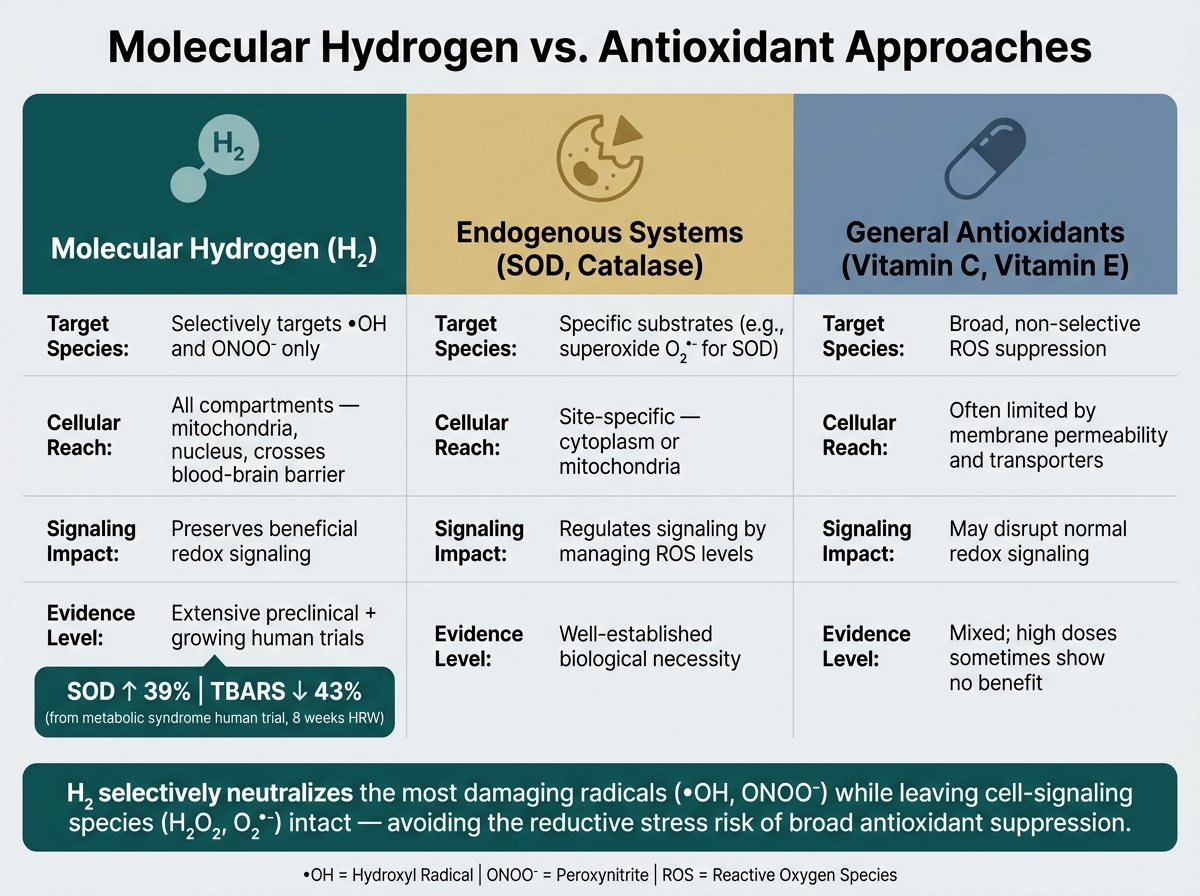
Molecular Hydrogen vs. General Antioxidants: How H₂ Targets Oxidative Stress
Hydrogen stands apart from standard antioxidant methods for one big reason: it doesn't try to shut everything down.
Selective Action Versus Broad Suppression of Reactive Species
Not all reactive species are bad. Some drive damage. Others help cells communicate and keep normal functions on track. That's where broad antioxidant strategies can run into trouble. They may suppress both the harmful species and the useful ones.
Hydrogen works in a more targeted way. It selectively reduces the most damaging radicals - specifically the hydroxyl radical (•OH) and peroxynitrite (ONOO⁻) - while leaving helpful signaling species such as superoxide (O₂•⁻) and hydrogen peroxide (H₂O₂) in place.
It also has a practical edge. H₂ diffuses fast across membranes and can reach mitochondria, nuclei, and the brain, unlike many larger antioxidants. On top of that, H₂ may do more than direct scavenging. It may also switch on the body's own defense systems through Nrf2, which can increase SOD and glutathione. That gives hydrogen a two-part mode of action: selective scavenging plus support for internal defense systems.
This matters because broad ROS suppression can create reductive stress. Hydrogen's selectivity may help lower that risk.
Comparison Table: Hydrogen, Endogenous Antioxidant Systems, and General Antioxidant Strategies
The table below shows how hydrogen compares with endogenous antioxidant systems and broad antioxidant strategies.
| Feature | Molecular Hydrogen (H₂) | Endogenous Systems (SOD, Catalase) | General Antioxidants (vitamin C, vitamin E) |
|---|---|---|---|
| Target Species | Selectively targets •OH and ONOO⁻ | Specific substrates, such as superoxide (O₂•⁻) for SOD | Broad, non-selective ROS suppression |
| Cellular Location | All compartments, including mitochondria and nucleus; can cross the blood-brain barrier | Specific sites, such as the cytoplasm or mitochondria | Often limited by membrane permeability and transporters |
| Signaling Impact | Preserves beneficial redox signaling | Regulates signaling by managing ROS levels | May disrupt normal redox signaling |
| Strength of Evidence | Extensive preclinical; growing human trials | Well-established biological necessity | Mixed; high doses sometimes show no benefit |
Limits of the Evidence and Practical Takeaways
Current Research Gaps and Measurement Challenges
Molecular hydrogen research looks promising, but it’s still in the early stages. Most of the evidence is still preclinical, so the link to human health is still being worked out. Human trials are small, and hydrogen is hard to measure in specific tissues because it diffuses and clears fast. In plain English, that makes it tough to directly confirm selective radical scavenging in humans.
There’s also no standard hydrogen protocol yet. Studies differ in concentration, delivery method, and frequency.
The Nrf2/hormesis model makes sense, but it still needs stronger validation in human studies.
That helps explain why the best evidence right now comes from biomarker changes, not hard clinical outcomes.
Conclusion: What to Remember About Hydrogen's Mechanism
Even with those limits, the pattern across studies points in the same direction. Hydrogen appears safe, and human studies show lower MDA, 8-isoprostanes, CRP, and IL-6.
The table below shows where the evidence stands right now across the main proposed mechanisms:
| Mechanism | Human Evidence | Cell/Animal Evidence |
|---|---|---|
| Systemic marker reduction (MDA, CRP) | Moderate to High | High |
| Selective scavenging (•OH, ONOO−) | Low (inferred from markers) | High (confirmed in vitro) |
| Nrf2/ARE pathway activation | Emerging/Indirect | High |
| Mitochondrial mKATP activation | Low | Moderate |
| Gene expression modulation | Emerging | High |
In the study protocols cited most often, hydrogen-rich water was taken in divided daily doses. Clinical studies have commonly used 1.5 to 2.0 liters per day, split across the day, delivering about 1.65 to 2.6 mg of H₂ daily. Edenvia Molecular Hydrogen tablets dissolve in water to create hydrogen-rich water. Larger, better-standardized human trials are still needed before the full clinical picture comes into focus.
FAQs
How is hydrogen different from a regular antioxidant?
Molecular hydrogen works differently from regular antioxidants. Instead of broadly reacting with many oxidants, it selectively targets the most damaging radicals - especially hydroxyl radicals - while leaving helpful reactive oxygen species alone. That matters because some reactive oxygen species play a normal role in cell signaling and immune function.
Hydrogen also has a physical advantage: it’s the smallest molecule. Because of that, it can move through cell membranes with ease, cross the blood-brain barrier, and reach places like the mitochondria, where this more focused protection can take place.
What does human research actually show so far?
Human studies suggest that molecular hydrogen may help reduce oxidative stress, lower inflammation, and support cellular health.
Clinical research has also linked it to better mobility and less physical discomfort. In one randomized controlled pilot trial, older adults who drank hydrogen-rich water for six months showed a 4% increase in mean telomere length, along with improved DNA methylation.
Why does hydrogen target some oxidants but not others?
Hydrogen is a weak reducing agent, which means it tends to react mainly with strong, harmful oxidants like hydroxyl radicals and peroxynitrite. At the same time, it largely leaves the ROS your body still needs alone.
That distinction matters. Some ROS, including hydrogen peroxide and nitric oxide, play normal roles in cell signaling, immune function, and blood vessel dilation. Edenvia Molecular Hydrogen tablets help support oxidative balance without getting in the way of normal cellular function.