

5 Ways Hydrogen Supports Heart Health
Molecular hydrogen (H₂) can help improve heart health by addressing key causes of cardiovascular disease, such as oxidative stress, inflammation, high blood pressure, and metabolic imbalances. It works as a selective antioxidant, neutralizing harmful free radicals while preserving beneficial ones. Research shows that H₂ reduces oxidative damage by up to 50%, enhances natural antioxidant defenses by 25–40%, and supports better blood vessel health. Here’s a quick summary of its benefits:
- Reduces Oxidative Stress: Targets harmful radicals like hydroxyl radicals while preserving essential molecules for cell signaling.
- Lowers Inflammation: Reduces inflammatory markers and protects blood vessels from damage.
- Improves Blood Pressure Regulation: Helps relax blood vessels and maintain healthy circulation.
- Protects Against Ischemia-Reperfusion Injury: Minimizes tissue damage during blood flow interruptions, such as heart attacks.
- Enhances Lipid and Glucose Metabolism: Supports healthy cholesterol and blood sugar levels, reducing arterial plaque risks.
Drinking hydrogen-rich water or using hydrogen gas inhalation are effective ways to incorporate H₂ into your routine. Studies suggest regular use can lead to noticeable improvements in cardiovascular health markers within weeks. Always consult a healthcare provider before starting any new supplement.
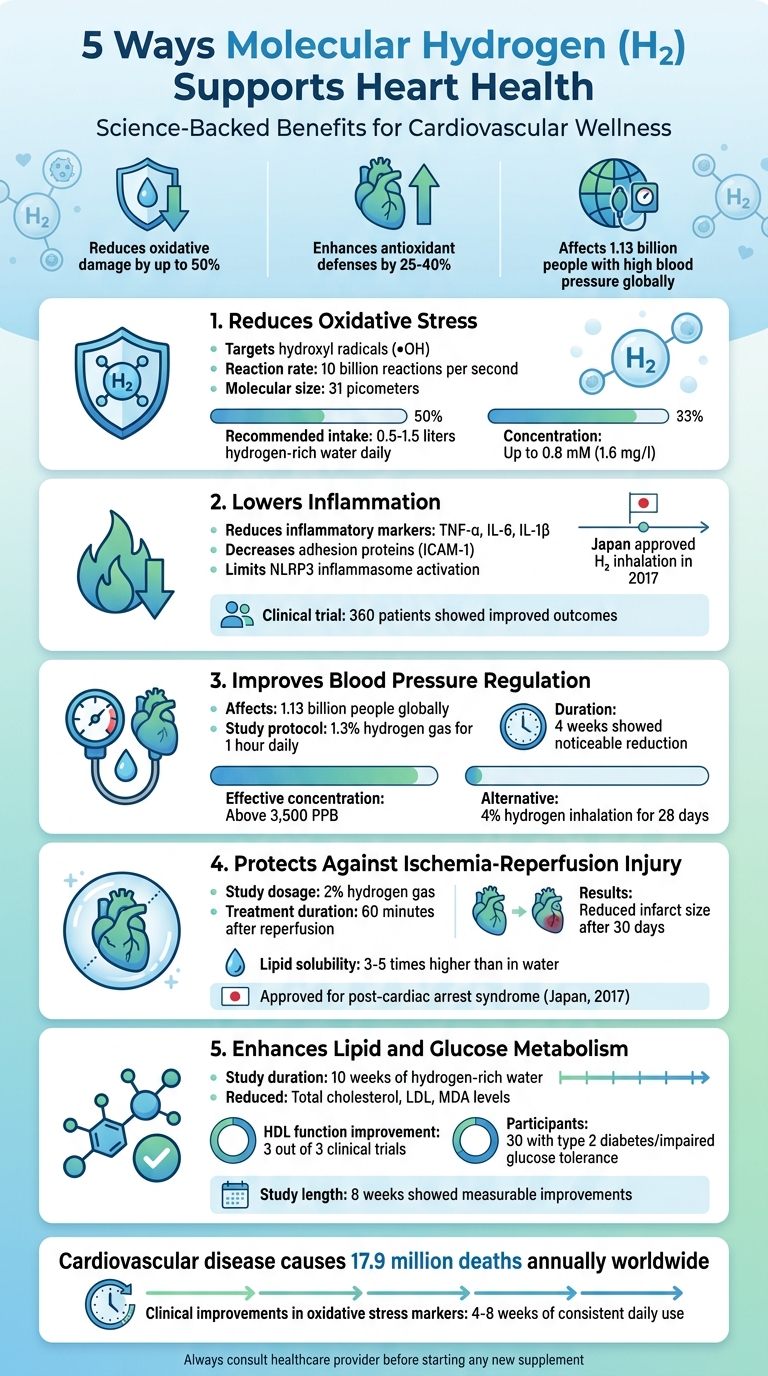
5 Ways Molecular Hydrogen Supports Heart Health: Key Benefits and Statistics
Hydrogen Water is Anti-Aging, lowers cholesterol, and lowers heart disease risk
sbb-itb-6860cc4
1. Reduces Oxidative Stress
Oxidative stress happens when harmful free radicals overwhelm your body’s defenses, damaging the cells lining your blood vessels. One of the most destructive free radicals, the hydroxyl radical (•OH), reacts with biomolecules at an astonishing rate of about 10 billion reactions per second. This constant damage plays a major role in the development of heart disease.
What makes hydrogen (H₂) stand out is its ability to selectively target harmful radicals like hydroxyl radicals and peroxynitrite while leaving beneficial molecules, such as hydrogen peroxide, intact. This balance helps maintain important cell signaling and immune functions, which traditional antioxidants like vitamins C and E cannot achieve.
A 2008 double-blind study published in Nutrition Research explored hydrogen-rich water's effects on 30 patients with type 2 diabetes or impaired glucose tolerance. After eight weeks, participants showed reduced levels of oxidized LDL cholesterol and urinary 8-isoprostane - both markers of oxidative damage . Similarly, a 2015 clinical trial in Scientific Reports by G. Song and his team observed significant reductions in malondialdehyde (MDA), a key biomarker of lipid peroxidation, in subjects with potential metabolic syndrome.
Thanks to its tiny molecular size (31 picometers), H₂ can easily diffuse through cell membranes, reaching critical areas like mitochondria and the nucleus. Once there, it activates the Nrf2 pathway, which stimulates the production of protective enzymes such as superoxide dismutase and glutathione peroxidase.
For cardiovascular benefits, research suggests drinking 0.5 to 1.5 liters of freshly prepared hydrogen-rich water daily over several months. Since H₂ is a gas that dissipates quickly when exposed to air, it’s best to consume it immediately after preparation.
Edenvia Molecular Hydrogen tablets offer a practical way to include hydrogen-rich water in your routine. These tablets dissolve in water, producing concentrations of up to 0.8 mM (1.6 mg/l), making it easy to enjoy the benefits of this selective antioxidant.
Beyond reducing oxidative stress, H₂ also contributes to cardiovascular health by helping to regulate inflammation.
2. Lowers Inflammation
In addition to reducing oxidative stress, hydrogen also plays a role in controlling inflammation, which is essential for maintaining cardiovascular health. Chronic inflammation in blood vessels and heart tissue can lead to serious conditions like arterial damage, plaque buildup, heart attacks, and long-term heart dysfunction. Left unchecked, these processes can wreak havoc on the cardiovascular system.
Molecular hydrogen works by inhibiting NF-κB activation, which in turn reduces inflammatory molecules such as TNF-α, IL-6, and IL-1β, as well as adhesion proteins like ICAM-1. It also decreases chemokines like MCP-1 (CCL2), which helps prevent inflammatory cells from infiltrating vessel walls. Additionally, it limits the activation of the NLRP3 inflammasome in heart tissue. Together, these actions create a powerful defense against inflammation, complementing hydrogen's antioxidant properties to protect the heart and blood vessels.
"H2 has become an attractive agent in the biomedical field by functioning as a gas signaling modulator that effectively reduces oxidative stress and inflammation." - Ján Slezák, Institute for Heart Research, Slovak Academy of Sciences
This scientific backing has led to noteworthy advancements. In 2017, Japan approved hydrogen gas inhalation as a cutting-edge treatment for post-cardiac arrest syndrome. Following this approval, a multicenter trial involving 360 patients demonstrated that hydrogen inhalation improved survival rates and neurological outcomes by reducing systemic inflammation and oxidative stress.
The anti-inflammatory properties of hydrogen go beyond emergency medical use. They may also help manage everyday cardiovascular strain, offering a practical way to support heart health. For those looking to incorporate these benefits into daily life, products like Edenvia Molecular Hydrogen tablets provide an easy solution. When dissolved in water, these tablets create hydrogen-rich water that supports cellular health and fits seamlessly into a wellness routine.
3. Improves Blood Pressure Regulation
Hydrogen's ability to regulate blood pressure ties into its anti-inflammatory and antioxidant properties, offering promising support for cardiovascular health.
High blood pressure impacts 1.13 billion people globally. Molecular hydrogen addresses this issue through both central and vascular mechanisms. One key player in this process is the autonomic nervous system, which controls involuntary functions like heart rate and blood vessel constriction. When stress activates the sympathetic nervous system, blood vessels tighten, causing blood pressure to rise. Hydrogen helps by calming sympathetic activity and boosting the parasympathetic system, which promotes relaxation.
A study published in Scientific Reports in November 2020 highlighted this effect in hypertensive rats. Rats exposed to 1.3% hydrogen gas for 1 hour daily over four weeks experienced noticeable reductions in blood pressure. The research found that hydrogen protects nitric oxide levels in the RVLM (rostral ventrolateral medulla), a critical brain region for vascular relaxation.
"H2 may suppress central sympathetic activity by scavenging ROS in the RVLM, thereby lowering the blood pressure and heart rate." - Scientific Reports
In addition to its effects on the nervous system, hydrogen improves endothelial function, which is essential for blood vessel health. The endothelium, the inner lining of blood vessels, plays a vital role in controlling contraction and relaxation. Studies show that hydrogen water with concentrations above 3,500 PPB significantly boosts endothelial function, helping blood vessels adapt to the body's needs. Another study from October 2024 revealed that rats with renovascular hypertension experienced reduced mean and systolic blood pressure after inhaling air containing 4% hydrogen for 28 days.
For those looking to support healthy blood pressure, Edenvia Molecular Hydrogen tablets provide a convenient daily option.
4. Protects Against Ischemia-Reperfusion Injury
Hydrogen doesn’t just help with oxidative stress and inflammation - it also plays a critical role in protecting the heart during blood flow interruptions. When blood flow to the heart is blocked and then restored, like during a heart attack or cardiac surgery, the process of reperfusion can trigger a surge of harmful free radicals. These radicals can cause additional heart tissue damage. Hydrogen steps in by targeting and neutralizing the most dangerous radicals, reducing this damage.
One controlled study on rats demonstrated this effect. Researchers administered 2% hydrogen gas at the start of ischemia and continued treatment for 60 minutes after blood flow was restored. The results? A significant reduction in infarct size, improved cardiac function, and lower left ventricular end-diastolic pressure, even 30 days after the injury. The Institute for Heart Research attributes this to hydrogen's ability to selectively act on hydroxyl radicals, preserving key cell signaling molecules.
Hydrogen also protects the mitochondria during reperfusion by preventing the mitochondrial permeability transition pore from opening. This action is vital for maintaining ATP production and reducing cell death. Thanks to its small molecular size and lipid solubility (3–5 times higher than in water), hydrogen can easily cross cellular membranes, making it highly effective at reaching and protecting heart tissue.
The importance of these findings is underscored by a 2017 milestone: the Japanese government approved hydrogen gas inhalation as an "advanced medicine" for treating post-cardiac arrest syndrome. This led to a multicenter trial with 360 patients, aiming to evaluate improvements in both neurological and cardiac outcomes.
For those looking to support cardiovascular health daily, Edenvia Molecular Hydrogen tablets provide an easy way to access the protective benefits of hydrogen.
5. Enhances Lipid and Glucose Metabolism
In addition to its anti-inflammatory and antioxidant properties, hydrogen plays a key role in managing lipid and glucose metabolism. Maintaining healthy cholesterol and blood sugar levels is critical for cardiovascular health.
One of the main culprits in arterial plaque formation is oxidized LDL cholesterol. Hydrogen, with its selective antioxidant properties, targets and neutralizes the free radicals responsible for LDL oxidation. A 2015 study published in Scientific Reports revealed that drinking hydrogen-rich water for 10 weeks significantly lowered total cholesterol, LDL cholesterol, and malondialdehyde (MDA) levels, a marker of oxidative stress.
Hydrogen also supports HDL cholesterol function. In a 2008 study published in Nutrition Research, researchers led by S. Kajiyama conducted a double-blind, randomized crossover trial involving 30 participants with type 2 diabetes or impaired glucose tolerance. Over eight weeks, those who consumed hydrogen-rich water experienced measurable improvements in HDL functionality. Specifically, HDL's ability to transport cholesterol improved, and signs of HDL oxidation decreased. Notably, all clinical trials (3 out of 3) examining HDL function reported significant enhancements after hydrogen water consumption. These changes contribute to reduced plaque formation and better vascular health overall.
"H2 can modulate glucose and lipid metabolism in both animal models and humans." – Ján Slezák, Institute for Heart Research, Slovak Academy of Sciences
Hydrogen achieves these effects through several mechanisms. It activates the Nrf2 pathway, which stimulates the production of antioxidative genes, and it reduces the expression of CD36, a protein involved in lipid uptake. Additionally, hydrogen's ability to dissolve in lipids - 3 to 5 times more effectively than water - allows it to penetrate fatty tissues and cholesterol particles with ease. For those looking to support daily metabolic health, Edenvia Molecular Hydrogen tablets offer a convenient way to tap into these benefits.
Conclusion
The research highlights molecular hydrogen's role in supporting cardiovascular health from multiple angles. With cardiovascular disease being the leading global cause of death, accounting for around 17.9 million lives annually, finding approaches that target root causes like oxidative stress and chronic inflammation is crucial. Molecular hydrogen stands out as a science-backed option that addresses these underlying issues rather than just managing symptoms.
Molecular hydrogen contributes to heart health by tackling oxidative stress, inflammation, blood pressure regulation, ischemia-reperfusion injury, and metabolic imbalances. Studies indicate it can reduce oxidative damage to blood vessel walls by 30% to 50%, showcasing its effectiveness across several pathways.
For those looking to integrate molecular hydrogen into their routine, Edenvia Molecular Hydrogen tablets provide a convenient option. Clinical results suggest that consistent daily use over 4 to 8 weeks leads to noticeable improvements in oxidative stress markers. However, it’s important to remember that molecular hydrogen is meant to complement, not replace, prescribed cardiovascular treatments. Always consult your healthcare provider before adding it to your regimen, particularly if you’re managing a heart condition or taking medications.
With a strong safety record and no known interactions with medications reported in clinical trials, molecular hydrogen is a well-researched supplement that can easily become part of your heart health plan.
FAQs
How much hydrogen-rich water should I drink for heart support?
Hydrogen-rich water doesn't have a set recommended daily amount specifically for heart support. However, studies suggest that drinking it regularly may support cardiovascular health. Adding it to your daily routine could help combat inflammation and oxidative stress - two factors closely linked to maintaining a healthy heart.
Is hydrogen-rich water safe if I take blood pressure or heart meds?
Hydrogen-rich water is widely regarded as safe and holds the GRAS (Generally Recognized as Safe) status from the U.S. Food and Drug Administration. That said, some people might experience mild, temporary side effects like bloating or gas. If you're on blood pressure or heart medications, it's a good idea to check with your healthcare provider to make sure it's suitable for your situation.
How fast can I see changes in heart health markers with hydrogen?
Hydrogen-rich water might make a difference in heart health faster than you'd think. Studies indicate it can lower oxidative stress and enhance cardiovascular markers in a short time frame - sometimes within just a few days to weeks.