

How Hydrogen Supports Mitochondrial Detox
Mitochondria are vital for energy production, but they also generate harmful byproducts called reactive oxygen species (ROS). If left unchecked, these can damage critical cellular components, including mitochondrial DNA. Molecular hydrogen (H₂) offers a precise way to address this issue by targeting the most harmful ROS while protecting beneficial ones. Here's what you need to know:
- Selective Antioxidant: H₂ neutralizes damaging radicals like hydroxyl radicals (•OH) without disrupting essential cellular signaling.
- Boosts Cellular Defenses: Activates pathways like Keap1-Nrf2, which enhances the body’s production of protective enzymes.
- Improves Mitochondrial Function: Supports ATP production, stabilizes membranes, and reduces oxidative stress.
You can easily incorporate hydrogen into your routine through hydrogen-rich water (HRW) made with dissolvable tablets. When paired with healthy lifestyle choices like exercise, balanced nutrition, and stress management, H₂ can help maintain mitochondrial health and resilience.
Mitochondrial Detox and Oxidative Stress: The Basics
What Is Mitochondrial Detox?
Mitochondrial detox is an ongoing cellular process that focuses on maintaining a balance in reactive oxygen species (ROS) levels and repairing oxidative damage. This ensures mitochondria can continue producing energy efficiently.
Mitochondria do much more than just generate ATP. They play a role in calcium signaling, programmed cell death (apoptosis), and lipid transport. Interestingly, mitochondria are both a source and a regulator of ROS. They rely on their own antioxidant systems to act as a buffer inside cells. The key goal of mitochondrial detox is to keep this system running smoothly.
To truly understand how mitochondrial detox works, it’s important to look at how oxidative stress impacts these processes.
How Oxidative Stress Affects Mitochondria
During normal respiration, about 1–2% of oxygen in mitochondria is converted into ROS. Under healthy conditions, the cell’s antioxidant defenses manage this without any issues.
Trouble arises when ROS production exceeds what the cell can handle. This imbalance, called oxidative stress, disrupts mitochondrial function in several ways. It deactivates critical enzymes in the respiratory chain and the Krebs cycle, which directly reduces ATP production. Excessive ROS also damages cardiolipin, a key phospholipid in the inner mitochondrial membrane that stabilizes the respiratory machinery. This damage can even lead to apoptosis, or programmed cell death.
Mitochondria are particularly vulnerable to oxidative stress because of their DNA. Mitochondrial DNA (mtDNA) suffers damage about 10 times more frequently than nuclear DNA. This is because mtDNA is located near the electron transport chain, where ROS are generated, and it lacks the protective histones that shield nuclear DNA. When mtDNA is damaged, the respiratory chain becomes less effective, producing even more ROS. This creates a self-perpetuating cycle that’s hard to break.
Why Redox Balance Matters
Maintaining a proper redox balance is critical because ROS have a dual role in the cell. While they can cause damage, they also play essential roles in cellular signaling. The goal of mitochondrial detox isn’t to eliminate all ROS. At controlled levels, ROS help coordinate communication between mitochondria, the cytosol, and the nucleus - a process known as retrograde signaling - and they also contribute to immune system regulation.
As researchers from the Medical University of Lodz explain:
"Mitochondrial ROS (mtROS) serve a dual role: they are major contributors to oxidative injury in numerous pathologies, yet they are also essential for redox signaling."
The table below highlights how ROS levels impact mitochondrial function:
| Normal ROS Levels | Excessive ROS (Oxidative Stress) | |
|---|---|---|
| Primary Role | Cell signaling, immunity, adaptation | Damage to lipids, proteins, and nucleic acids |
| Energy Production | Efficient ATP synthesis | Deactivation of Krebs cycle enzymes; mtDNA mutations |
| Cellular Outcome | Stress resistance and healthy adaptation | Cell death (apoptosis/necrosis) and chronic disease |
| Antioxidant Status | Endogenous systems manage by-products | Antioxidant capacity is overwhelmed |
An effective mitochondrial detox focuses on neutralizing the most harmful radicals, like hydroxyl radicals, while preserving the ROS that play beneficial roles in signaling. This understanding opens the door for targeted approaches, such as using molecular hydrogen, to help restore balance.
Tyler LeBaron: Hydrogen Water, Mitochondrial Health, Selective Antioxidants, & Longevity | TUH #265
How Molecular Hydrogen Aids Mitochondrial Detox
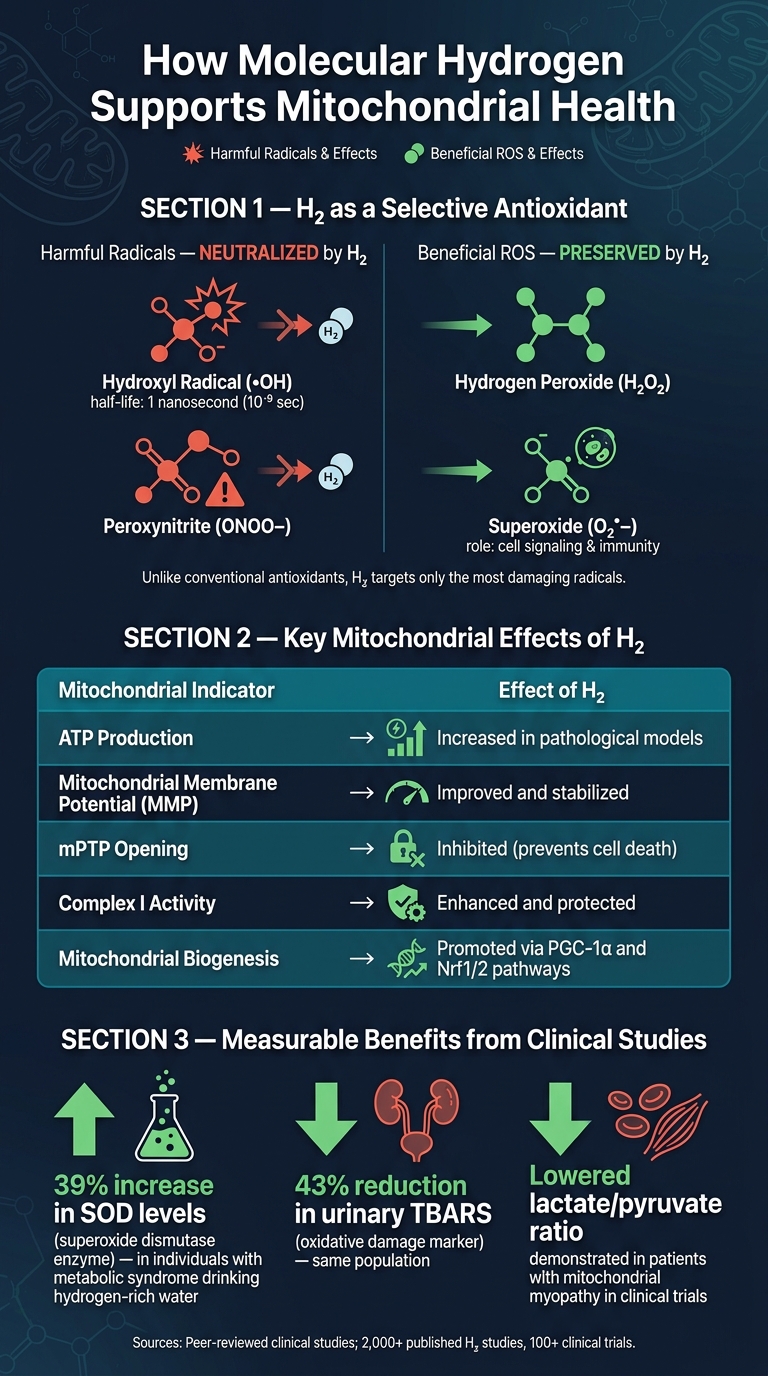
Molecular Hydrogen vs. Oxidative Stress: Key Effects on Mitochondrial Health
Hydrogen as a Selective Antioxidant
Unlike most antioxidants that neutralize reactive oxygen species (ROS) indiscriminately, molecular hydrogen has a unique ability to target only the most harmful radicals. Specifically, it neutralizes hydroxyl radicals (•OH) and peroxynitrite (ONOO–) while sparing beneficial ROS like hydrogen peroxide and superoxide. This distinction is critical because some ROS play essential roles in cellular signaling and function.
Research shows that H₂ reacts exclusively with the most damaging radicals, preserving the delicate redox balance within cells rather than disrupting it. For example, hydroxyl radicals are particularly destructive, with a half-life of just 1 nanosecond (10⁻⁹ seconds). This means they react almost instantaneously with nearby cellular components, such as mtDNA, membrane lipids, and proteins in the respiratory chain. Molecular hydrogen intercepts these radicals before they can cause significant harm, directly supporting the detoxification processes in mitochondria.
How Hydrogen Improves Mitochondrial Efficiency
Molecular hydrogen doesn't just neutralize harmful radicals - it also enhances mitochondrial performance. Thanks to its tiny molecular size, H₂ can cross cell membranes and reach mitochondria in under a minute, a capability that most traditional antioxidants lack.
Once inside, H₂ improves the electron transport chain's efficiency by reducing electron leakage, which is a primary source of excess superoxide production. Miroslav Barancik from the Slovak Academy of Sciences explains:
"H2 may function as a rectifier of mitochondrial electron flow in the disordered or pathological states when the accumulation of electrons leads to ROS production."
This efficiency boost results in measurable benefits. Clinical studies have demonstrated that H₂ can lower the serum lactate/pyruvate ratio in patients with mitochondrial myopathy, indicating improved electron transport chain function. Additionally, H₂ inhibits the opening of the mitochondrial permeability transition pore (mPTP), a process that, if unchecked, can lead to cell death. The table below highlights the key effects of molecular hydrogen on mitochondrial health:
| Mitochondrial Indicator | Effect of Molecular Hydrogen (H₂) |
|---|---|
| ATP Production | Increased in most pathological models |
| Mitochondrial Membrane Potential (MMP) | Improved and stabilized |
| mPTP Opening | Inhibited (prevents pro-apoptotic signaling) |
| Complex I Activity | Enhanced and protected |
| Mitochondrial Biogenesis | Promoted via PGC-1α and Nrf1/2 pathways |
Hydrogen and Cellular Resilience
Molecular hydrogen not only addresses oxidative stress but also enhances the cell's ability to handle future stress. This is achieved through hormesis, a process where mild stress signals encourage cells to strengthen their defenses, improving mitochondrial detoxification at a deeper level.
H₂ activates the Nrf2/ARE pathway, which stimulates the production of the body’s own antioxidant enzymes, such as superoxide dismutase (SOD), catalase, and heme oxygenase-1 (HO-1). Studies show that drinking hydrogen-rich water led to a 39% increase in SOD levels and a 43% reduction in urinary TBARS (a marker of oxidative damage) in individuals with metabolic syndrome. Furthermore, H₂ triggers the mitochondrial unfolded protein response (mtUPR), a repair mechanism that enhances protein-folding capacity within the mitochondrial matrix, enabling cells to recover more effectively from stress.
Professor Jiankang Liu from Xi'an Jiaotong University elaborates:
"The protective role of H2 may be mainly dependent on its unique ability to penetrate every aspect of cells to regulate mitochondrial homeostasis by activating the Keap1-Nrf2 phase II antioxidant system rather than its direct free radical scavenging activity."
sbb-itb-6860cc4
How to Use Hydrogen for Mitochondrial Detox
Choosing a Hydrogen Delivery Method
For most people, hydrogen-rich water (HRW) made with dissolvable tablets is the easiest way to incorporate hydrogen into their daily routine. Products like Edenvia Molecular Hydrogen tablets are portable, convenient, and ensure consistent dosing. All you need to do is drop a tablet into water, and within minutes, you have hydrogen-rich water ready to drink - whether you're at work, at the gym, or traveling.
| Delivery Method | Practicality | Best For |
|---|---|---|
| Hydrogen tablets | High – portable, precise dosing | Daily use, travel, on-the-go |
| Hydrogen water generators | Medium – home use only | Long-term home routines |
| Gas inhalation | Low – requires equipment | Clinical or supervised settings |
Hydrogen tablets are a practical, easy-to-use option that fits seamlessly into most lifestyles.
Building a Daily Hydrogen Routine
When it comes to hydrogen, consistency is key. Start by dissolving one Edenvia tablet in room-temperature or chilled water. Let it sit for about 3 minutes, then drink it within 30 minutes to ensure you're getting the full hydrogen concentration for mitochondrial detox support.
Experts recommend drinking 1.5 to 2 liters of hydrogen-rich water daily, split into multiple servings. Professor Kinji Ohno from Nagoya University Graduate School of Medicine explains:
"Hydrogen may have a threshold effect or a dose-response effect and 1.0 liter or more per day of HEW is likely to be required to exert beneficial effects."
Most people begin to notice changes within 2 to 4 weeks, but the full benefits of mitochondrial detox often take 6 months or more of consistent use.
Lifestyle Tips to Support Mitochondrial Detox
Pairing your hydrogen routine with healthy lifestyle choices can amplify the benefits. Regular exercise, for instance, boosts mitochondrial biogenesis and works hand-in-hand with hydrogen to improve recovery. Drinking hydrogen-rich water before or during workouts may also reduce lactic acid buildup and ease post-exercise fatigue.
On the nutrition front, focus on foods packed with magnesium, B vitamins (B1, B2, B3, B12), and antioxidants like vitamins C and E. These nutrients support ATP production and protect mitochondrial membranes. Additionally, prioritize quality sleep and stress management. Chronic stress increases ROS (reactive oxygen species) production, which can counteract the detox benefits of hydrogen. As Edmund Yeo, a Holistic Health Researcher, puts it:
"Mitochondrial health depends on multiple factors. Exercise, quality sleep, balanced nutrition, and metabolic health remain fundamental for supporting cellular energy and overall well-being."
Tracking Progress and Adjusting Your Approach
How to Track Your Results
Hydrogen's impact on mitochondrial efficiency can be profound, but to fully benefit from its detox effects, tracking your progress is key. Once you’ve incorporated hydrogen into your routine, monitor how it affects you using both subjective and objective markers. A simple way to do this is by keeping a daily log. Rate aspects like energy levels, mood, muscle soreness, and mental clarity on a scale of 1–10. Over 4–8 weeks, these scores can reveal clear trends and help you understand how hydrogen is working for you.
Here are some signs of progress to watch for:
- Physical: Noticeable reduction in post-exercise fatigue, quicker recovery, and better endurance (often within 2–4 weeks).
- Mental: Enhanced mood, reduced anxiety, and sharper cognitive function (around 4 weeks).
- Metabolic: Improvements in blood glucose levels and cholesterol (typically seen in 8–10 weeks).
- Vascular: Better circulation and endothelial function (as early as 2 weeks).
- Inflammatory: Decreased joint and muscle pain (timing varies).
Clinical research backs these observations, showing measurable improvements in biomarkers with regular hydrogen use. If you have access to lab testing, consider working with your doctor to track markers like serum lactate, lactate-to-pyruvate ratio, fasting glucose, and cholesterol. These can offer a deeper look at your cellular health.
When to Consult a Healthcare Professional
For most healthy adults, hydrogen-rich water is considered safe and doesn’t typically require intensive monitoring to support mitochondrial detoxification. However, there are situations where involving a healthcare professional is essential.
If you’re managing a chronic condition like progressive muscular dystrophy or mitochondrial myopathies - or undergoing treatments such as radiotherapy - hydrogen may interact with your current medications or impact disease progression. For instance, a 2011 clinical trial reported that a patient with MELAS experienced hypoglycemia when using hydrogen-enriched water alongside insulin. Adjusting the insulin dose resolved the issue, highlighting the need for medical supervision in such cases.
"Hydrogen-enriched water improves mitochondrial dysfunction in MM [mitochondrial myopathies] and inflammatory processes in PM/DM [polymyositis/dermatomyositis]." - Kinji Ohno, Professor, Nagoya University Graduate School of Medicine
Mild side effects like increased urination are common and generally harmless. But if you encounter persistent digestive discomfort or other unusual symptoms, reduce your intake and seek advice from your doctor. Staying proactive with tracking and consulting a healthcare provider when needed ensures that your hydrogen routine remains safe and effective.
Conclusion: Using Hydrogen to Support Mitochondrial Health
Hydrogen plays a vital role in supporting mitochondrial function and overall cellular well-being, as outlined earlier. Its ability to quickly penetrate mitochondria sets it apart from traditional antioxidants. Once inside, it targets harmful free radicals like hydroxyl radicals and peroxynitrite while sparing essential signaling molecules.
For maintaining mitochondrial health over time, hydrogen promotes key processes such as mitophagy, biogenesis, and the activation of the Keap1-Nrf2 pathway. This pathway boosts the production of protective enzymes like superoxide dismutase and catalase, which are crucial for managing oxidative stress.
"H₂ may be mainly dependent on its unique ability to penetrate every aspect of cells to regulate mitochondrial homeostasis by activating the Keap1-Nrf2 phase II antioxidant system rather than its direct free radical scavenging activity." - Jiankang Liu, Professor, Xi'an Jiaotong University
As Professor Liu highlights, hydrogen’s primary value lies in its ability to regulate cellular pathways, going beyond simply neutralizing free radicals.
The body of research supporting molecular hydrogen is extensive, with over 2,000 published studies and more than 100 clinical trials documenting its effects. Incorporating hydrogen into daily life can be as simple as drinking hydrogen-rich water. For instance, Edenvia Molecular Hydrogen tablets dissolve in water, making it easy to include hydrogen in your routine - whether before a workout, during meals, or as part of your morning habits.
However, hydrogen works best when combined with an overall healthy lifestyle. Pair it with balanced nutrition, regular exercise, quality sleep, and stress management for optimal results. Think of hydrogen-rich water as a supportive tool to keep your mitochondria efficient, resilient, and better equipped to handle oxidative stress. By making it part of your daily routine, you can reinforce these benefits and promote long-term cellular health.
FAQs
Can hydrogen-rich water affect my medications or blood sugar?
Research suggests that hydrogen-rich water could influence glucose metabolism. Some studies have observed improvements in fasting blood sugar and lipid levels. In one clinical case, a patient on insulin experienced a hypoglycemic episode, which was managed by adjusting their insulin dosage. Although no major effects on enzymes involved in drug metabolism have been identified, it’s essential to talk to your healthcare provider before using molecular hydrogen - especially if you’re managing blood sugar levels or taking medications.
How do I know if hydrogen is improving my mitochondrial health?
You can gauge better mitochondrial health through noticeable changes such as having more energy, sharper mental focus, and quicker recovery after physical activity. Because mitochondria are your body's energy producers, improvements in their function often lead to reduced tiredness and increased endurance. Edenvia Molecular Hydrogen plays a role by reducing oxidative stress and aiding in ATP production, the energy currency of your cells. Over time, you might also observe improvements in markers like balanced lactate levels, which reflect more efficient energy use. Staying consistent is crucial to achieving and maintaining these benefits.
What’s the best time to drink hydrogen-rich water for results?
For optimal results, drink the water immediately after the Edenvia Molecular Hydrogen tablet has completely dissolved, which typically takes 90 seconds to 3 minutes. To maximize absorption and antioxidant benefits, consume it within 15–30 minutes. Drinking it on an empty stomach can help you reach peak plasma hydrogen levels. However, it’s also an excellent choice as a recovery drink after a workout or as a regular part of your wellness routine.