

Top Studies on Hydrogen and Oxidative Stress Reduction
Hydrogen therapy is gaining attention for its potential to reduce oxidative stress and support cellular health. Unlike traditional antioxidants, molecular hydrogen (H₂) specifically targets harmful reactive oxygen species (ROS) like hydroxyl radicals, while sparing beneficial ROS critical for cellular functions. Key findings include:
- Selective Antioxidant Action: H₂ neutralizes harmful ROS without disrupting essential cellular processes.
- Brain and Cellular Protection: H₂ crosses the blood-brain barrier, reaching areas like mitochondria and the nucleus to combat oxidative damage.
- Clinical Benefits: Studies show H₂ improves survival rates in oxidative stress models, supports metabolic health, and aids neurodegenerative conditions like Alzheimer's and Parkinson's.
- Exercise Performance: Hydrogen-rich water boosts power output and endurance in athletes by enhancing mitochondrial efficiency.
These findings highlight molecular hydrogen's role in reducing inflammation, improving recovery, and promoting overall wellness. Its safety and effectiveness make it a promising tool for addressing oxidative stress-related conditions.
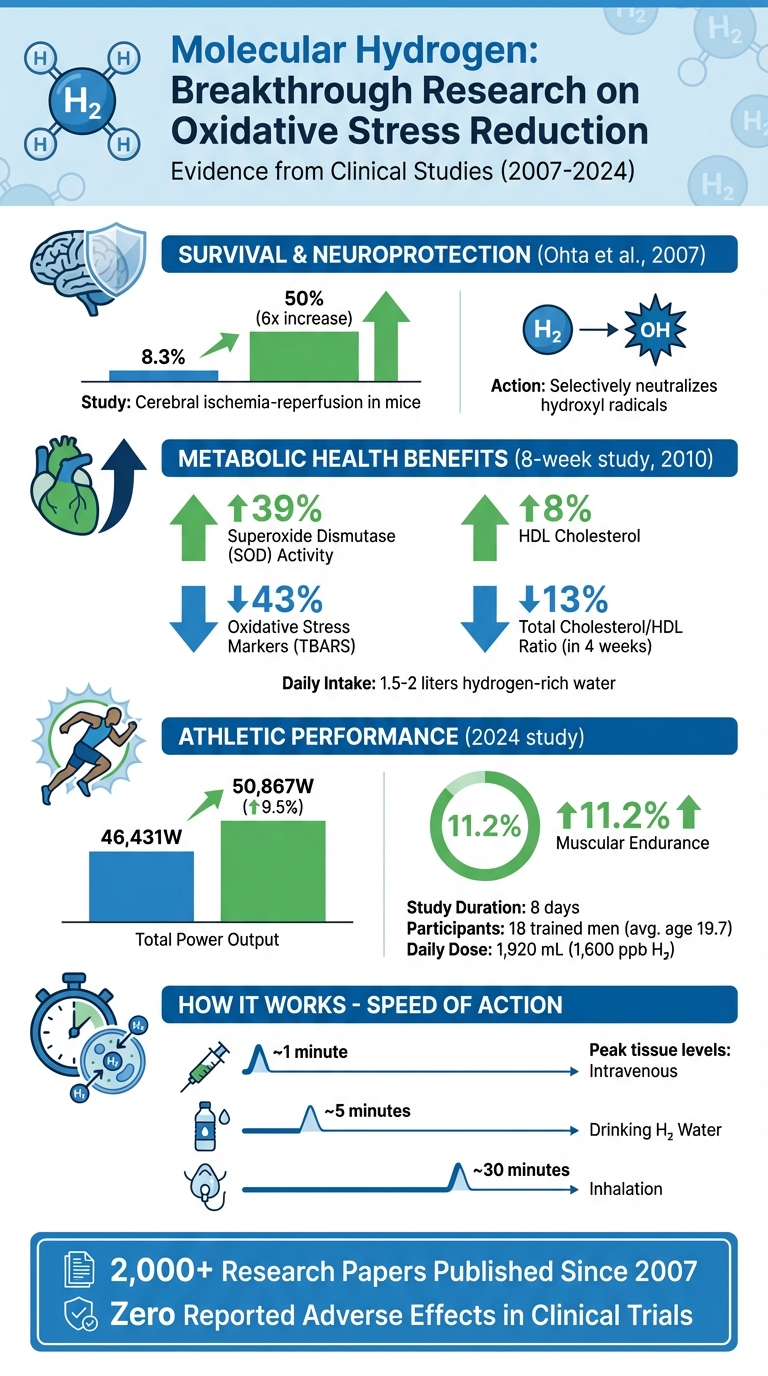
Molecular Hydrogen Research Findings: Key Clinical Benefits and Statistics
Research Studies on Molecular Hydrogen and Oxidative Stress
Ohta et al. (2007) – Original Study in Nature Medicine

In June 2007, Shigeo Ohta and his team at Nippon Medical School published a groundbreaking study in Nature Medicine. They explored whether inhaling 2% hydrogen gas (H₂) could protect brain tissue during acute oxidative stress. Using cultured PC12 cells and rat models of focal cerebral ischemia, the researchers found that H₂ selectively neutralized harmful hydroxyl radicals while sparing beneficial reactive oxygen species. Advanced detection techniques confirmed this selective action.
In global cerebral ischemia-reperfusion models, H₂ treatment significantly reduced oxidative damage markers like 8-hydroxyl-2′-deoxyguanosine and 4-hydroxynonenal. Remarkably, the survival rate of mice improved from 8.3% to 50% - a result that outperformed edaravone, a commonly used clinical reactive oxygen species (ROS) scavenger. This study laid the foundation for further research into H₂'s potential benefits in metabolic and neurodegenerative conditions.
Hydrogen-Rich Water and Metabolic Syndrome
Building on earlier findings, researchers turned their attention to H₂'s effects on metabolic health. In 2010, Atsunori Nakao led an 8-week pilot study, published in the Journal of Clinical Biochemistry and Nutrition, involving 20 participants with potential metabolic syndrome. Subjects consumed 1.5 to 2 liters of hydrogen-rich water daily, with a hydrogen concentration of 0.55–0.65 mM produced using a metallic magnesium stick.
After eight weeks, participants experienced a 39% increase in superoxide dismutase (SOD) activity and a 43% reduction in thiobarbituric acid-reactive substances (TBARS), both indicators of reduced oxidative stress. Metabolic improvements included an 8% rise in HDL (the "good" cholesterol) and a 13% decrease in the total cholesterol-to-HDL ratio within just four weeks. These results suggest that hydrogen-rich water could serve as a promising approach for managing and preventing metabolic syndrome.
Neuroprotective Effects of Hydrogen
Adding to the evidence, researchers also examined H₂'s potential to combat neurodegenerative stress. A notable study published in Current Alzheimer Research in April 2018 tested hydrogen-rich water on individuals with Mild Cognitive Impairment (MCI). In this randomized, double-blind, placebo-controlled trial, 73 participants consumed about 300 mL of hydrogen-rich water daily for one year. While overall results did not show significant differences, a subgroup of patients carrying the APOE4 genotype experienced meaningful improvements in total ADAS-cog scores and word recall tasks. As Nishimaki et al. noted:
"H2‑water may have a potential for suppressing dementia in an oxidative stress model and in the APOE4 carriers with MCI".
Additionally, a pilot study on Parkinson's disease revealed that patients who drank 1 liter of hydrogen-rich water daily for 48 weeks showed measurable improvements on the Unified Parkinson's Disease Rating Scale. In contrast, placebo group scores worsened. These findings highlight H₂'s ability to cross the blood-brain barrier and reduce neuroinflammation, potentially by lowering levels of pro-inflammatory cytokines like TNF-α, IL-1β, and IL-6. This positions H₂ as a promising tool for addressing neurodegenerative conditions.
sbb-itb-6860cc4
Molecular Hydrogen in Wellness and Recovery
Exercise-Induced Oxidative Stress Reduction
Engaging in high-intensity workouts often leads to oxidative stress, which can hinder performance and slow down recovery. A 2024 double-blind study published in Frontiers in Physiology explored this issue with 18 trained men (average age 19.7 years) who consumed 1,920 mL of hydrogen-rich water daily, containing 1,600 ppb of molecular hydrogen, for seven days. On training days, participants took additional doses. The results were impressive: those drinking hydrogen-rich water saw a 9.5% boost in total power output (50,866.7 ± 6,359.9 W compared to 46,431.0 ± 9,376.5 W) and an 11.2% increase in muscular endurance during half-squat exercises.
Lead researcher Kaixiang Zhou highlighted the significance of these findings:
"Eight days of intermittent HRW intake could significantly improve muscular endurance performance in trained individuals, making it a promising strategy for athletes or fitness enthusiasts looking to boost muscular endurance during resistance training or competitions."
The study attributes these benefits to molecular hydrogen's ability to enhance mitochondrial ATP production, improve enzyme efficiency, and promote lactate oxidation. However, it’s worth noting that hydrogen-rich water did not speed up recovery from muscle soreness or neuromuscular fatigue within the first 48 hours. Still, the performance improvements point to molecular hydrogen's broader potential in reducing inflammation and aiding recovery.
Airway Inflammation and Antioxidant Enzyme Activation
Beyond athletic performance, molecular hydrogen's selective antioxidant properties play a key role in reducing oxidative stress. Unlike some antioxidants, H₂ neutralizes harmful reactive oxygen species while preserving beneficial signaling molecules. It also targets critical cellular sites, reducing DNA damage and inflammation by limiting leukocyte aggregation. Together, these actions highlight its potential for managing oxidative stress and supporting overall wellness.
For those looking to incorporate these scientifically-backed benefits into their daily routine, Edenvia Molecular Hydrogen tablets offer a simple way to prepare hydrogen-rich water at home. Visit Edenvia Molecular Hydrogen to learn more.
These findings emphasize molecular hydrogen's dual role in promoting recovery and reducing inflammation, making it a promising tool for combating oxidative stress and supporting healthy aging.
How Hydrogen Inhalation Reduces Oxidative Stress: A Scientific Summary
Clinical Evidence for Molecular Hydrogen
Research has moved beyond preclinical studies, with clinical trials now highlighting how hydrogen-rich water can lower oxidative stress and support cellular health.
Reduction in Clinical Biomarkers of Oxidative Stress
Drinking hydrogen-rich water regularly has been shown to reduce malondialdehyde (MDA) levels, a marker tied to lipid peroxidation and cell membrane damage. Lower MDA levels point to less inflammation and a reduced risk of chronic diseases. Interestingly, hydrogen's safety has been well-documented, with its use in high concentrations dating back to the 1940s for deep-sea diving. It’s also naturally produced by gut bacteria in the human body. These findings align with other studies showing benefits for cardiovascular health and mitochondrial function.
Cardiovascular and Mitochondrial Benefits
Clinical trials have demonstrated that hydrogen-rich water can enhance cardiovascular health and energy production at the cellular level. For example, a two-week study in healthy adults revealed significant improvements in peak oxygen uptake (VO₂ peak), a key measure of aerobic fitness and heart efficiency. Additionally, consuming hydrogen-rich water has been shown to lower blood lactate levels during exercise, indicating better mitochondrial efficiency. Hydrogen also helps maintain the activity of essential antioxidant enzymes, such as superoxide dismutase (SOD) and glutathione peroxidase (GSH-Px), even under oxidative stress.
How Molecular Hydrogen Works
Molecular hydrogen plays a crucial role in neutralizing harmful radicals - specifically hydroxyl radicals (•OH) and peroxynitrite (ONOO⁻) - while leaving essential reactive oxygen species intact. This balance is key to maintaining normal cellular function and combating oxidative stress.
"Molecular hydrogen selectively scavenges hydroxyl radicals and peroxy-nitric radicals that are responsible for oxidative stress and disease process, while sparing other reactive oxygen species such as hydrogen peroxide, superoxide and nitric oxide that are critical to normal cell physiology."
- Dinesh Ramanathan et al., Medical Gas Research
Thanks to its small and neutral molecular structure, hydrogen can quickly penetrate cells and organelles. It achieves peak tissue levels astonishingly fast - within about 1 minute after intravenous administration, 5 minutes after drinking hydrogen-rich water, and 30 minutes after inhalation.
Beyond its ability to enter cells rapidly, molecular hydrogen enhances the body's internal antioxidant defenses. It helps maintain vital antioxidant enzymes like superoxide dismutase (SOD) and catalase, which are often depleted during oxidative stress. Moreover, hydrogen influences inflammatory pathways by suppressing nuclear factor kappa B (NF-κB) signaling and the NLRP3 inflammasome. This dual action reduces secondary oxidative damage and promotes cellular health across various organ systems.
Conclusion
Molecular hydrogen stands out as a selective antioxidant with an excellent safety record. Since the pivotal 2007 study, more than 2,000 research papers have demonstrated that H₂ specifically targets the most harmful reactive oxygen species - like hydroxyl radicals and peroxynitrite - while leaving beneficial signaling molecules intact. This balance is essential for maintaining normal cellular functions.
What makes molecular hydrogen even more intriguing is its dual action. It not only neutralizes harmful radicals directly but also activates protective pathways, such as Nrf2. This activation boosts the production of antioxidant enzymes, including superoxide dismutase and catalase, further amplifying its protective capabilities.
"H2 not only exerts antioxidant effects by directly reducing •OH and ONOO−, but also exerts indirect antioxidant, anti-inflammatory, and anti-apoptotic effects by regulating gene expression."
- Shin-ichi Hirano and Yoshiyasu Takefuji, Researchers
Clinical studies consistently show that hydrogen therapy is safe, with no reported adverse effects, even in long-term use across diverse conditions. Its ability to diffuse quickly into cells allows it to protect vital organelles effectively. These findings highlight molecular hydrogen's potential in addressing oxidative damage associated with aging.
For those looking to harness these benefits, Edenvia Molecular Hydrogen provides easy-to-use tablets that dissolve in water, creating hydrogen-rich water. This product is designed to reduce inflammation, support joint health, and enhance cellular wellness through targeted antioxidant effects.
FAQs
How is molecular hydrogen different from typical antioxidants?
Molecular hydrogen is notable for its precise and targeted action. Unlike traditional antioxidants that broadly neutralize various reactive species, hydrogen focuses specifically on harmful hydroxyl radicals. At the same time, it leaves beneficial reactive oxygen species (ROS), such as superoxide and nitric oxide, untouched. This selective approach helps lower oxidative stress while maintaining the critical roles of essential ROS in cellular signaling and other vital processes.
What’s the best way to take hydrogen for oxidative stress (water, inhalation, or other)?
Drinking hydrogen-rich water is the best way to address oxidative stress. Studies indicate that it can lower oxidative responses while leaving other bodily processes unaffected. It's an easy and practical approach backed by research.
How long does it take hydrogen-rich water to start working in the body?
Hydrogen-rich water can start benefiting the body in as little as an hour after consumption. Research has shown measurable changes in vascular endothelial function and oxidative stress markers within this period. These findings suggest it may help support cellular health and combat oxidative stress effectively.