

Top Studies on Molecular Hydrogen and Immune Cells
Here’s the short answer: research on molecular hydrogen and immune cells is early but interesting. In people, the best data comes from a 4-week randomized trial in 38 healthy adults, where hydrogen-rich water was linked to lower PBMC apoptosis, fewer CD14+ monocytes, and lower activity in NF-κB-related inflammatory genes. In autoimmune reports, researchers saw shifts in PD-1+ T cells, Fas+ B cells, Tregs, and Bregs - but those studies were small and often mixed hydrogen with standard treatment.
If you want the main takeaway fast, it’s this:
- Human evidence is still limited
- The clearest human signal is immune modulation, not an “immune boost”
- The best-studied cells are PBMCs, monocytes, T cells, B cells, neutrophils, and macrophages
- The main pathways studied are NF-κB, NLRP3, STAT3, and Nrf2
- Most mechanistic detail still comes from animal and lab studies
In plain English: hydrogen may help dial down oxidative stress and inflammatory signaling, and that may change how some immune cells behave. But I’d treat the current data as early-stage, not as proof for clinical use.
What stands out most across the article:
- In healthy adults, 1.5 liters/day of hydrogen-rich water for 4 weeks changed PBMC gene expression
- The hydrogen water used was about 1.6 mg/L
- PBMC apoptosis was lower after treatment, with reported P values around 0.036–0.042
- CD14+ monocytes also fell versus placebo, with P around 0.039–0.042
- RNA sequencing showed lower expression of inflammatory genes like NFKB1, IL1B, IL6R, and IL8
- In autoimmune studies, immune cell shifts looked subset-specific and at times temporary
- In preclinical work, hydrogen was linked to more Tregs, less neutrophil infiltration, and a shift in macrophages away from M1 and toward M2
Is Hydrogen an IMMUNE SYSTEM Booster?? - Ep 46 - H2Minutes
sbb-itb-6860cc4
Quick Comparison
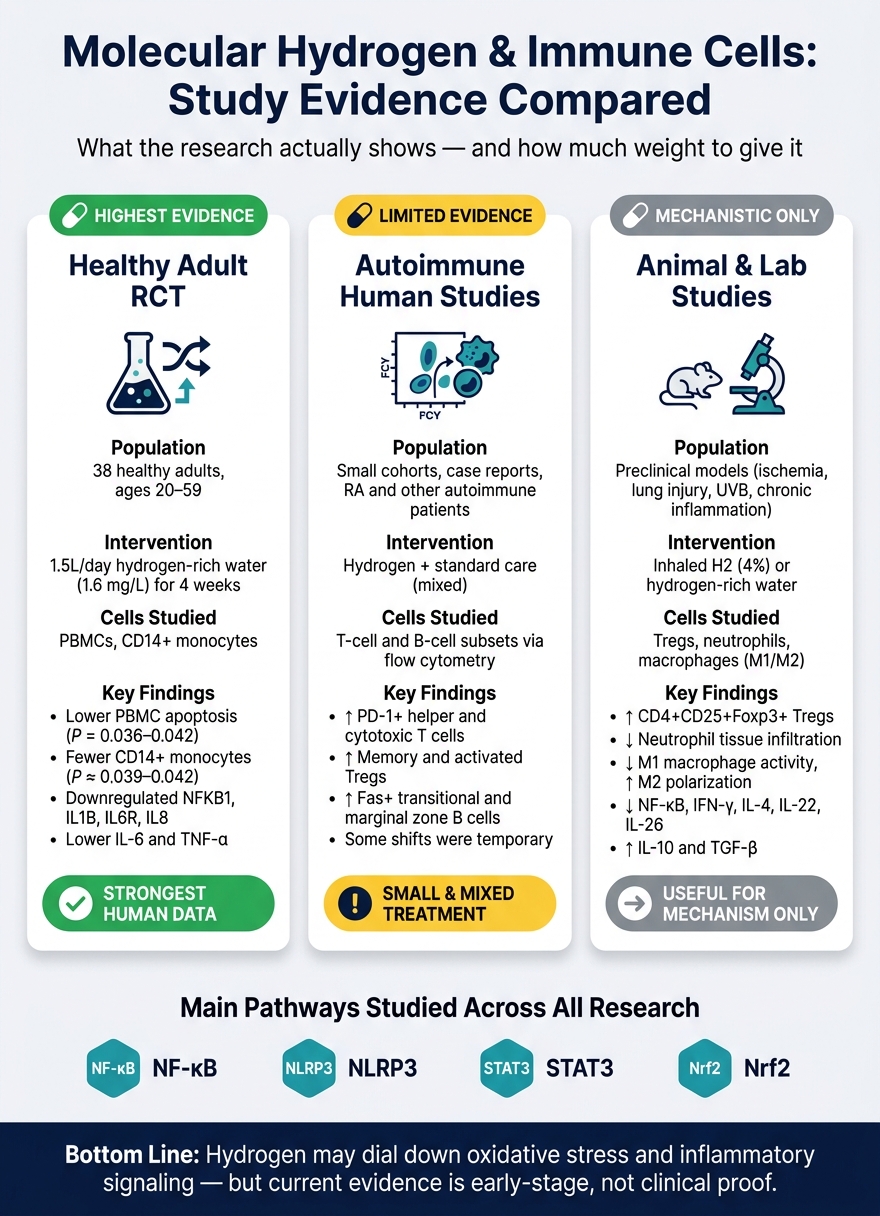
Molecular Hydrogen & Immune Cells: Study Evidence Compared
| Study area | What was studied | Main immune changes | How much weight I’d give it |
|---|---|---|---|
| Healthy adult RCT | PBMCs, CD14+ cells, cytokines, gene expression | Lower PBMC apoptosis, fewer CD14+ monocytes, lower NF-κB-related signaling | Highest among studies in the article |
| Autoimmune human studies | T-cell and B-cell subsets by flow cytometry | Changes in PD-1+ T cells, Fas+ B cells, Tregs, Bregs | Limited, due to small size and mixed treatment |
| Animal/lab studies | Tregs, neutrophils, macrophages, cytokine pathways | More Tregs, less tissue infiltration, less M1 macrophage activity | Useful for mechanism, not proof in people |
So if you’re scanning for the bottom line, here it is: the strongest human study suggests hydrogen can shift immune markers in a short time, but the full picture in patients is still unclear. The article mainly supports a cautious view - promising signals, small human studies, and a lot left to test.
Top human study on hydrogen-rich water in healthy adults
A randomized, double-blind, placebo-controlled trial tracked 38 healthy adults, ages 20 to 59, over 4 weeks. Participants drank 1.5 liters per day of hydrogen-rich water with about 1.6 mg/L of dissolved hydrogen, or the same amount of plain water as a placebo. The study looked at PBMCs, CD14+ cells, inflammatory cytokines, and gene expression.
At the start, there was no meaningful difference in PBMC apoptosis between the two groups (P = 0.606). After 4 weeks, PBMC apoptosis was lower in the hydrogen group than in the placebo group (P = 0.036–0.042). The study also found lower oxidative stress and better antioxidant capacity.
PBMCs, CD14+ cells, and NF-κB-related findings
CD14+ monocytes also dropped after 4 weeks (P ≈ 0.039–0.042 versus placebo).
RNA sequencing showed a clear shift in PBMC gene expression. Genes tied to the inflammatory response and NF-κB signaling were downregulated. NFKB1, IL1B, IL6R, and IL8 were lower in the hydrogen group.
Secondary summaries also reported lower IL-6 and TNF-α after 4 weeks.
No significant adverse events were reported, and the intervention seemed well tolerated. Still, larger independent trials are needed to see how steady these immune-cell and gene-expression changes are. The autoimmune-disease study below looks at whether similar immune shifts show up in patients.
Top clinical study on immune cell changes in autoimmune disease
The strongest human data here comes from small immune-phenotyping studies in autoimmune disease. Most were small, uncontrolled studies or case reports, and hydrogen was used alongside standard care. Researchers took blood samples at baseline and follow-up, then used flow cytometry to track T-cell and B-cell subsets. In some studies, they also looked at clinical measures like DAS28 in rheumatoid arthritis (RA).
PD-1 positive T cells, Fas positive B cells, and Treg-related changes
PD-1 is a marker of lower T-cell activity, while Fas helps remove autoreactive B cells.
In RA, flow cytometry showed increases in PD-1+ helper T cells and PD-1+ cytotoxic T cells, along with higher levels of memory and activated Tregs. Across case-based autoimmune reports, researchers also saw rising proportions of Fas-expressing B-cell subsets, including transitional B cells and marginal zone B cells. Some analyses also found fewer Tr1 cells and more naïve Treg cells.
Case reports in IgG4-related lung disease and Sjögren's syndrome pointed in the same general direction. These reports described more Tregs and fewer Fas-positive T-cell and B-cell subsets.
That said, there’s a clear catch. Sample sizes were small, follow-up periods were short, and most patients were already on immunosuppressive therapy. So it’s hard to tell how much of the change came from hydrogen versus background treatment. Some PD-1+ T-cell shifts also looked temporary, with percentages moving back toward baseline at later follow-up points.
For now, these findings are best viewed as early signals, not practice-changing evidence. Larger, standardized randomized trials are still needed before clinicians can use these patterns with confidence.
These early signals lead into the next issue: which immune cells show the most consistent changes across studies?
Key studies on T-cell balance, neutrophils, and macrophages
Across the research, the steadiest immune-cell findings land in three places: regulatory T-cell balance, neutrophil recruitment, and macrophage polarization.
Molecular hydrogen and regulatory T-cell balance
One review reported higher regulatory T cells (Tregs) and fewer Fas-positive helper and cytotoxic T-cell subsets after oral molecular hydrogen use.
Animal and mechanistic reviews point in the same direction. In models of ischemia-reperfusion injury and chronic inflammation, hydrogen has been shown to increase CD4+CD25+Foxp3+ Treg populations while lowering NF-κB and pro-inflammatory effector cytokines such as IFN-γ, IL-4, IL-22, and IL-26. Reviews also note that hydrogen may increase IL-10 and TGF-β, both of which help support Treg activity and immune tolerance.
That pattern doesn’t just show up in immune-cell counts. Preclinical models suggest it carries into tissue-level immune signaling too.
Neutrophil infiltration, macrophage activation, and cytokine signaling
T-cell balance is one part of the story. The next piece is whether hydrogen changes how inflammatory cells move into tissue in the first place.
A hypoxia/reoxygenation lung-injury model found that 4% inhaled hydrogen lowered GM-CSF and G-CSF, which help recruit neutrophils and activate macrophages. The same study also found less neutrophil infiltration and less pro-inflammatory M1 macrophage infiltration in lung tissue. In a separate chronic UVB mouse study, hydrogen significantly reduced epidermal and dermal T-cell infiltration, while macrophage and neutrophil counts only trended downward and did not reach statistical significance. In plain terms, hydrogen may affect T-cell trafficking more strongly than total myeloid-cell counts in some tissues.
Reviews of acute lung injury models add another layer: hydrogen can inhibit M1 macrophage accumulation while promoting M2 polarization, shifting macrophage activity away from a pro-inflammatory state. It also appears to act upstream on NF-κB and chemokines, which may help shape whether inflammatory cells enter tissues at all.
Most of this evidence is still preclinical. That supports biological plausibility, but it does not yet confirm the same effects in humans.
What these studies show overall
The clearest effects show up in immune modulation and lower oxidative stress, not some broad “immune boost.” That distinction matters. The best human trial found lower immune-cell apoptosis and less inflammatory signaling after 4 weeks of hydrogen-rich water.
In autoimmune disease, the pattern looks more specific to certain cell groups. A separate autoimmune study found subset-specific shifts in T and B cells, including PD-1+ T cells and Fas+ B cells.
Across these studies, the cleanest signals come from immune biomarkers, not symptoms alone. Data from transcriptomics, flow cytometry, and cytokine panels give the clearest readout. That said, most of the mechanistic detail still comes from animal and in vitro models, and those results don’t always carry over neatly to humans. Human trials are still limited by sample size, study length, and lack of population diversity.
So the picture here is promising, but still early.
FAQs
Does molecular hydrogen boost immunity or modulate it?
Molecular hydrogen mainly helps regulate immunity instead of just pushing it higher. It works as a selective antioxidant, helping neutralize harmful free radicals while leaving in place the helpful reactive oxygen species your body still needs for normal immune function and cell signaling.
By helping keep inflammation and immune-regulating pathways in check, it supports a healthier immune environment. Edenvia Molecular Hydrogen tablets provide hydrogen-rich water support that may help reduce oxidative stress and support a more balanced inflammatory response.
Which immune cells are most affected by molecular hydrogen?
Research suggests molecular hydrogen mainly acts on macrophages and regulatory T cells.
More specifically, it may help push macrophages away from the pro-inflammatory M1 state and toward the anti-inflammatory M2 repair state. At the same time, it may support regulatory T cell balance, which can help promote healthier immune regulation and lower neuroinflammation.
How strong is the human evidence so far?
Human evidence on molecular hydrogen looks promising, and the safety record is strong. Across more than 1,000 studies, plus a meta-analysis of 38 human trials, researchers reported no serious adverse events.
There’s still an important catch: many human studies are small or early-stage. So this isn’t a settled case yet.
Even so, the results are hard to brush off. Trials have reported meaningful outcomes, such as better mobility in Parkinson’s patients, lower oxidative stress markers, and longer telomere length in older adults.